Style & Beauty
How to Declutter Your Wardrobe Without Losing the Clothes You Love

The wardrobe problem we all know
You know the feeling. The wardrobe is stuffed. Hangers crammed so tight you have to tug to get anything out, shelves stacked with jumpers you forgot you owned, and yet every morning you stand there and say the same thing. I have nothing to wear.
It makes no sense, and yet it is one of the most common problems in any house. The clothes are there, lots of them, but they are not working as a wardrobe. Somewhere in that pile are the pieces you actually love, buried under the ones you do not.
Here is the good news. Fixing it does not require a brutal all-or-nothing clean out. This is a gentler way to edit your wardrobe down so the clothes you love are actually findable. You keep what you genuinely wear, you let go of the rest without guilt, and you end up with a wardrobe that works on a Tuesday morning, not just in a magazine.
Start with what you reach for
Before you throw anything out, take a week or two and notice what you actually wear. Not what you think you should wear, or what you hope to wear after those few kilos. What you reach for on a normal Tuesday.
That pile of favourites is your honest starting point, and it is probably smaller than you expect. Most of us wear a small fraction of what we own. The same few jumpers, the same two pairs of jeans, the same three dresses rotate through the week while the rest of the wardrobe hangs there, untouched and slightly reproachful.
There is nothing wrong with you for this, and it is useful information. The clothes you reach for are telling you what you love: they fit, they feel good and they suit your real life. Decluttering is not about becoming a different person. It is clearing the way for the person you already are.
Take everything out (yes, all of it)
This is the one slightly annoying step that makes everything else easy, so I am going to ask you to do it properly. Take everything out of the wardrobe. Every single thing. Coats, shoes, the weird scarf someone gave you, all of it.
It feels worse before it feels better, and that is normal. You will look at the mountain on your bed and wonder how it all fit. But emptying the wardrobe lets you see the whole picture at once, instead of the same few items at the front, and it forces you to make a decision about each thing rather than letting it hide.
As you take things out, sort them into rough piles. Keep in one spot, maybe in another, repair in a third, donate in a fourth. Do not overthink the sorting as you go. You will have a chance to be honest with the maybe pile later.

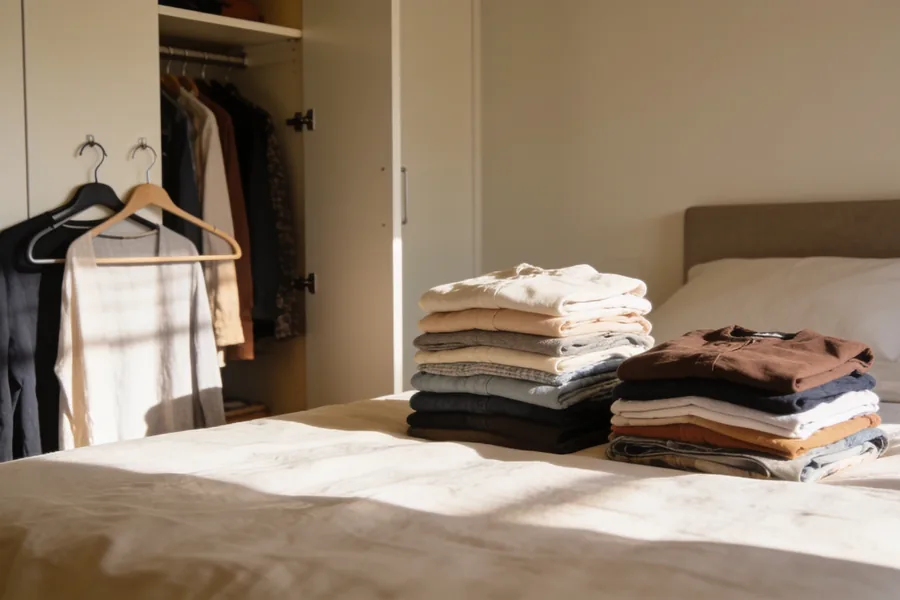
And while the wardrobe is empty, wipe down the shelves and the rail. It takes two minutes, it makes the space feel fresh, and you will not get another chance this easy for a while. Make it a morning with a cuppa, not a marathon. This is the annoying middle bit, not the end result. Clearing a space out is the same feeling as editing a cluttered room or giving your home a deep clean, and it lifts the mood the same way.
The keep pile first, and the honest questions
Now the nice part. Build the keep pile first, because that sets the tone. Keep what you genuinely wear and love now, not what you loved once or might love again. What you reach for and feel good in, which is exactly the pile you already noticed in step one.
For everything else, especially the maybe pile, ask a few simple, honest questions.
Does it fit and feel good? Not “it fits when I hold my breath”. Does it fit, right now, and feel comfortable?
Is it in good condition? If it has a stain that will not come out or fabric that has gone bobbly beyond saving, it is not doing you any favours hanging there.
Does it go with things you kept? A piece that only goes with one other thing will sit unworn again. A piece that works with several things you kept will earn its place.
Have you worn it in the past year? Two fair passes first. Occasion wear, the dress for weddings and funerals, gets a pass even if it has not been out in a while. Genuine seasonal items get a pass if they were worn in their season. Everything else that has sat for a full year is telling you something.
If a piece is only being kept out of guilt, because it was expensive or a gift or you feel you should like it, that is the pile to let go of. The money is spent either way. Keeping it does not get it back, it just takes up space and makes you feel vaguely bad every time you see it.
This is also the moment to be honest about your style rather than the trends. Popular seasonal fashion can be fun to look at, but the pieces you will actually wear are the ones that suit your life. Keep the ones that feel like you, not the ones that feel like a look you admired on someone else.
Repair, alter, then donate
You will probably find a small pile of things that are almost right. A missing button. A hem that has come down. A favourite jacket that just needs a new zip. These are worth a repair pile, but only if you are honest about the next part.
Are you actually going to get it done? If you have a sewing kit and the confidence to fix a button, brilliant, do it this week. If the repair needs a tailor and you have been meaning to go for six months, be honest. A truly beloved piece is worth one trip to a tailor. But if it is only being kept because it could be nice once fixed, and you know you will not take it, it belongs in the donate pile.
Donate the clean, wearable rest. Op shops across Australia are always glad of good-quality clothing, and passing things on means someone else gets real use out of them. Things that are truly worn out can be recycled where your council offers it, or binned as a last resort.
There is no room for guilt trips here, including about the money you spent. The money was spent the day you bought them. What you are doing now is freeing up space and letting the clothes go to someone who will wear them, which is a better ending than hanging unworn for another three years.
Put it back so it stays that way
This is the step that makes the decluttering last, because a wardrobe you can actually use stays tidy far longer than one you have to fight.
Put like with like. All the jumpers together, all the shirts together, all the trousers together. When you can see everything in one category at once, you stop buying the same black jumper for the fifth time because you could not see the four you already own.
Keep your everyday favourites at eye level. The things you reach for most should be the easiest to reach. Put occasion wear and out-of-season things higher up, where they are not taking up your daily attention.
Use the drawer space for folded basics. Jumpers, t-shirts and knitwear stack beautifully, and a neat stack is easier to see than a pile balanced on a shelf.
And when the wardrobe starts to drift, as it will, because wardrobes do, give it a ten-minute tidy rather than waiting for it to become a project again.
If you live somewhere with limited storage, making a smaller wardrobe work matters even more, and a few clever habits go a long way when space is tight in an apartment. The goal is not a wardrobe that looks like a museum. It is one that is easy to use every day.
Start with one rail
Let me be honest about what this will not give you. It will not turn you into someone with eleven items and a colour chart, and it will not require a big spend on new storage boxes.
What it will give you is a wardrobe that works for your real life. A rail of clothes you actually wear, all of which you can see, all of which fit and feel good. Mornings get faster when you are not digging through a pile of things you never wear to find the one jumper you love.
And you do not need to do the whole thing at once. Start with one rail, or one drawer, or even just the jumpers. Edit that down, see how good it feels to open that one space and find exactly what you want, and let that feeling carry you to the next section.
The clothes you love are in there somewhere. They have been all along. They were just buried under everything that is not them. Give yourself a cuppa, an honest afternoon, and permission to let go of the rest. Future you, standing in front of a wardrobe that finally works, will thank you for it.
Sources:
- The Salvation Army Australia, Donating clothing