Healthcare
How Long Is Gastro Contagious? The Rule for Sending Kids Back to School

The small voice calls out around 2am, and you are awake before your brain catches up. You make it to the bathroom just in time, then sit on the cold tiles with a hand on a warm back while the washing machine starts its second load of the night. Most parents I know have been exactly here. Gastro does not care about your sleep.
There is a different worry that shows up once the worst passes, and it usually arrives on Sunday night. How long is this contagious? Can they go back to school on Monday? This article answers both with the real rule, and it gives you a calm plan for the days in between. It is general information, not medical advice, and the official sources for your state are listed at the end.
Before we get to the rule, one reassurance. Whatever you are picturing in that moment, this illness is familiar to every GP, every pharmacy and every childcare centre in the country, and there is a well-worn path through it. You are not the first parent to sit on a bathroom floor tonight, and you will not be the last. That is worth remembering when it feels overwhelming.
What gastro actually is
Gastro is short for gastroenteritis, which sounds serious and is really just an infection of the stomach and bowel. In most childhood cases it is viral, usually norovirus or rotavirus, and it has nothing to do with something you fed them or failed to wash. It is not the flu, even though people say “stomach flu.” It will not be helped by antibiotics, because antibiotics treat bacteria, and this is not that.
It is also extremely common. A bout or two before a child finishes primary school is completely normal, and most parents survive several of these nights. The first time feels frightening because the vomiting is sudden and the mess is everywhere, but the illness itself follows a known pattern. Naming it calmly matters, because children take their cue from the adults in the room. If you can be the steady one, it helps them more than any medicine.
You will also hear gastro called food poisoning, and the two overlap, but they are not the same thing. Food poisoning comes from eating food that carries bacteria or their toxins, and it tends to hit hard after a single meal. Viral gastro spreads from person to person, through hands, surfaces and close contact, which is why it runs through a family or a childcare room rather than striking one person who ate the wrong thing. Most childhood gastro is the viral kind, and that is quietly reassuring: it means nothing you bought, cooked or packed in a lunchbox is to blame.
How long it lasts
The symptoms are hard to miss. Vomiting, diarrhoea, tummy cramps, and sometimes a mild fever. They tend to arrive fast and feel awful, and then, for most children, they ease just as quickly.
The honest time frame is 24 to 72 hours. Most children are past the worst within that range, and it is the answer to the question parents type into Google at 3am: how long does gastro last. Some children are back to themselves within a day, and a few take a little longer. What you are waiting for is the gap between episodes to grow, the vomit to stop and the energy to creep back.
When symptoms push past that window, or when a child cannot keep even small amounts of fluid down, that is the signal to call the GP rather than keep waiting. It does not mean you have done anything wrong. It means the usual timeline has stretched, and a doctor is the right next step.
How long it is contagious
This is the part that surprises most parents, because it does not match how the child feels.
A child is most contagious while they are actively vomiting or having diarrhoea. That part is obvious. The trickier part is that the virus keeps being shed in stool for days after the symptoms stop. A child can look completely better, bounce off the couch and ask for toast, and still be passing the virus to everyone they touch.
That is why the return rule is built on symptom-free time rather than on “feeling better.” Feeling better and no longer being contagious are not the same moment. The child may feel ready for the world on Wednesday while the virus is still leaving their body on Friday. The clock that matters is the one that starts after the last episode, not the one that starts when they smile again.
It is also worth knowing that a child can shed the virus before any symptoms appear. The time between catching the virus and the first symptom is usually one to two days, which is part of why gastro is so efficient at moving through a house. By the time the first child vomits, the siblings have often already been exposed, and the family is effectively sharing the same bug whether you quarantine or not. That is not a failure of your cleaning. It is simply how this virus travels.
The school and childcare return rule
Here is the practical answer you came for. In Australia the guideline is to keep a child home until at least 24 hours after the last episode of vomiting or diarrhoea, and several states, along with many childcare centres, use 48 hours.
The exact number depends on where you live. SA Health uses at least 24 hours. NSW Health’s published exclusion table sets 48 hours for children in school and care, and some childcare settings apply 48 hours during outbreaks even in states where the general rule is shorter. That is why this article will not give you one magic national figure, because there is not one. Each state and territory publishes its own table, and your centre may have its own written policy on top of it.
So the advice is simple. Follow your centre’s written policy where one exists, because that is the rule that actually applies on Monday morning. Check your state’s health department table if you are unsure, and when in doubt, one extra day home is never the wrong call for gastro. Nobody was ever harmed by a child staying home an extra day, and plenty of classrooms have been spared a round of it by exactly that choice.
One practical note on the Monday morning moment. If the state number and the centre’s number disagree, the centre’s written policy wins for care, and the school’s policy wins for school. Ask both up front, in writing if you can, so you are not negotiating at the gate with a child in the back seat. A quick message to the centre on Sunday night saves a lot of awkwardness and gives everyone a clear answer.
Caring for a child with gastro at home
Home care for gastro is mostly about one thing: fluids. The illness clears on its own, and your job is to keep them hydrated while it does.
The method that works is little and often. Small, frequent sips of water, or an oral rehydration fluid from the pharmacy made up for kids, go down and stay down far better than one big drink that comes straight back up. A teaspoon or a few mouthfuls every few minutes is enough. Ice blocks count too, and for many children they are the easiest thing to accept. Plain food, like toast, crackers or a banana, only when they are ready for it, and rest whenever their body asks for it.

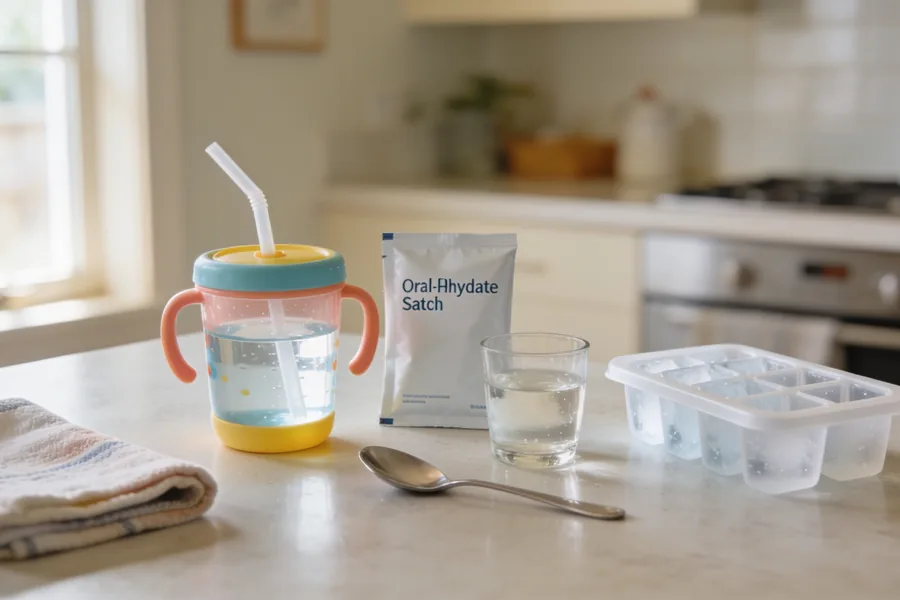
Keep the drinks within reach and keep your own voice calm. Children read your worry, and a relaxed parent who says “small sips, you are doing fine” gets more fluid into a sick child than a stressed one who is counting every millilitre. You are not failing if they refuse food for a day. The fluids are the medicine here, and food can wait until the stomach settles.
What not to give matters just as much. Skip full-strength juice and sugary drinks, because they can make diarrhoea worse, and do not reach for anti-vomiting medicine unless a doctor or pharmacist has said to use it. Plain water is fine for older children. For a baby, keep offering breastmilk or formula alongside the extra fluids, because for them it is both food and drink, and their small bodies lose fluid faster than an older child’s.
Red flags: when to call the doctor
Most gastro needs nothing more than time and fluids, but there is a list of signs that mean a call to the doctor, or to emergency care, is the right move. You are not overreacting to call. Every one of these is worth a professional opinion.
Dehydration can come on faster than parents expect, especially in babies and toddlers, because their bodies are small and they lose fluid quickly when both ends are busy. That is why this list exists. Read it as permission to call, not as something to worry through alone.
- Dry mouth and lips, or no tears when they cry.
- Fewer wet nappies than usual, or long gaps without weeing.
- Sunken eyes, or a soft spot on a baby’s head that dips.
- Unusual drowsiness, or floppiness that is not just tiredness.
- Blood in the vomit or the stool.
- Severe tummy pain that is not easing.
- A fever in a baby under three months.
If you see any of these, call your GP or health advice line. Dehydration is the real risk with gastro, and it is treatable, but it is easier to treat early than to turn around. Trust the list over the hope that it will pass. A worried parent who calls is doing the right thing, full stop.
Stopping it from spreading through the house
Gastro moves through a household fast, but you can slow it down with a few plain habits.
Soap and warm water beat hand sanitiser for this virus. Norovirus is stubborn, and sanitiser does not reliably kill it, so make handwashing the rule after the bathroom, after nappies, and before food. Clean the bathroom and the high-touch spots, the taps, the toilet flush, the door handles, with a bleach-based cleaner. Give the sick child their own towel for a few days, and wash your own hands after you help them. Keep their cup and plate separate, and wash them well.
If there is a baby in the house, a stomach bug needs even more care. The same habits that carry a newborn through winter illness season, which I have written about before in my guide to natural ways to prevent colds and flu in your newborn this winter, apply double here. Wash your hands before you pick the baby up, no matter how many times a day you do it, and keep the sick child’s things away from the baby’s things where you reasonably can.
Not every “stay home” is an illness
Gastro has a clear physical rule, and that makes it a straightforward call. But it is worth gently saying that not every child who says they feel sick on a school morning has a stomach bug.
If a child is regularly fighting school when they are well, complaining of tummy aches that vanish on weekends, or crying on Sunday nights about Monday, that is a different conversation, and a calmer one than a sick day. It deserves patience and a proper look at what is happening at school, not a lecture and not a forced day off. My calm guide to school refusal walks through how to tell the difference and where to start, because keeping the two separate helps you respond to the right problem.
A real stomach bug and a worried child both need you. They just need different things from you.
Let the clock, not the guilt, decide
Gastro is miserable, common and almost always short. It is not a reflection on your parenting, your cleaning or your cooking. It is a virus that moves through families, and almost every family gets its turn.
The rule is simple once you know it. Keep them home until they have been symptom-free for a full day, two in many states and centres, and use that time for fluids and rest. The doctor is the right call the moment you are worried, not the moment you are certain. And when you are second-guessing whether one more day at home is overkill, let the clock answer instead of the guilt. One extra day costs very little. A classroom of gastro costs a lot more.
Sources:
- Healthdirect Australia – gastroenteritis (what it is and when to seek help)
- NSW Health – School exclusion periods fact sheet (infectious disease exclusion times)
- SA Health – Exclusion from childcare, preschool, school and work