Healthcare
The First Aid Kit You Already Own (and What Has Quietly Gone Off in It)

- Most households own a first aid kit and almost none of them has looked inside it since the day it arrived.
- A kit is not a shopping list. It is a decision about a house, and the decision is different for a family with a toddler, a house with a workshop, and a couple in their sixties.
- Things quietly go off in there: strips lose their stick, sterile seals fail, gloves perish, and liquids carry dates.
- Two mistakes make a kit useless, and neither of them is about what is in it.
- And the contents are the easy half, which is the part this article ends on.
There is a first aid kit in most Australian homes. It is usually in a cupboard near the bathroom, it usually arrived as a gift or a bulk-buy, and it has usually not been opened since. If that sounds familiar, this article is a gentle errand rather than a lecture. We are going to work out what a kit is for, what should be in yours rather than what a shop says, what has quietly expired, and where it should live so somebody can find it in the minutes that matter.
What a kit is actually for
The plain definition: first aid is what you do in the first minutes of an injury or an illness, until more help arrives. That is the whole window a kit is built for. The minutes before an ambulance, a doctor, or the neighbour who used to be a nurse.
So everything in the box should be there for one reason: somebody in this house might need it in those minutes. Not because a list said so, and not because it seemed sensible for a household that is, on average, not this one.
Two things follow. A kit does not treat anything by itself; it is equipment waiting for a person who knows what to do with it. And buying a bigger kit is not the same as being more prepared. The larger box with forty extra items is not a safer house. It is a larger box.
So the rest of this article is a set of questions rather than a list of products.
The four questions that decide what is in yours
The method here is borrowed, and it is borrowed openly: workplace first aid codes in Australia decide a kit’s contents by looking at what could happen, how likely and how serious each thing is, what is needed for it, and then reviewing the lot. That is a method rather than a rule, and in a house it transfers almost unchanged. It is a much more useful way to fill a box than a standard packing list.
Question one: who lives here, and who visits? A household with a toddler needs things a household of two adults does not, and a house where a frail grandparent visits needs a different set again. If a new baby is part of your picture, the site’s Natural ways to prevent colds and flu in your newborn this winter is about prevention rather than reaction, and it is the right companion piece for that stage.
Question two: what actually happens here? A kitchen, a workshop, a pool, a motorbike, a dog, a trampoline and a paddock produce very different kinds of trouble, and a kit should reflect the building and the habits rather than the suburb.
Question three, and this is the one nobody asks: what can anybody in the house actually do? Equipment for a skill nobody has is equipment that will not be used in a frightened moment. Answer that honestly and your kit gets more useful, not smaller.
Question four: where does it live, and who checks it? That one gets its own section further down, because a kit nobody can find is not a kit. The useful kit is the one whose contents were decided by the household’s own week.
What goes in, and what quietly goes off
Group the contents in your head rather than reading them as a shopping list. The groups are what you will check your box against.
Things that clean and cover a wound: the dressings, the strips, the bandages, the tape, the saline, the gloves.
Things for the events a kit is meant to equip you for, named as kinds of harm rather than as instructions: cuts, scratches, grazes and splinters; sprains and strains; minor burns; major bleeding; broken bones; eye injuries; and shock. Those are the categories a workplace code equips for, and a household can borrow them without borrowing a single instruction from anywhere. This article will not describe what to do about any of them, and that is on purpose.
Then the paragraph worth reading twice: things get smaller or disappear with age. Adhesive strips lose their stick. Saline, antiseptic and eye products carry expiry dates. Packaged sterile items stop being sterile if the seal has gone, which is why a split packet is a bin item rather than a spare. Gloves perish in a hot cupboard, quietly, and are the last thing you want failing at the wrong moment. A kit is not a time capsule. It is a small stock of perishable goods.
And the things people forget entirely: the list of what the kit contains, something to write with, emergency contact details that are current, a torch, and a pair of scissors that will cut what needs cutting.
A kit going off is a different thing from a certificate running out of currency. If it is the second one you are wondering about, that is a separate subject with its own rules.
The two mistakes that make a kit useless
Neither of these is about what you put in. Both are about everything around it.

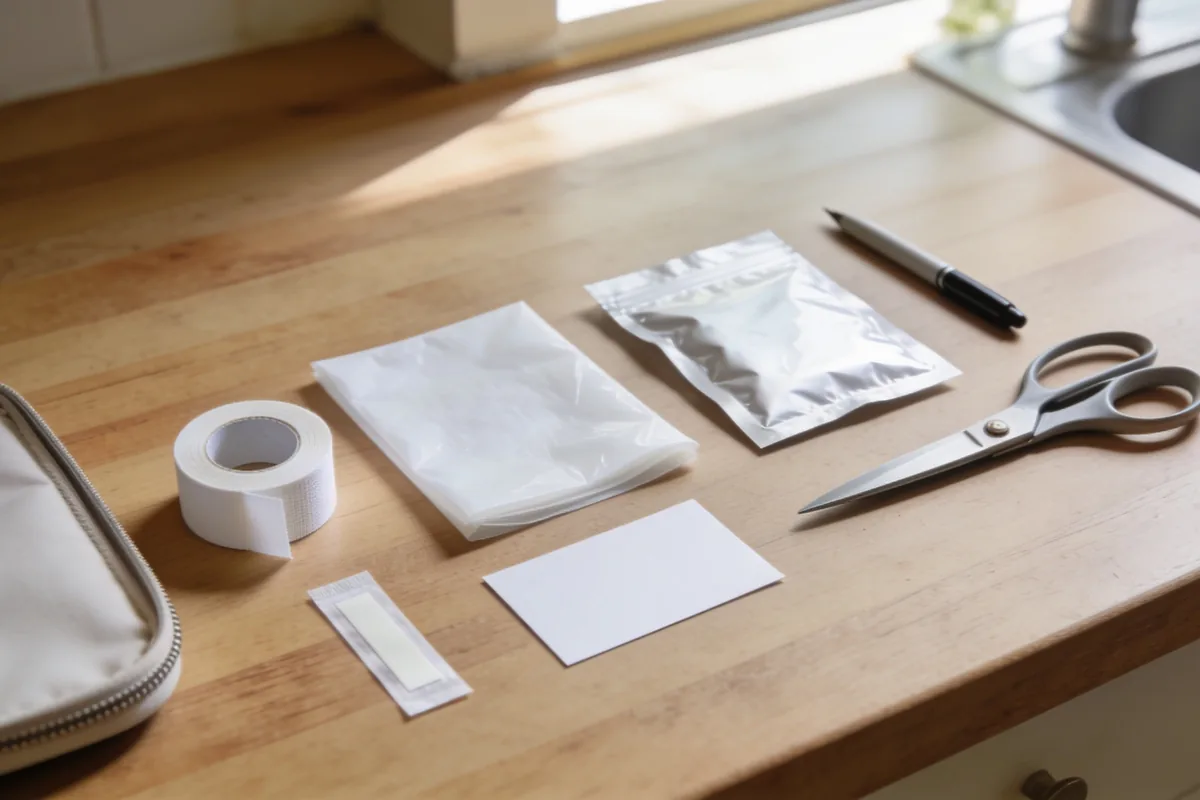
The first mistake is the kit nobody has checked. Bought, put in a cupboard, opened two years later to find the strips have curled, the saline has a date on it, and something is missing because it was used and never replaced. The fix is a routine rather than a resolution. Name one person who owns the kit in your household, check it after anything comes out of it, and give it one proper look a year, on a date you will remember, with the check date written on the inside of the lid so future you knows where things stand.
The second mistake is the kit nobody can find or reach. On the top shelf behind the saucepans, in a locked cupboard, in the boot under the pram, in a bathroom that only one person in the house uses. The borrowed workplace standard is a good one for a home too: reachable, known to everyone, and not locked. If two adults in the house cannot say where it is without looking, it is in the wrong place.
And the third mistake is the quiet one, so it gets its own moment later rather than a paragraph here: a kit containing equipment nobody in the house has been taught to use. Nothing about that is a reason to take anything out. It is information, and it tells you what to do next.
Where the kit should live
Placement, not storage. This is about function rather than tidiness.
One at home, in a place everybody in the house can name. That is the whole test, and it is stricter than it sounds. A kit is for the moment when somebody is frightened and moving fast, and muscle memory is the only map they will have.
One in the car. Workplace codes treat a kit as standard equipment for a vehicle that is somebody’s workplace, and the same logic works for the car that carries the family. One honest note: a car kit lives in heat, so it ages faster than the one in the hallway and deserves its own check more often.
One in the shed, the workshop or wherever the tools are, because that is where the injuries your household’s week produces tend to happen.
One in the caravan, the boat or the camper, because those are places where somebody can be a long way from help.
And one that is not about your house at all. The grandparent’s place. The car of the person who drives everybody else around. The sports bag that leaves the house every week, which in a household with children is a world of its own; the site’s The ultimate guide to cleaning kids’ toys: safe, simple, and effective methods looks after the rest of that gear, and the kit is the part that matters most.
One more version, for the household that needs a conversation rather than another kit: if two people live alone and see a neighbour twice a week, the useful arrangement is knowing where each other’s kit is, which is a five-minute conversation that pays for itself.
The only thing that matters more than the kit
The contents are the easy half, and this is the part worth ending on.
Among the many people who have written down what is in their own kit, one note keeps appearing: make sure everyone in the house knows how to use what is in it. That is the difference between a household that copes with a bad five minutes and one that watches them happen.
A kit is equipment for a situation that is unfamiliar by definition. Nobody uses it on a normal Tuesday, so nobody has practice by default. The households that manage are usually the ones where somebody was shown what to do once, properly, and has kept that with them since. That is a person deciding to be ready, and it costs an afternoon.
This article is not going to describe what to do with the things in the box. That is not what a cupboard article is for, and there are people whose whole job is teaching it well. The line from a Tarneit first aid trainer that delivers CPR and first aid courses, including on site for workplaces is worth keeping in the meantime: the box is worth having because somebody might need it, and it is worth knowing how to use because somebody will.
Where the kit should live
The short version, short enough to act on today.
Decide the contents by who lives here and what happens here. Check the dates and the seals, and replace what has gone off and what has been used. Write the check date inside the lid. Put it somewhere every adult in the house can point to without thinking. Keep one in the car and one where the tools are, and check the car one more often because of the heat. And make sure whoever is in the house knows what is inside.
The kit is not the part that saves anybody. It is the part that is already there when somebody who knows what to do needs it.
Sources consulted: Safe Work Australia’s model code of practice for first aid in the workplace; healthdirect information on first aid.