Home & Garden
The Drain That Keeps Blocking: What a Repeat Actually Tells You

- Once is bad luck. Twice is information.
- A drain does not block because of what you put down it. It blocks because of where the water stops moving, and that is a property of the pipe.
- Six things actually cause a repeat blockage, and the famous one is not always your one.
- Clearing a drain removes a symptom. Fixing it removes a condition, and telling the two apart is the decision this article is about.
- And the reader who can describe the pattern has already done the hard half of the work.
If you are standing over a drain that was cleared last year, wondering whether this is simply your life now, the first useful thing to hear is that a repeat is not bad luck. A drain that blocks twice is telling you something specific about the pipe, and the message gets clearer the more precisely you can describe what keeps happening. This is not an article about how to clear a drain. It is about why the same one keeps filling up, and how to tell clearing it again from fixing it properly.
What a drain actually is
Start with the one piece of understanding everything else hangs on, because it is simple and almost nobody is told it plainly.
A drain is not a tube. It is a run of pipe with joints, changes of direction, connections where other pipes join it, and a fall, which is the slope that carries water and everything in it away by gravity rather than by pressure. Every one of those features is a place where the flow slows.
That has two consequences the reader needs. Water that slows drops what it is carrying, which is how a deposit forms in the first place. And a drain that has blocked once has already told you where its slow point is, because it will block in the same place every time, and it will do it for the same reason.
The connections matter as well: every pipe that joins the run adds one more place for debris to pause. And the fall matters more than most people realise. A pipe with barely enough slope works fine until something small changes, and then it does not. A pipe that has settled differently from its neighbours loses its fall quietly, which is one of the ways a line that was fine for years stops being fine.
The honest limit: you cannot see any of this from the grate. Everything downstream of the drain is out of sight, which is exactly why the next section is about what is likely to be in there.
What is actually in the pipe
Six causes cover most repeat blockages. Each one is recognisable from the outside if you know what you are looking at.
Fat, oil and food. The most common, the most household-owned, and the one that returns because the line is already coated. It does not vanish when it goes down the sink. It cools, sticks and narrows.
Wipes and paper that do not break down. The modern one. They catch on an existing rough patch and build a dam behind it, and the word on the packet is not a promise about the pipe. Once one of them catches, the rest arrive to keep it company, which is why a wipes problem and a rough patch in the pipe are usually found together.
Tree roots at a joint. And here is the correction worth keeping: roots enter at a crack or a joint, not through a solid pipe. That is why they come back at the same spot, and why the failure, rather than the tree, is the thing to find.
A sagging or bellied section. Ground movement, age or a bad original fall, where water sits and solids settle. The pipe is not blocked so much as permanently slower than it should be.
Scale and corrosion in an older line. The pipe narrows over the years and there is no blockage to remove, only a smaller pipe than the house needs.
And a foreign object. A toy, a cloth, a build-up of gravel from a broken grate. This is the one cause that genuinely does not recur once it is out, which is the reason to rule it in or out honestly rather than assuming a return is coming.

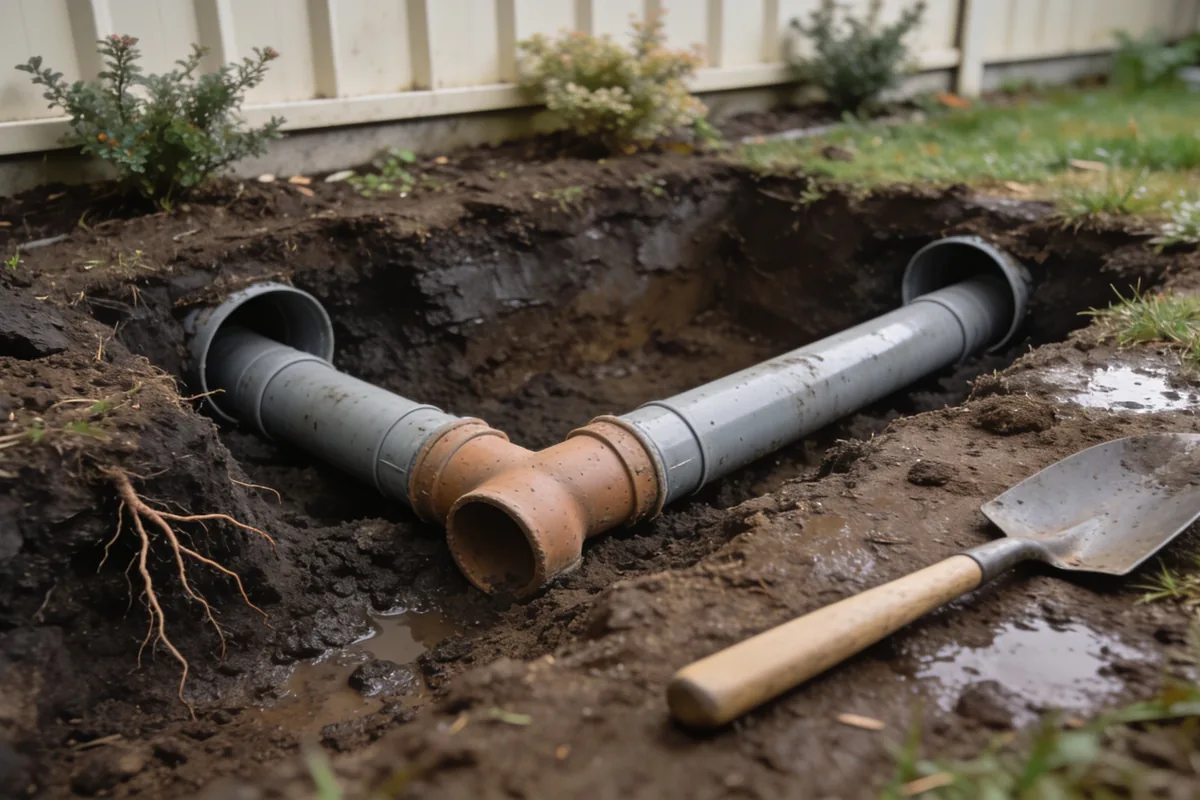
One more note before the list turns into a diagnosis: when the pipe itself is the problem rather than its contents, it usually shows in more ways than a blockage, and the site’s Top signs your home pipes need repairs is the list worth checking yourself against. Notice, too, that five of the six causes point at the pipe or the pattern rather than at the household, which is the uncomfortable half of the trade and the reason this article leads where it does.
Why it comes back at the same place every time
This section is the article’s whole argument: a renewed blockage in the same spot is a diagnosis, not a coincidence.
It means the pipe at that point is either damaged, narrow, badly laid or permanently coated. Clearing it removes the symptom and leaves the condition underneath, which is why the relief lasts weeks or months rather than years.
Here is the practical version. The reader who can say “it is always this drain, it is always about a year apart, and it backs up when the washing machine empties” has handed a plumber more than a camera will find in ten minutes. That sentence contains the location, the interval and the trigger.
Two patterns are worth recognising by name. The seasonal one, which points at roots or at rubbish entering from outside, because the pattern follows the tree or the weather. And the load-related one, which points at a partially restricted line that only fails when the fixture upstream empties into it. In both cases the pattern is the evidence.
The interval is information as well. A repeat that arrives faster each time means the condition is getting worse, and a repeat that arrives on the same schedule means you are running on a cycle. Cycles can be planned for. Escalations should be acted on. Write the dates somewhere you will find them again, because next year you will want them.
And one thing to resist: do not conclude it is roots because roots are the famous cause. The famous cause and your cause are two different things, and the difference is worth a question before anybody starts digging.
How a plumber works out which one it is
It helps to know what the visit involves, because it tells you what you are paying for and why some visits are quick.
Asking first. The history is the cheapest diagnostic there is, which is why the previous section matters more than any tool. Everything about the pattern, the interval and the trigger shortens the job. The history is not small talk before the real work. It is the diagnostic, and a plumber who skips it is leaving the cheapest tool they own in the van.
Looking at the layout. Which fixtures are affected, what sits upstream, where the low spots are, and what is growing near the line. None of this involves opening anything, and all of it narrows the field.
Testing with water, rather than assuming. How it backs up and where it appears tells you where the restriction sits, and a plumber who tests before quoting is doing the job in the right order. How it backs up is itself a reading: a slow rise points one way, an instant flood another, and a gurgle somewhere else in the house a third.
And looking inside the line, which is the step that turns clearing into diagnosing. It is the difference between knowing that a drain is blocked and knowing why. What it changes is everything downstream: a cleared drain with a known cause comes with a plan, and a cleared drain without one comes with a return visit.
What a proper diagnosis produces is a reason rather than a cleared drain. If you take one sentence from this article, take that one.
Clearing it, or fixing it
This is the decision the article exists for, and it is genuinely a decision rather than an instruction.
Clearing is the right answer when it is the first time, when the cause is one the household owns and can change, when the line is otherwise sound, or when the reader is renting and the fix is not theirs to authorise. In those cases the site’s How to clear blocked stormwater drains in winter: a practical Aussie guide covers the maintenance side properly, and this article will stay on the pattern.
Fixing is the right answer when the same drain blocks twice within a reasonable period, when it blocks with nothing unusual going into it, when the pattern is seasonal or load-related, when the line is old, or when the reader has paid to clear the same spot more than once already.
The honest arithmetic, with no numbers in it: the question is not what each visit costs. It is how many visits you are prepared to pay for. A householder can decide that for themselves once they know which cause they have, and knowing the cause is the whole reason this article pushes on the pattern rather than on the blockage. Fix and clear are not always either-or, either. A household can fix the cause and still clear the line once more while the fix settles in. What matters is that the money buys a reason rather than only relief.
That is also the point a Merrylands plumber who handles blocked drains across Western Sydney starts from on a repeat blockage, because the third visit to the same drain is a pattern rather than bad luck. Whether the pipe is the householder’s to fix or sits on the other side of a boundary is its own question, and it is a different article, but it is a fair one to ask.
The things that make it worse
A short section, deliberately modest, because habits help at the margin rather than working miracles.
What genuinely helps. Keeping fat out of the sink and putting it in the bin rather than washing it down with hot water. Being sceptical of anything described as flushable. A drain grate over anything that can drop into an open drain. Noticing a slow drain before it stops, because a drain that drains slowly has already told you it is narrowing, and the site’s Signs your stormwater drains are blocked: don’t ignore these red flags is the detection list for exactly that stage. And writing down when it happens, because a pattern is the most useful thing you can bring to the visit.
What does not help: relying on a chemical cleaner as a routine. It can clear a soft blockage and it cannot touch a root, a sag or a scale problem, so a repeat visit from the bottle is really a sign that the cause has not been found. That is not a safety claim about anything, and it is not an instruction about anything. It is just the observation that a routine is a strange thing to have for a one-off problem.
What to tell the plumber when you ring
Here is everything above, compressed into what to have ready.
Which drain it is, and how many times it has blocked. Roughly how long apart the blockages are. What it does when it backs up, and which fixture causes it. Whether it drains slowly all the time or only sometimes. Anything growing near the line. How old the house and the line are, as far as you know. Whether the property is owned or rented. And whether anything unusual has been put down it.
That is a two-minute conversation, and it changes the visit from a search into a confirmation.
And there is no shame in a repeat. Drains are infrastructure, and infrastructure deserves a reason rather than a fresh excuse each time. The reader who can describe the pattern has already done the hard half of the work. And a plumber who asks about it before quoting is the one to keep.
Sources consulted: published household guidance on drainage and plumbing.