Home & Garden
Why Your Kitchen Drawer Sticks, Sags or Slams (and How to Fix It)

- A drawer is three things: the box, the front panel, and the runner that lets the box slide. Most of the trouble is in the third one.
- Most of what people blame on the drawer is alignment or load, and both are fixable without buying anything.
- The piece that came off in your hand is not always a broken runner. Look at what it is before you order.
- Two measurements and one count are all you need before you buy a replacement. Write them down first.
- And the honest line up front: plenty of these are a ten-minute fix, and one of them is genuinely a new box.
Something has gone wrong with this drawer, and you cannot tell whether it is a five-minute job or a new kitchen. If you are standing in front of it with a small piece of plastic in your hand, take a breath. The drawer itself is usually innocent, and it is not usually the thing that broke. Let us work out what actually happened before anybody buys anything.
What is actually under the drawer
Three parts, and it helps to know which is which before you start wiggling things.
The box is the container, the sides and base that hold the cutlery. The front panel is the face you pull on, and it carries nothing structural: its job is to look good and give you somewhere to put a handle. The runner, which plenty of people call a slider, is the mechanism that lets the box travel in and out. Most of what goes wrong lives there.
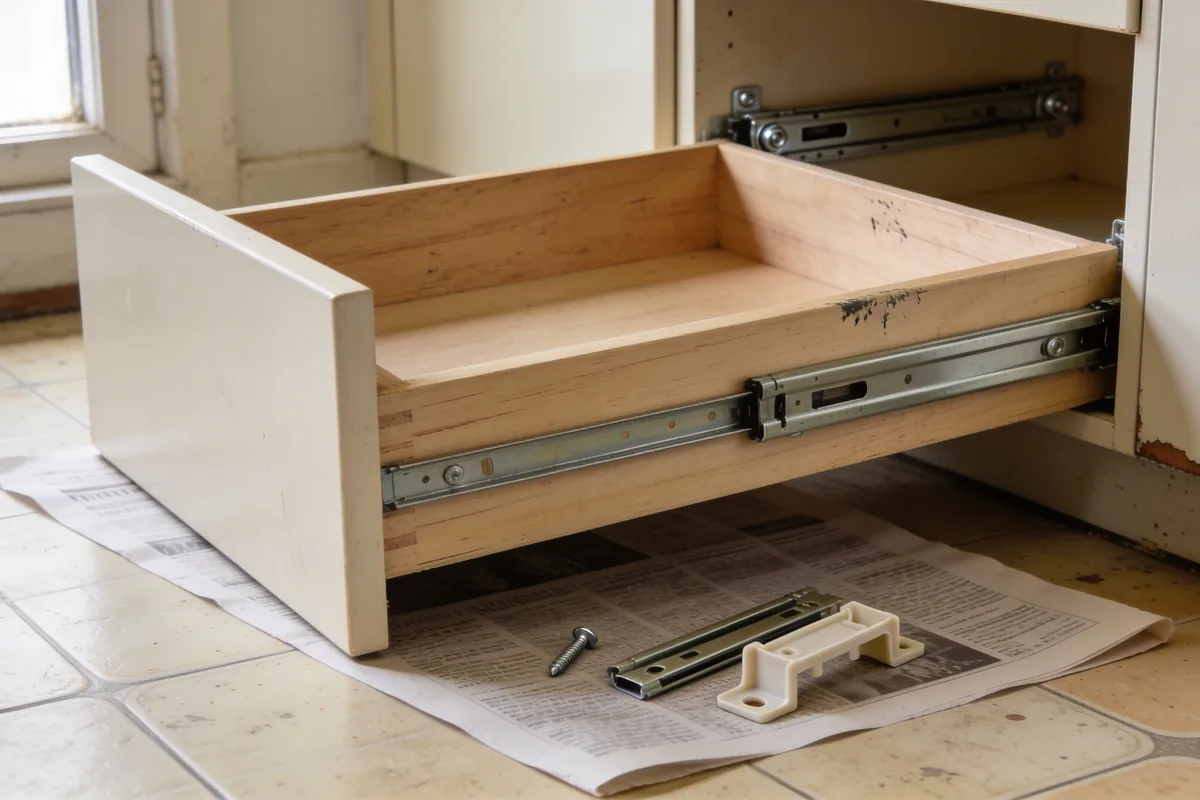
A runner is a two-part system. One part is fixed to the inside of the cabinet, one is fixed to the side or the underside of the box, and the two slide against each other on rollers or on ball bearings. Older Australian kitchens almost always have side-mount runners, screwed to the cabinet side and the outside of the box. Newer kitchens tend to use under-mount runners, which hide beneath the box.
Worth knowing before you blame the mechanism: the runner carries the whole load, and the load is heavier than it looks. A drawer full of cutlery, tools or tinned food speeds up everything below. If the drawer has been groaning for a while, the weight has been part of the story.

“The drawer catches and drops at one end”
The most common complaint in the whole kitchen, and almost never a lost part.
What has usually happened is that the drawer has come out of alignment. One runner is sitting a little higher, lower or further back than its partner, so the box twists as it travels, and one corner drops. The drawer did not lose anything. It just stopped agreeing with itself.
Check it like this. Pull the drawer right out. Some runners have a release lever or tab, usually on both sides, and squeezing them frees the box. Not every runner has one, in which case the box simply lifts out. With the box out, look at three things. Are both sides attached at the same height? Is one bracket bent or sprung? Has one side of the cabinet’s runner dropped out of its screw holes?
Now the fixes, in the order to try them.
Reseat the box first. Drop it back in and give it a firm push and a wiggle. A surprising number of drawers were never fully on, and behave perfectly once they are.
Tighten or reset the brackets next. If one side has worked loose, snug it up and try again. Small adjustments move a drawer more than you would think.
If a fixing screw has stripped its hole, the hole is the problem, and a bigger screw is not the answer. A fixing that has pulled out needs repair rather than force, and wood filler or a glued matchstick in the hole will hold a screw again.
Only replace the runners if the mechanism itself is worn, cracked or missing pieces. And if the front panel is the thing that looks lopsided, come back to this section, because the front is almost never the cause. It is just where the misalignment shows.
“The drawer is stiff, grindy or noisy”
Now the drawer that fights back. Four causes, usually in this order.
The runner is worn. Rollers flatten, a track bends, and ball bearings pick up grit and start to growl. A runner that has done decades of service has done its job, and replacing the pair is a legitimate answer, not a defeat.
The runner is overloaded. Every runner has a load rating, and it is a real property of the part rather than a marketing line. It is printed on the packaging of the replacement, so read it before you buy, and compare it with what the drawer holds day to day. Heavy stuff in the bottom drawer, cutlery in the middle: the load is not evenly spread, and the worst drawer wears fastest.
Something is caught. A cutlery tray can sit proud of the box, a screw can back out inside the cabinet, and sawdust or flour in the track will grind like sandpaper. Pull the drawer out and run your hand along the track. You will usually find the culprit in seconds.
And the last one, which is the unhappy one: the cabinet is out of square. An older carcass that has moved cannot be fixed with parts, and no new runner on the shelf will make it true again. Straighten what you can and accept that this drawer will never be the smooth one.
“The drawer slams, or will not stay closed”
The most straightforward symptom, with the most straightforward answer.
Soft close is a damper built into the runner that catches the last part of the travel and eases the drawer home. It is a property of the runner rather than of the drawer, which means it is replaced rather than repaired. There are add-on catches and dampers for some runners, and some drawers come with the feature built in.
Two other causes are worth a look. An uneven cabinet can leave the drawer running slightly downhill, so it will not hold position on its own, and a missing or worn latch is often the actual part to replace on an older kitchen. Check both first.
One decision point while you are here. If you are replacing the runners anyway, that is the moment soft close is cheapest to add, because it comes down to which part you carry home. If the runners are fine, it is not a job worth doing for its own sake.
And if what you secretly want is a kitchen that looks different rather than a drawer that behaves, that is a different job with its own rules, and the site’s The Finishing Touch That Defines Your Space: Choosing the Right Cabinet Hardware is the right place to start.
The part that came off in your hand
This section saves people money, because not every failure is a runner and not every loose piece is broken.
Three things fall off, and they mean three different things.
A plastic clip or bumper. This is usually a stop or a retainer, and it can often go straight back on. If it clips on, clip it on. Look at where it fell from before you look at a catalogue.
A bracket or a bracket tooth that has snapped. The bracket ties the runner to the box or the cabinet, and once the bracket is broken the assembly is finished. Order the pair.
A roller, or a strip of ball bearings that has come away from its track. Same verdict: the runner is finished, and the pair gets replaced.
Then the harder case, and this one deserves a moment. If the corners of the box are eroded, or the box has swollen and no longer sits square, the runner is not the problem and no runner will fix it. Chipboard swells when it gets wet, and a kitchen near a dishwasher or a leaky tap will do it slowly, a little at a time. When that happens, you have three options: a new box, moving the runner to sound material, or accepting that this drawer is now the shallow one for tea towels. All three are better than spending money on parts that cannot help.
The two numbers to write down
Before you buy anything, take two measurements and one count. That is the whole shopping list.
Measure the length of the runner, along the part. Then measure the depth it has to live in, inside the cabinet, from the front frame to the back panel. These are not the same number, and buying by the wrong one is the classic second trip to the shop. Write both down.
Then the count that is not a measurement: the sides. Runners are a matched pair, and both sides are replaced together, because a new runner against an old one is a drawer that still limps. If yours is an older cabinet, the new part’s fixing holes will not line up with the old ones. That is normal, and it is a drill problem rather than a wrong-part problem.
Take the two numbers to the counter, or the search box, and you have turned a guess into a purchase. It is the sort of question a Melbourne cabinet hardware supplier with a trade counter and an online store answers every day, and watch how carefully they ask the same questions back to you.
What to check before you buy anything
The compressed version, so you can close the tab and go and look.
Which of the three symptoms is it: catching and dropping, stiff and grindy, or slamming? Is the box itself sound, or has it swelled and gone soft? Is the front panel the thing that is lopsided, and if so, have you checked the alignment first? The front is usually innocent. Are the fixings still in sound material, or has one pulled out and left a hole that needs repairing? And have you written down the runner length and the cabinet depth?
That is the check. Most drawers that have annoyed somebody for a year are one pair of parts and twenty minutes of work. And if the answer turns out to be a new box, you have discovered that for the price of nothing, with the drawer still on the bench and the kettle still warm.
Sources consulted: cabinet runner technical documentation from a hardware manufacturer; trade supplier fitting guide.