Home & Garden
Low-Light Indoor Plants: A Beginner’s Guide to Keeping Houseplants Alive

The honest short version
If you have killed a houseplant, or three, this guide is for you. Here is the secret that changes everything: most houseplants do not die from too little light. They die from too much water. The number one killer of indoor plants is a kind, well-meaning owner watering them more often than they need.
The second thing to know is what “low light” actually means. It does not mean a dark room with no windows. It means a bright room where the plant sits a few metres back from the window, or a north or east facing spot. If the room you want to fill has a window at all, something can almost certainly live in it.
So the beginner method is simple. Start with two or three hardy plants. Learn to check the soil with your finger before you water, instead of watering on a fixed schedule. Then leave them alone a little more than feels natural. That is most of it.
One honest note before the detail. This is general gardening information, and plants are living things with their own preferences. Words like “most plants”, “can” and “some varieties” are doing real work here. If a particular plant is struggling, the variety and your specific room matter.
Why indoor plants die (and it is rarely your fault)
Before you blame yourself, know this. Killing a few houseplants is not a personal failing. It is the standard entry fee for learning to keep them, and almost everyone who is now good with plants has a graveyard of early victims behind them.
Most people are simply never taught how. The instructions that come with a plant are usually a plastic tag that says “water regularly”, which is almost designed to be misunderstood. Read literally, water regularly means water often. And watering often is exactly what kills most indoor plants.
Overwatering is the biggest killer. When a plant sits in soil that stays wet, the roots cannot breathe. They rot, and the plant dies from the bottom up. The classic story is the person who waters every few days to be safe, then wonders why the leaves go yellow and mushy.
The second killer is no drainage. A pot with no hole in the bottom collects a pool of water under the soil, and the roots sit in it permanently. Even a plant that copes with normal watering will drown in a pot with nowhere for the water to escape.
The third is a genuinely dark spot. Some plants tolerate low light, but none thrives in a room with no natural light at all. A plant in a windowless corner or a hallway that never sees daylight is slowly starving, and no amount of water will fix that.
What “low light” really means
Let us translate the jargon, because the plant world uses “low light” in a way that confuses beginners. A plant labelled low light does not want a cave. It wants less light than a sun-loving plant, which is a very different thing. The label compares it to other plants, not to your darkest room.
In plain terms, low light means one of two spots. A bright room where the plant sits a few metres back from the window, out of the direct sun. Or a north or east facing windowsill, which gets gentle morning light rather than the harsh afternoon sun of a west facing window.
The honest limit is this. A room with no window at all is not low light, it is no light, and even the hardiest plants will struggle there long term. A bathroom or hallway with a small window works, as does a room with a skylight. A completely windowless room does not, and no plant recommendation in this guide changes that.
How do you judge a spot with your own eyes? Use the book test. Stand where you want to put the plant and try to read a book comfortably in the middle of the day. If you can read without switching on a light, the spot has enough light for a low-light plant. If you cannot, look for somewhere closer to a window.
This is why people put plants in the wrong spot and then blame themselves or the plant. And if you are in an apartment working out which rooms and windows suit what, the questions in our guide to apartment living in Australia are worth thinking through before you fill a room with greenery.
The easiest plants to start with
Here are six forgiving plants that tolerate lower light. Common names only, no Latin required. Each gets a plain description, why it is forgiving, and the one thing it cannot handle. Pick two or three that appeal.
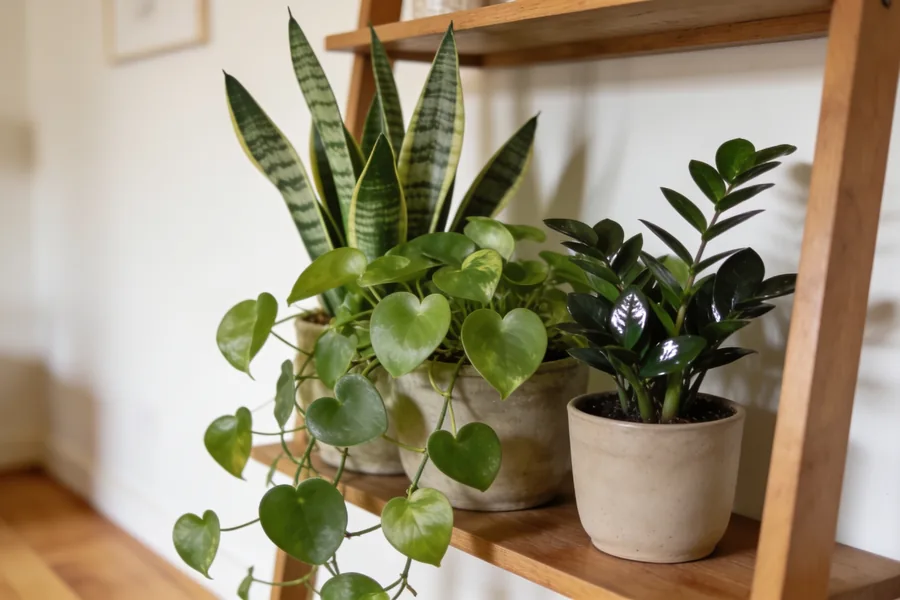
Snake plant. Tall, stiff, sword-shaped leaves that grow upwards, often edged in yellow or patterned in a darker green. It is famously tough, tolerates low light and irregular watering, and it will wait for you while you travel. The one thing it cannot tolerate is soggy soil, so let it dry out completely between waters.
Pothos. A trailing vine with heart-shaped leaves, usually green or variegated with cream and yellow. It grows happily in low light and tells you when it is thirsty: the leaves droop, you water, and within hours they perk back up. That makes it the most forgiving plant on this list for learning to read what a plant needs. The one thing it cannot tolerate is sitting in standing water, which rots the roots.
ZZ plant. Glossy, dark green, slightly waxy leaves along upright stems. It is almost absurdly tolerant of low light, neglect and irregular watering, which is why it appears on every unkillable plant list. The one thing it cannot tolerate is overwatering. It would rather be forgotten for a month than watered every week.

Spider plant. Long, slender, arching leaves, green with a white or cream stripe down the middle. It is forgiving and grows quickly, sending out baby plants on trailing stems that you can pot up and give away. The one thing it cannot tolerate is being left bone dry for too long, so it likes slightly more regular water than the snake or the ZZ.
Peace lily. Broad, dark green leaves and white flowers that look a little like a calla lily. It is a drama queen in the best way: it droops dramatically when thirsty and revives within hours of a drink, which makes it an excellent teacher for a beginner. The one thing it cannot tolerate is being left to wilt repeatedly.
Philodendron. Heart-shaped leaves on a plant that can trail or climb, usually a rich green. It is forgiving, grows well in low to medium light, and is often confused with pothos, which is fine, because the two have very similar temperaments. The one thing it cannot tolerate is cold draughts and soggy roots.
Start with two or three of these rather than filling a windowsill on day one. Fewer plants means less to learn at once, and the confidence from keeping three alive beats the guilt of killing eight.
Watering without guessing
Watering is where beginners either kill their plants or worry themselves into killing them, so here is a method that removes the guesswork. Use your finger.
Push a finger into the soil up to about the second knuckle. If the top couple of centimetres feel dry, it is time to water. If they still feel damp, wait. That is the whole test. Plants do not drink on a schedule. They drink when they are dry, and your finger tells you when that is.
A simple water-when, do-not-water-when check helps at the start. Water when the top of the soil is dry to the touch, when the pot feels noticeably lighter, and when the plant is in its growing season. Do not water when the soil is still damp an inch down, when the pot still feels heavy, or when it is mid-winter and the plant has slowed down.
Drainage matters more than most people realise. Water until it runs out of the bottom of the pot, which tells you the whole root ball is wet. Then let it drain and empty the saucer, so the pot is not sitting in a puddle. A plant in a decorative pot with no hole should be taken to the sink, watered, drained, and returned.
The winter rule deserves its own paragraph. Between roughly June and August, most indoor plants grow much more slowly, which means they drink far less. Ease right off the watering, often to half as often or less, and stop fertilising until spring. A plant that needed water every five days in summer might need it only every ten or twelve in winter.
If you have already overwatered a plant, here is the rescue in plain steps. Stop watering it immediately. Let the soil dry out completely, which can take a week or more. If the roots are mushy or the pot smells rotten, repot into fresh, dry potting mix and trim away the soft roots. Then resist the urge to water it to help it settle. Give it a bright spot and let it recover on its own.
Light, warmth and the winter slowdown
An Australian winter changes things for indoor plants, and knowing how keeps you from panicking when a plant that thrived in March starts looking quiet in July. The plant is not dying. It is resting.
The days get shorter and the sun sits lower in the sky, so even a spot that was bright in summer gets noticeably less light in winter, and the plant responds by slowing its growth. Growth slows, the plant needs less of everything, and the leaves may look the same while the roots do very little.
What it needs less of is water and fertiliser. A plant that is not growing is not drinking much, so the finger test becomes even more important, because the soil stays damp for longer between waters. And fertiliser in winter is actively unhelpful. You would be feeding a plant that is not hungry, which can burn the roots. Put the fertiliser away until spring.
What it needs protection from is the indoor winter climate. Houses develop cold draughts around windows and doors, and dry heat from heaters. Both stress plants. Keep them away from cold draughts, do not let leaves press against a freezing window pane, and do not park a plant directly in front of a heater, where the hot, dry air browns the leaf tips.
This is also the time to be patient with new plants. A plant bought in winter and brought home to a darker, cooler room will take a while to settle, and it may drop a leaf or two while it adjusts. That is normal. Give it the winter to find its feet, and it will reward you with fresh growth in spring.
Repotting, pests and reading a sad plant
Plants cannot tell you in words that something is wrong, so they tell you with their leaves. Learning to read the signs turns you from someone who guesses into someone who knows.
Yellow leaves usually mean one of two things. Too much water, which is the most common cause, especially if the yellow leaves feel soft and mushy. Or, less often, not enough light. Brown, crispy leaf tips usually point to dry air, inconsistent watering, or a plant sitting too close to a heater. Sticky leaves, or fine webbing under the leaves, usually mean a pest such as scale or spider mites, which are common and very treatable.
The fixes are as plain as the symptoms. For yellow leaves from overwatering, back off the water and let the soil dry. For crispy tips, water more consistently and move the plant away from the heater. For pests, wipe the leaves with a damp cloth, and for a more stubborn outbreak, an insecticidal soap from a garden centre, used as the label directs, sorts out most of them.
Repotting sounds intimidating and is actually simple. You know it is time when roots grow out of the bottom of the pot, when water runs straight through without soaking in, or when the plant has clearly outgrown its pot. Choose a pot one size up, one with drainage holes. Gently tip the plant out, loosen the roots a little, sit it in the new pot at the same depth it was before, and fill around it with fresh potting mix. Water it in, then let it settle for a week or two.
Do not repot a struggling plant. If a plant is already stressed from overwatering or pests, repotting adds another shock, so fix the immediate problem first and let the plant recover. Repotting is a refresh for a healthy plant, not a rescue for a sick one.
A boring routine beats enthusiasm
Here is the care rhythm that actually works, and it is deliberately unexciting. Pick one watering day a week and check every plant on that day. Check the soil with your finger, not the calendar, and water only the ones that need it. Dust the leaves now and then, because a dusty leaf cannot catch light properly. And give each plant a quick look while you water, so you catch yellow leaves, pests or a leaning stem early.
The reason this works is that plants reward a boring routine more than enthusiasm. Enthusiasm waters too often, repots too soon, buys fertiliser and moves plants around, and every one of those interventions is a chance to get it wrong. A boring routine checks the soil, waters the ones that need it, and leaves the rest alone. That is what most houseplants actually want.
There is a wider point here worth keeping. A calm, cared-for space, plants included, is part of the same mood-and-home idea as a deep-cleaned and ordered room. You are not just keeping plants alive. You are building a room that feels lived in and looked after, and the plants are the part of it that grows.
Start with one plant. Learn its name, learn its soil, learn how it tells you it is thirsty. When that one is thriving, add another, and let the collection build at its own pace. A windowsill full of healthy plants is not built in an afternoon. It is built one plant at a time, by someone who checks the soil on a Saturday and does not water out of guilt.
Sources:
- Gardening Australia (ABC), Indoor plants and houseplant care
- Australian Institute of Horticulture, General indoor plant guidance (common-name reference)