Food
A Spanish Spread at Home: What to Buy, What to Cook, and the Order to Do It In

- Most of a great Spanish spread is bought, not cooked.
- The core of it is a board of cured and marinated things, bread and good oil. The cooking is three dishes, and two of them take minutes.
- The order matters more than the recipes, and the point of the whole plan is not to be in the kitchen when people arrive.
- One thing to sort when you invite, and one thing to do with the packets you bought.
There is a moment on the afternoon of a dinner party when the host realises they have agreed to do everything at once, and the kitchen starts to feel like a small hot trap. A Spanish spread is the answer to that afternoon, because most of it is bought rather than cooked, and the small amount of cooking can be done in waves instead of all at once. Here is the plan: what to buy, three things worth cooking, and the order that keeps you at the table.
Why a Spanish table feeds itself
The shape of the meal is the whole trick. Everything goes in the middle, everyone takes from the middle, and the table keeps working while you are at the stove.
Compare that with a plated dinner, honestly for a second. You plate, you serve, you sit last, and the food is at its best before it arrives at the table. A spread is the format that lets the person who cooked actually eat. It also gives you room: nothing is timed to a single moment, so a late arrival or a slow start does not wreck anything. A plated roast notices a late arrival; a board does not. Dishes sit, bread gets torn, someone finds the anchovies, and the evening carries itself.
The shop: what to buy rather than make
This is the section that saves your evening, and it is best imagined as a conversation with a deli counter rather than a recipe list.
Cured and sliced: a good cured ham, sliced thin, and a cured sausage such as chorizo. Both are bought. Both are better than anything you are going to make at home.
Cheese: a firm sheep’s milk cheese, cut into wedges rather than cubes, so people can break pieces off instead of spearing them.
Marinated and tinned, which is where the best value sits: olives, white anchovies in vinegar, and a jar of roasted peppers. These do more work than they cost, and they keep for the next time you do this.
Bread, where the one strong opinion lives: buy more than you think you need. Bread is what disappears first, and it is what makes everything else stretch. An extra loaf costs almost nothing and fixes half the problems that come up.
The oil and the vinegar: one good olive oil for the table, one for the pan, and a sherry vinegar if the shop has it. That is the whole list.
And the one rule on quantity, which is a shopping rule rather than an arithmetic one: buy for the board, not for the plate. If it fits comfortably on one large board with room left for the bread, that is a table’s worth. You can always add a cooked dish later. You cannot un-buy a third kind of salami that nobody finishes.
What to cook: three dishes worth the effort
Three, chosen for a reason. One can be made hours ahead, one takes five minutes at the stove, and one is a bowl of green things.
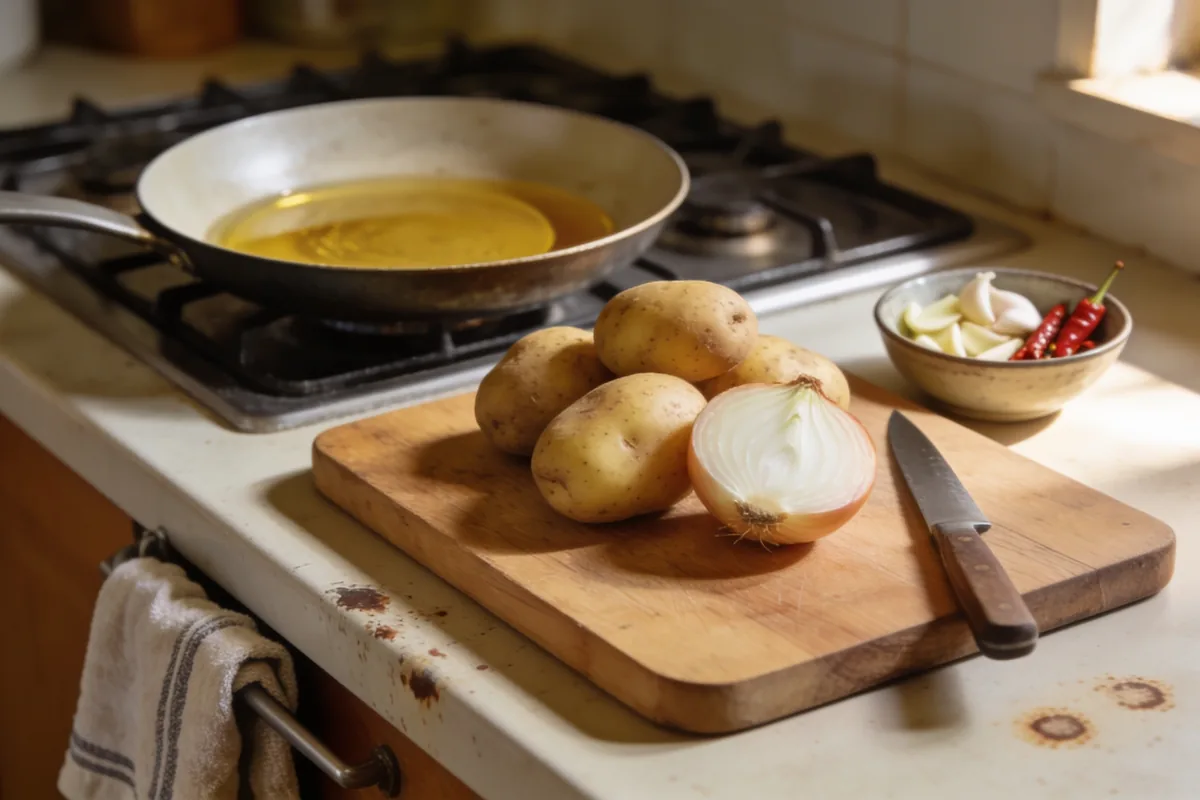
The make-ahead one: a Spanish potato and egg tortilla. It is potatoes and onion cooked slowly in plenty of oil until they are soft rather than browned, folded through beaten egg, and set gently in a pan. Two things decide whether it works: slow rather than hot, and set rather than browned. It is excellent at room temperature, which is exactly what a host needs, because it can sit on the table being perfect while you do everything else.
The five-minute one: prawns in oil with garlic and chilli, cooked in one small pan and served in the same pan. The mistake to avoid is overcooking them, and the second mistake is walking away from the garlic. Once it smells right, the pan is done.
The green one: blistered pequillo or padron peppers, made because they take one pan, a splash of oil and a pinch of salt, and because someone at the table who does not eat meat will be quietly glad of them. Do not add a fourth dish. Three is a plan, and four is a trap.

And if a dish comes up short, remember that a good deli sells cooked dishes you can pass off as your own, and there is no shame in one of the three arriving from a counter. The site’s Easy Winter Dinners: 6 One-Pot Meals That Cut Down the Washing-Up is built on the same principle, if this approach to cooking suits you: few pans, no fuss, food that waits for people.
Make ahead, and the last hour
The timeline, which is the most useful page of this plan.
Two days out: order or shop for the cured things. A good deli is not open at the hour you will remember to go, so this one cannot be left to the day.
The morning of: make the tortilla and let it cool, make any dressing or marinade the plan calls for, and put the drinks in the fridge. Cold things need longer than people think, especially in a warm month.
An hour before: set the table and put out the serving pieces, slice the cheese, take the cured meat out to come to room temperature, and move the bought things into small dishes. This is the hour that buys you the whole evening. Do not dress the board yet. That is the last thing before the doorbell, and it takes two minutes.
When they arrive: the board and something cold to drink, and nothing on the stove.
Then the two hot dishes in waves, with the pan of prawns last so it arrives hot, and the peppers before it. The rule that keeps you at the table: do not do all three at once. Two of them take minutes, and one of them can wait its turn without suffering.
What to drink, and how to serve it
One short paragraph, deliberately without a wine list.
The structure follows the food. Something to open before anyone eats. Something cold and crisp through the fried and seafood dishes. And something lighter and redder as the meal moves to the sausage and the peppers.
You do not need a Spanish wine list to do this well. A bottle you already like is a better decision than a bottle you cannot pronounce, because the meal is the point and the wine is in service of it. Two practical lines: put the water on the table in a jug rather than pouring it for people, and keep the empty bottles off the table as you go. Small things, but they keep the table looking like a table, and a jug means nobody has to ask twice.
The table, and the guests you have not thought about
Two halves here: the table itself, and the people around it.
The table: one large board rather than five small ones, and small plates, and not quite enough of them, because people take less when the plates are small and the board stays generous. The bread goes in a basket you do not mind losing. Mismatched dishes are completely fine, and honestly better than matching ones. The table is a working surface, not a styling exercise.
The guests: the allergy conversation at home is a different conversation from the one at a restaurant. Ask when you invite, not when you serve, because a message at the invitation stage gives you time to change what you buy. When you do the shop, read the packets, and keep them nearby while the table is out, so anyone who wants to check something can check it rather than take your word for it.
Two practical notes. Keep the fried and breaded things off the board if someone is avoiding gluten, rather than turning the table into a minefield. And keep the cold seafood out of the warm room: put it out when people sit down rather than leaving it out all evening. No lecture, no list of allergens, no claim that any dish is safe for anyone. Just the two habits that make the evening easier for everyone.
The night, in order
The compressed version, ready to screenshot.
Two days out, buy the cured and marinated things. The morning of, make the tortilla and chill the drinks. An hour before, out come the boards and the serving dishes. When they arrive, the board and something cold to drink, and the stove stays off. Then the peppers, then the prawns, then the cheese and whatever is left.
And if you would rather someone else ran the whole night, the site’s Why Mediterranean Restaurants Are a Great Choice for Group Dining makes the case for a table that big, which is the night a Spanish and Mediterranean restaurant in Burpengary that does the whole spread for a table runs whenever the room is full.
The best spread is the one where the person who cooked is sitting down by the second wave. Everything in this plan is arranged to make that happen, so do the shopping early, keep the cooking small, and let the table do the rest.
Sources consulted: Food Standards Australia New Zealand allergen labelling information.