Science & Nature
With the Moon Gone Around Midnight, the Geminids Peak the Night of 14 December

Two meteor showers are on the calendar, and only one is worth planning around. The small one is this week. The Leonids peak overnight on 17 into 18 November, and they are a modest pre-dawn warm-up. The big one is the Geminids, the best meteor shower Australia gets this year, and they peak on the night of Monday 14 December. This year the Moon is a thin crescent that has set by about midnight, and the International Meteor Organization (IMO) calls the maximum moon-free.
Here is the catch. From Australia the Geminid radiant, the patch of sky the meteors appear to spread from, is low and late. It rises between about 9pm and 11:40pm, and it climbs only 14 to 45 degrees at its best. So the plan is short. Go after midnight, go to a dark site, and aim for the night of 14 into 15 December. The rest of this post is the reasoning, plus the tables to check it against your own city.
The Leonids this week: a warm-up, not the main act
The Leonids are active from 6 to 30 November. The IMO puts their peak rate at about 15 an hour, and that figure is the zenithal hourly rate (ZHR): what a keen observer would count under a perfect sky with the radiant straight overhead. You will see fewer. Models of the comet’s dust trails (Vaubaillon; Sato, as cited by the IMO) show only weak, low-density trails and no significant outburst. It is a tidy little shower without any fireworks.
The sources disagree on timing, so here is a ruling. The IMO lists two predicted peak times. The nodal time is 23:45 UT on 17 November, which is 10:45am on Wednesday 18 November on the east coast. That is daylight, so it is no use to you. The Maslov time is 16:00 UT on 17 November, which is about 3am on east-coast clocks and midnight in Perth. That one falls in the dark. For Australia, plan around the Maslov time, because it is the only one of the two you can see. At the Maslov time the radiant has only just risen or is still below the horizon in most cities, so the useful hours are the ones after it rises.
The Moon is not in the way. It reaches first quarter at 22:48 AEDT on 17 November (US Naval Observatory, USNO), and in all seven cities below it sets before the Leonid radiant rises. That matches the IMO’s note that there is no moonlight disturbance near the maximum.
| City | Moon sets (night of Tue 17) | Leonid radiant rises (Wed 18) |
|---|---|---|
| Brisbane | 12:22am | 12:58am |
| Darwin | 1:07am | 1:30am |
| Perth | 12:59am | 1:36am |
| Sydney | 1:37am | 2:20am |
| Melbourne | 2:08am | 2:56am |
| Adelaide | 2:00am | 2:44am |
| Hobart | 2:07am | 3:00am |
Moon times from USNO data. Radiant rise times are our own calculation from the IMO radiant position (RA 152 degrees, Dec +22), wall-clock, no horizon obstructions.
Morning twilight starts about 5:14am in Sydney (USNO civil twilight), so the window is a couple of hours before the sky washes out. The pre-dawn of Tuesday 17 looks much the same, with the Moon setting a little earlier. If you are already up, or already out, have a look. If not, treat it as a rehearsal: find your dark spot, learn where the low eastern horizon is, and save the effort for December.
The Geminids on an Australian clock
The Geminids are active from 4 to 20 December. The IMO’s maximum is 14 December at 14h UT, with a ZHR of 150, and it describes a “broad moon-free maximum” with rates of 100 and more holding for roughly 10 to 12 hours. In recent decades the peak has landed anywhere from 21h UT on 13 December to 18h UT on 14 December.
Converted to a wall clock, the 14h UT maximum lands at:
- Sydney, Melbourne, Hobart and Canberra: 1am Tuesday 15 December
- Adelaide: 12:30am Tuesday 15 December
- Brisbane: midnight, the start of Tuesday 15 December
- Darwin: 11:30pm Monday 14 December
- Perth: 10pm Monday 14 December
The spread comes from time zones and daylight saving. If the clock change is still a fuzzy business for you, the guide to when Australia's clocks go forward covers it, and it has some sensible advice for the short night that follows a 1am peak.
The second ruling is about the date. Plenty of Northern Hemisphere guides say “the night of the 13th”, and they describe the Moon on their night. That does not translate. The IMO window from 21h UT on 13 December to 18h UT on 14 December runs from about 8am on the 14th to about 5am on the 15th on the east coast. The dark hours inside it belong to the night of 14 into 15 December, not the 13th. And for Australia the question that matters is how much Moon is in the sky once the radiant is up. For the Leonids the answer is none. For the Geminids it is a thin crescent for the first hour or two, then none.
One night is not magic, mind you. The maximum is broad, so 13 into 14 and 15 into 16 December are fair backups. Cloud will decide more of your night than the exact hour will.
The Moon is not the problem this year
The new Moon falls on 9 December and first quarter on 17 December (IMO, Table 4 of the 2026 calendar). So on the night of 14 December the Moon is a waxing crescent, about 21 per cent lit (USNO). It sets from 10:22pm in Brisbane to 12:10am in Melbourne and Hobart. On 15 December it is about 29 per cent lit (USNO, Sydney date). On the backup night of 13 into 14 December it sets earlier again, from 9:50pm in Brisbane to 11:46pm in Hobart.

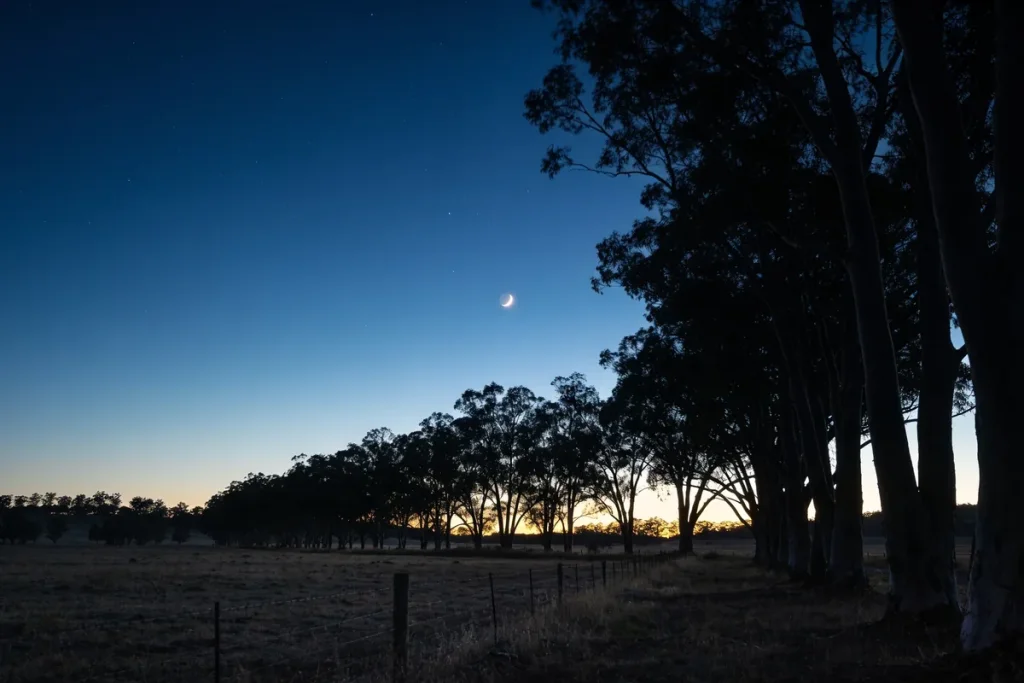
Compare that with next year. The IMO’s 2027 calendar has the Full Moon on 13 December 2027 and says it severely disturbs the Geminids that year. So 2026 is the year to make the effort, and 2027 is the one to skip. Moonlight washes out the fainter meteors first, and a crescent that is gone by midnight takes that problem off the table.
The catch: a low radiant
The headline number hides this part. The Geminid ZHR of 150 is measured, in the IMO’s words, “with the shower radiant overhead”. From Australia the radiant never gets close to overhead. The IMO notes that in the southern hemisphere the radiant appears around local midnight and culminates near 02h local time, which is 3am on daylight-saving clocks. The table works it out city by city.
| City | Moon sets | Radiant rises | Radiant’s highest | IMO peak moment (14h UT) |
|---|---|---|---|---|
| Brisbane | 10:22pm | 9:04pm | about 30 degrees, 1:42am | 12:00am Tue |
| Darwin | 11:05pm | 9:16pm | about 45 degrees, 2:42am | 11:30pm Mon |
| Perth | 11:00pm | 9:48pm | about 25 degrees, 2:10am | 10:00pm Mon |
| Sydney | 11:39pm | 10:34pm | about 23 degrees, 2:50am | 1:00am Tue |
| Adelaide | 12:01am | 11:00pm | about 22 degrees, 3:10am | 12:30am Tue |
| Melbourne | 12:10am | 11:18pm | about 19 degrees, 3:14am | 1:00am Tue |
| Hobart | 12:10am | 11:36pm | about 14 degrees, 3:06am | 1:00am Tue |
Geminid night, Monday 14 into Tuesday 15 December 2026, wall-clock times with daylight saving where observed. Moon times from USNO data. Radiant rise and highest point are our own calculation from the IMO radiant position (RA 112 degrees, Dec +33), to the nearest few minutes, with no horizon obstructions and no refraction. The peak moment is the IMO’s 14h UT converted to local time.
In every city the radiant rises while the Moon is still up, but only for a short stretch, and the Moon is a thin crescent low in the west while the radiant sits low in the east. By the time the Moon has set, the radiant is still climbing. In Sydney, Melbourne and Hobart the sky is properly Moon-free from around midnight, and the radiant keeps rising until about 3am. Darwin gets the highest radiant, at 45 degrees. Hobart gets the lowest, at 14.
These are geometry, not a forecast of what you will see. We have not printed a meteors-per-hour count for any city, and neither should anyone else. A low radiant means fewer meteors than the headline figure, even under a good dark sky, and cloud, haze and your own eyes all change the number. Expect a decent night, well short of the headline 150.
The sceptics have a fair point too. A common view among Australian stargazers online is that it is only worth getting up if you leave the city, and from a suburban backyard they are right. Losing the Moon does not rescue the count when streetlights are washing out the sky. Light pollution is the bigger limit, which is why the dark site matters more than the exact minute.
The next 12 months of showers, and one to skip
The wider calendar below is worked from the IMO 2026 and 2027 calendars, with the Moon notes from the IMO’s own tables. IMO peaks are in UT, so add 8 to 11 hours for Australian clocks. The “From Australia” column is our own read of the radiant geometry.
| IMO peak | Shower | IMO ZHR | Moon (IMO) | From Australia |
|---|---|---|---|---|
| 17 Nov 2026 (23:45 UT; Maslov 16:00 UT) | Leonids | about 15 | first quarter 17 Nov; no moonlight disturbance | radiant rises 1 to 3am; modest |
| 14 Dec 2026, 14h UT | Geminids | 150 | new Moon 9 Dec; moon-free maximum | the year’s best; radiant low, 14 to 45 degrees |
| 8 Feb 2027 | Alpha Centaurids | about 6 (variable) | new Moon 6 Feb; good conditions | southern radiant (Dec -58); low rate |
| 6 May 2027, 09h UT | Eta Aquariids | about 50 (40 to 80+; about 40 in recent years) | no moonlight interference | pre-dawn only; radiant near the celestial equator, reachable from all of Australia |
| 31 Jul 2027 | Southern Delta Aquariids (with Alpha Capricornids, ZHR 5, often bright) | 25 for about two days | favourable; new Moon 2 Aug | IMO: one of the most active annual sources in the southern hemisphere |
| 13 Aug 2027 | Perseids | 110+ | waxing Moon | radiant (Dec +58) does not rise south of about 32 S; skip from Perth, Sydney, Melbourne |
| 22 Oct 2027 | Orionids | about 20 | bright waning Moon lights the sky when the radiant is up | usable but moonlit |
| 18 Nov 2027, 06h UT | Leonids | about 15 (IMO notes uncertain short rises to 40 to 50) | waning gibbous toward last quarter; troubled | moonlit |
| 14 Dec 2027 | Geminids | 150 | Full Moon 13 Dec; severely disturbs | skip the year |
The Geminids in 2026 and the Southern Delta Aquariids in July 2027 are the two to plan for, and the Eta Aquariids in May 2027 are worth a pre-dawn alarm. The Northern Hemisphere favourites are another matter. The Perseid radiant does not rise from Perth, Sydney or Melbourne, and the Quadrantid and Ursid radiants sit so far north that, from most Australian cities, they barely clear the horizon, if they do at all. That is our geometry, and it is why a Northern Hemisphere meteor calendar is a poor guide for an Australian year.
How to watch without making it hard
You do not need any gear, just a dark spot and some patience.
- Get away from streetlights. This is the biggest lever you have. A paddock, a beach carpark with the lights off or a national park beats any backyard.
- Look at as much sky as you can. Lie back and take it all in rather than staring at one spot, because meteors can show up anywhere, and the radiant is only where they appear to start.
- Give your eyes time. Dark adaptation takes a good while, and one glance at a phone screen can undo it.
- Pack a rug and a warm layer. Even in December, a clear night in the country gets properly cool after midnight.
- Plan for the bush. Heat, fire danger and insects are all part of an Australian December. A night at a camp is easier with the right kit, and the first-timer's camping packing guide covers the basics.
- Check the fire weather first. If you are heading to a bush site, read up on how fire weather works and check the day’s warnings before you leave.
- Tell someone where you are going. A dark, remote spot late at night is worth mentioning to a friend.
The Night Worth Setting an Alarm For
2026 is the Geminids’ year to make an effort for. The Moon is a thin crescent that sets between about 10:20pm and 12:10am, the IMO calls the maximum moon-free, and the broad peak gives you backup nights if cloud rolls in. The radiant is low and late from Australia, so plan the hours after midnight at a dark site, on the night of 14 into 15 December. The Leonids this week are an optional pre-dawn warm-up at about 15 an hour.
Set the alarm, pack the rug and pick the spot now. That way the only thing left to chance on the night is the cloud.
Sources: International Meteor Organization, 2026 Meteor Shower Calendar (https://www.imo.net/files/meteor-shower/cal2026.pdf); International Meteor Organization, 2027 Meteor Shower Calendar (https://www.imo.net/files/meteor-shower/cal2027.pdf); U.S. Naval Observatory, Astronomical Applications Department, rise, set and transit data (https://aa.usno.navy.mil/data/RS_OneDay)
You must be logged in to post a comment Login