Food
What Fruit Is in Season in Australia This Spring: The Produce Worth Buying Now
There is a morning, usually some time in September, when the greengrocer changes character overnight. One week you are still reaching for the pumpkin and the potatoes that carried you through winter, and then suddenly the front crate is asparagus standing in a jar of water and there are punnets of strawberries that smell the way strawberries are supposed to smell. It is a small thrill, watching the season turn, and it usually leaves you standing there a beat too long, trying to remember what you are meant to do with broad beans.
The question underneath is simpler than it feels. What do I actually buy this week, and why does the market fruit always taste better than the stuff from the big supermarket? This guide is the plain answer: what is genuinely ripe through an Australian spring, what is worth waiting for, and easy ways to use the good things while they are here.
Spring in Australia runs roughly September to November, and exactly when each crop peaks shifts with your part of the country, so the windows below are ranges rather than dates. Treat them as a rough map, then let your local market correct you.
Why “in season” is worth caring about
Eating in season is not a rule you have to obey, and nobody is going to judge you for buying a mango in July. It is a shortcut, and it works for three boring reasons.
Produce picked in its natural window does not travel as far, so it can stay on the plant longer and actually ripen before it reaches you. It costs less when it is local and abundant, because the grower is not paying to fly it across the world or grow it under lights. And it tastes of something, which is the part that shows up on the plate.
The reverse is the strawberry problem. Buy a strawberry out of season, when it has travelled from the other side of the world or been grown under lights, and you often get something that looks right and tastes of almost nothing. The same fruit in late spring, picked nearby and sold the same day, does not need sugar or a dressing to earn its place.
None of this is a lecture. If you want a treat from the other hemisphere, buy it and enjoy it. But if you are deciding what to spend your fruit and vegetable money on this week, the season is the most reliable guide you have. The growers have already done the thinking, and the specials board at your local shop is their answer written down.
There is a geography to it as well. A lot of the citrus on southern markets in spring comes out of the Riverland and the Riverina, the tropical fruit comes up from north Queensland, and the berries come from whichever region is warm enough to be picking. None of it has crossed an ocean to reach you, and that is part of why it tastes the way it does.
The fruit that is actually ripe now
Citrus is still carrying the spring table. Mandarins are the easy one, sweet and simple to peel, and they are the lunchbox fruit of the season for good reason. Lemons are everywhere, which is good timing because you will want them for the salads and dressings coming up. Early oranges are starting to appear as well, so it is a decent window for fresh juice.
Strawberries build through spring rather than arriving all at once. The first local punnets show up as the days warm, and they keep improving as the season goes on. The ones to grab are the ones that smell sweet before you even open the lid, because smell is the only honest test a strawberry passes. They are a buy-and-eat-this-week fruit rather than something to store, so pick them up when you plan to use them.
Apples and pears are at the tail end of their season, and they are still good eating, especially the varieties that store well. Avocados are in good supply through spring, which makes them a reliable base for lunches without much thought. Passionfruit start coming back as the weather warms, and rhubarb is right at home in the cooler end of spring, which is handy if you like it baked with the early citrus.
If you live in the tropical north, add pineapple and pawpaw to that list. They are in their element up there while the southern states are still shaking off the cold.
The vegetables worth buying now
The fruit list answers the “what fruit is in season” question, but spring vegetables are where the season really shows off.
Asparagus is the poster child. It is a spring vegetable through and through, and the bunch that snaps cleanly when you bend it will be the best thing on your plate all week. If it is new to your kitchen, the simplest entry point is a hot pan, a little oil and a pinch of salt, because asparagus does not need a sauce to be good.
Peas come in three useful forms: snow peas and sugar snap peas that you eat whole, and garden peas that need shelling. All three are worth buying now, and all three are at their best with very little done to them.
Broad beans are the other spring classic. They ask for a little work, shelling them and then popping the bright green beans out of their grey skins, but that ten minutes of effort is rewarded. A bowl of broad beans with a little salt is one of the cheapest good meals of the season.
Radishes are quick, peppery and make everything look finished. Spring onions are the quiet workhorse of the spring kitchen, good in salads, scrambled eggs and anything that wants a gentle onion flavour. Leafy greens, from spinach to silverbeet to the good loose-leaf lettuces, are plentiful while the weather is still mild. Herbs are having their moment too, and a handful of mint or parsley is what turns all of the above into a salad.

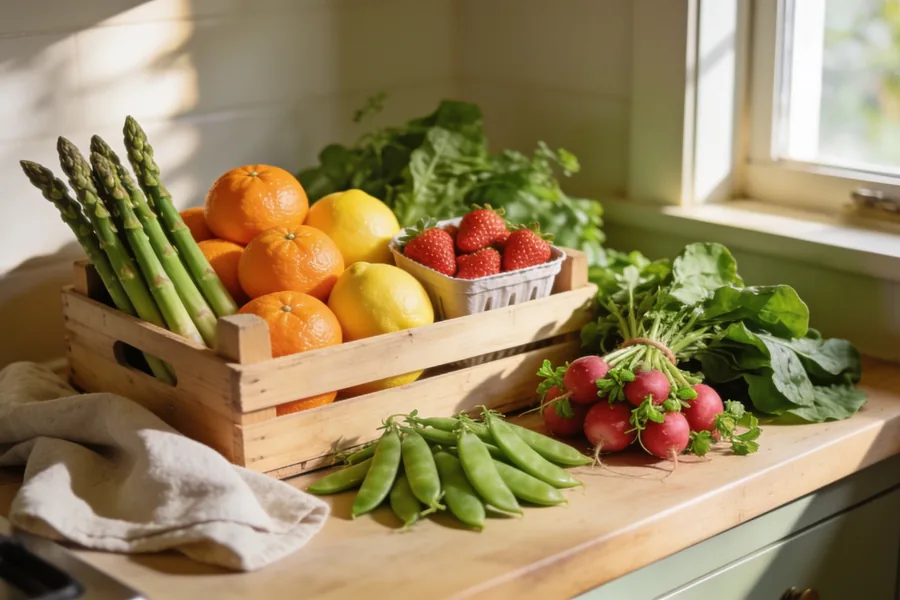
And as the weeks warm up, the first zucchini and capsicum start to appear. Be honest about those: early ones are more of a promise of summer than the main event, but they are welcome in a pan with the asparagus.
One honest note on the list as a whole. A few of these are end-of-winter stragglers still going strong rather than brand-new season arrivals, but that does not make them less worth buying. Good is good, whatever week it shows up.
How to tell without a chart
You do not need a seasonality chart to shop well. You need one rule of thumb.
If it is locally grown and on special, it is probably in season. That is not a coincidence. When a crop is at its peak there is plenty of it, and when there is plenty of it the price drops to move it. The reverse holds too. If something has been flown in from the other hemisphere, the price and the flavour both say so.
Beyond that, use your hands and ask questions. Fruit should smell of itself rather than of nothing, and a punnet of strawberries that does not smell like strawberries will not taste like them either. Asparagus should snap, not bend. Citrus should feel heavy for its size, because that weight is juice. And the person running the stall usually knows what arrived that morning, so it costs nothing to ask what is good today.
What to wait for
Part of trusting a “buy now” list is knowing what is not ready yet, so here is the patience part. Knowing what is coming also helps you plan, because the fruit you skip this week is the fruit that will be better next month.
Mangoes are not here yet. Cherries are not here yet. Stone fruit, the peaches, nectarines and plums, is not here yet. They arrive later in spring and into summer, and they are worth waiting for, because a mango picked early and shipped is a sad thing next to one that ripens in its own time.
The main berry flush is the same story. Strawberries are building now, but the full summer berries, the raspberries and blueberries at their peak, are still to come. Tomatoes and corn are summer food too, so the warm-weather cooking you are daydreaming about gets its turn soon enough.
None of that is a reason to be disappointed. It is a reason to eat the citrus and the asparagus while they are the ones in the spotlight. The one-pot dinners that got you through winter have earned a rest, though the habit is worth keeping. My six easy winter one-pot meals are the ones to reach for on the nights that are still cool, and most of them take a spring vegetable swap happily.
Simple ways to use the spring haul
You do not need recipes for any of this. You need a few ideas, because good produce does not want to be fussed over.
Asparagus on toast with a poached egg is a full meal, and asparagus in a frittata is the same idea for a crowd, using up whatever else is sitting in the crisper. Snow peas and sugar snaps are best raw or barely cooked, thrown into a salad or dropped into a hot pan for thirty seconds. Garden peas smashed onto toast with lemon and mint make a spring lunch that costs almost nothing, and a salad of broad beans, peas, radish and lemon is the season on one plate. If broad beans feel like too much effort on a weeknight, buy the pods anyway and shell them while you listen to something, because the beans freeze and the work is a one-off.
Citrus makes the dressing that ties it all together: lemon juice, olive oil and a little salt works on every green thing listed above. Strawberries belong with yoghurt at breakfast or straight out of the punnet, and the slightly imperfect ones are the ones to chop into a salad. Broad beans and peas also freeze well if you buy too many, which is the one bit of forward planning worth doing.
The whole point of buying in season is that it gets eaten, and that is where storage matters. If half of what you bring home still ends up limp at the back of the crisper, my guide to stopping fruit and vegetables from dying early in the fridge is the natural next step. The best season in the world does not help if the produce never makes it to the plate.
The market is the calendar
Eating with the season is the laziest way to eat well, and that is exactly why it works. You do not have to plan a menu around what you feel like cooking. You let the market decide, and the market is rarely wrong.
So next Saturday, wander past the citrus and the asparagus, pick up whatever is piled highest and priced lowest, and take it home to do very little to. The spring table sets itself. All you have to do is show up for it.
Sources:
- NSW Health – seasonal fruit and vegetable guide
- Foodtree – Australian seasonal produce guide
- Cancer Council – seasonality guide for buying fruit and vegetables