
Home & Garden
Gutter Guards: What They Stop, and What They Never Will

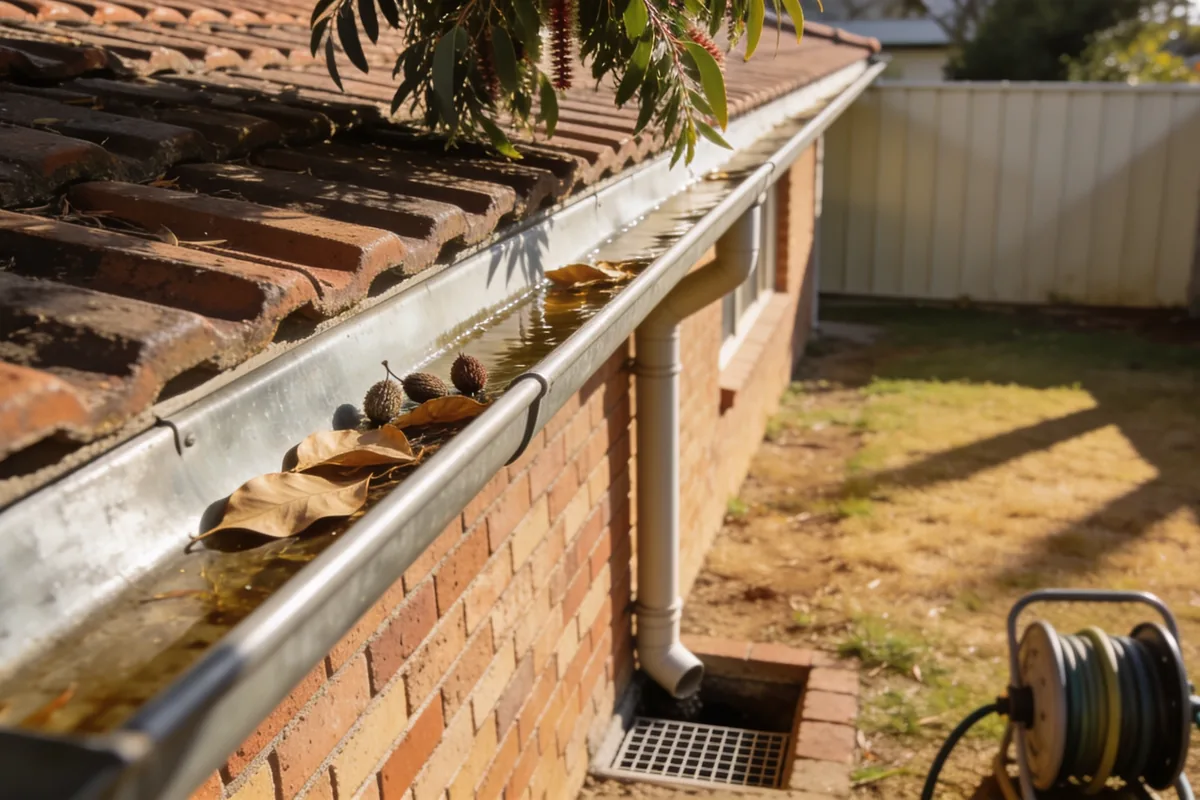
- A gutter guard is sold as the end of a job. It is really a change to it, and the question is whether that change is worth it on this roof.
- What lands on your roof, and what shape it is, decides most of it.
- A guard does not stop debris landing up there. It changes where the debris ends up and who deals with it.
- Before a guard helps, the water has to be able to leave: a gutter that does not fall to its outlet is a different problem.
- And yes, the gutters still need cleaning afterwards. Less often, and differently. Anyone who tells you otherwise is selling something.
If you have a quote for a gutter guard, or you are standing at the kerb looking at a gutter full of leaves, you are asking the right question in a crowded room. Search for the product and you will find a wall of them for sale, and underneath, a run of people asking whether any of them actually work. The answer starts with a smaller question. Work out what your roof sends into your gutters, and whether your gutters can already deal with it.
Is a gutter guard right for your roof?
Five questions. The answer at the end is the same one this article gives in prose, and it is not always "yes".
If this does not load: what lands on your roof, and what shape it is, decides most of it. Then ask whether your gutter falls to its outlet and where the water goes after that. If the gutter holds water, a guard is not the first thing to fix.
Answer all five questions and a plain answer will appear here.
General guidance only. Check the fall of your gutters, your outlets and your roof with somebody who works on roofs before you buy anything.
No products, brands, sizes or prices are named here. The answer is built from your answers alone.
What a guard is, and the four kinds
In plain terms, a guard is something placed between the gutter and whatever lands on the roof. Almost every product is one of four ideas.
The most common is a screen over the top of the gutter: a mesh or perforated sheet that lets water through and keeps debris out. Its weak point is built in, because you have added a surface to the roof and that surface can clog itself.
Then the curved or surface-tension cover: a solid profile with a rounded leading edge, relying on water to cling and curl in while leaves slide off the front. It works on flow, which means it depends on the flow behaving, and heavy rain on a steep roof is where flow gets interesting.
The third kind is an insert that sits inside the gutter, a foam or brush filler that lets water through and holds debris up top where it can dry.
And the fourth is not an add-on at all: a gutter profile shaped to shed debris by itself, relying on the roof to wash it clear.
Four answers to the same problem, and none of them is magic. Each one controls what reaches the channel, in its own way.
What a guard does not do
This is the honest half, and none of it makes guards useless. It describes a product with conditions, which is what a quote should tell you in the first place.
It does not stop debris landing on the roof. Whatever falls up there still has to come down somewhere, and if it does not make it into the gutter, it is sitting on your roof instead.
It does not remove the maintenance. It changes what gets cleaned, how often, and by whom. People who have lived with guards for a few years are nearly unanimous on this one: the thing that now needs clearing is often the guard.
It does not solve fine debris. Small leaves, needles and seed pods are the classic disappointment, because they either pass straight through a screen chosen for bigger leaves or lodge in it. Matching the guard to what your trees drop decides whether it works or becomes a second job.
It does not guarantee that the water goes in. A solid cover depends on water following the curve, and on a steep roof in a downpour, water can skip past the gutter entirely. People describe waterfalls against the wall, the opposite of the intended outcome.
And it does not fix a gutter that was already the problem. That one gets its own section below, because it is where the most money gets spent for the least return.
The three things that decide it
Three questions, and they do most of the work.
What lands on your roof, and what shape is it? Broad leaves off a deciduous tree behave nothing like fine needles or seed pods, and dry dust and grit off a garden are a third case again. It is the question people regret not being asked before they buy.
What does your roof and your gutter do, above and below? How much roof drains into the run you are covering, how steep it is, how long the gutter is, whether it is an ordinary gutter or a box gutter, and where the water goes once it is in. A guard on a gutter that does not fall to its outlet is a lid on a pond, and we will come back to that next.
And who cleans it now? The honest comparison was never guard against nothing. It is guard against the arrangement you already have. A household that pays somebody twice a year is making a decision about money. A household that has not been up a ladder in four years is making a decision about something else entirely.
Answer those three, and the useful guard, if there is one, has usually chosen itself.
What has to be true before it helps
This is where the money gets saved, and it is the part almost nobody publishes.
The gutter has to fall to the outlet. The Australian Government’s own rainwater guidance is to make sure all gutters fall towards their outlets and to use outlets that fit to the underside of the gutter, because water has to be able to leave. If water sits in the gutter after rain, you do not have a leaf problem. You have a drainage problem, and a guard will sit on top of it without touching it.
The water has to have somewhere to go. A downpipe taking more than it can handle, a rain head packed with debris, a pit that fills: every one of those sits downstream of the guard and none is fixed by it. It is the same story the site’s Signs your stormwater drains are blocked: don’t ignore these red flags tells from the other end.
The roof itself has to be part of the plan. Overhanging vegetation is named in that same guidance as something to deal with, and a guard is not an answer to a tree that stands over the roof, dropping into it all autumn.
And the water has to be wanted or sent away, because those are two different projects. If you capture rainwater, the guidance treats the whole thing as a system: the roof and gutters, the collection system including downpipes, leaf-shedding rain heads and first flush diverters, the tank, and the supply. A leaf screen belongs in that system as one component rather than as an accessory, and what the water is for changes how good it needs to be. The site’s Is storing rainwater a smart move? What you need to know covers that side of the picture. And if the water ends up at a tap, the guidance gives its own reasons to get advice about what it fell on first, naming lead flashing, asbestos sheeting and old paint.
The honest summary of all this: a guard is the third or fourth thing to fix, not the first. Fall, outlet, downstream flow, then the guard. In that order, it earns its place. Out of that order, it is an expensive lid.
The ongoing job, and what makes a guard fail
So, do you still have to clean the gutters? Yes. Less often, and differently.
What the maintenance becomes is this. You clear the top surface of the guard rather than the channel underneath, and the outlets and the rain head, because that is where whatever gets through ends up. And you do a full run after a big storm and at the end of autumn, because those are the two moments the roof delivers its load.
And these are the four ways a guard fails, from the people who have lived with one. The wrong type for the debris: fine material and a screen chosen for leaf shape. The wrong profile for the roof: a cover that cannot handle the flow on a steep run. Fixings and set-out that do not suit the gutter, so the guard lifts or holds water against the fascia. And one more: a guard fitted over a gutter that was already flat, blocked or rusted underneath.
If a guard has to be lifted off to clean what is under it, the job has not shrunk. It has grown a step.
When it is genuinely worth it
The other side of the ledger, because a guard is not a bad idea. It is a conditional one.
It is worth it where the debris suits the guard: broad leaves, an ordinary pitched roof, a gutter with a proper fall and a clean outlet. That is the combination the product was designed around, and in that combination it does what the brochure says.
It is worth it where the alternative is a ladder. A two-storey house, a steep roof, or a household where getting up there is not safe: for those homes the point of a guard is not removing the job, it is reducing how often somebody does something risky. That is a good reason to buy one, and it has nothing to do with cleanliness.
It is worth it where the water is being captured, since the guidance treats a screen as part of a working collection system rather than as an extra.
And it is worth paying for somebody who knows the roof rather than the cheapest kit on a shelf, which is the same case the site’s Roofing supplies: your complete guide to quality, value and long-lasting protection makes about materials generally. Some of it is also just where you buy: a Truganina roofing supplier that stocks rainwater goods and flashing is the kind of counter where the fall, the outlet and the screen can be worked through in one conversation.
On the other side, one honest note. On a single-storey house with a clean run, a safe way up, and not much landing on the roof, the money is better spent on a ladder and an afternoon. There is no shame in that answer.
The question that decides it
The whole thing, compressed, in the order the decision happens.
What lands on your roof, and what shape is it. Whether your gutter empties properly, with no water sitting in it after rain. Where the water goes after the gutter, and whether that path is clear. Who cleans it now, and how safely they can get up there. And whether the water is captured or sent away, because that changes what the screen is for.
No guard is going to end the job. The ones worth buying make the job smaller, on a roof that suits them, and once you know which roof you have, that is enough to make the call.
Sources consulted: Your Home rainwater guidance.


- Mould is not a stain problem. It is a water problem, and the water is still there.
- The state health guidance puts one rule first: control the moisture, or it comes back. Cleaning is the symptom, not the cure.
- Where it shows tells you more than how much of it there is, and some places are telling you about the building rather than the surface.
- Bleach changes how a surface looks. It does not change why it is wet, which is why the same corner is back in six weeks.
- And there is a point where this stops being a cleaning job at all, which is the most useful thing anybody can tell you.
You cleaned it. You cleaned it properly, with the window open and a decent cloth, and for a while the corner looked fixed. Now it is back, and if this is the third spring in a row, you are probably wondering what you are doing wrong. Here is the answer, and it is a kind one: nothing. You have been treating the symptom instead of the water. Once you find the water, the cleaning stops being a seasonal chore, and finding it is a job you can start today.
Is this a cleaning job, a habit, or a building problem?
Five questions, one plain answer. The answer is the same one this article gives in prose, and it is not always "clean it again".
If this does not load: mould comes back when water is still arriving. Find the water first, whether that is a drip, a leak, or a room that cannot dry. If it is a leak, get a plumber. If the area is large or it keeps regrowing, get help looking at the building.
Answer all five questions and a plain answer will appear here.
General information, not health advice and not legal advice. Where the moisture is coming from is a question about your building. If it is a leak, get a plumber. If it is large or it keeps returning, get professional help.
No products, brands or prices are named here. Follow the label on anything you use, and never mix cleaning products.
The one rule, and it is the government’s first step
Start with the sentence the Victorian health authorities put first, because it is the whole article: the best way to control mould is to control moisture, so the sources of moisture need to be found and removed or controlled, or the problem is likely to reoccur.
Then the second sentence, which is just as useful: mould will only grow in damp, unventilated rooms. Two conditions, and only one of them can be fixed with a cloth. You cannot clean a room into being dry. You can only make it dry, and the room will do the rest.
That reframes the whole situation. A household that has cleaned the same corner three winters running has not failed at cleaning. It has been doing the right job on the wrong problem, and it has been doing it in a climate that is very good at the wrong problem. A Melbourne winter is a closed-up season: the windows stay shut, the heating goes on, the washing dries inside, and every room gets a little more water in the air than it can get rid of. That is the machine that keeps feeding the corner, which is the point the site’s The science behind Melbourne’s unpredictable climate: what’s really going on? makes from the weather side.
Where the water actually comes from
Walk your own house with this list in your head, because almost every source is ordinary and none of them is exotic.
The bathroom is first, and it is the wettest room in the house. A hot shower puts a surprising amount of water into the air, and the fix is usually airflow rather than repair: a room that gets shut up straight after a shower keeps every drop of that steam, and it condenses on the first cool surface it finds.
And cool surfaces are where you will see it. Windows, the frames, the reveals at the sides of the glass, external wall corners, the back of a wardrobe standing against an outside wall, the wall behind a bed headboard. Water in the air goes to the coldest place it can, which is why the same corner of the same room shows up every year.
The roof and the plumbing are the two the guidance names explicitly, including damaged pipes and drains, and the instruction that comes with them is short: call a plumber. That is not a cleaning matter and no amount of scrubbing will settle it.
The laundry and the drying are the quiet one. A load of washing dried indoors puts water into the room that then gets closed up, and a household that does it every week is running a small humidifier on purpose.
And then everything small that puts water into one room’s air. The kettle boiled under a low cupboard. The aquarium. The plants. The slow drip under the kitchen sink that nobody has dealt with, quietly adding to the tally every day.
The reader is looking for one combination: the room that is wet and shut. Wet and open is fine. Dry and shut is fine. Wet and shut is where mould lives.
Where it shows, and what each place is telling you
Where it turns up is more informative than how much of it there is, so read the spots like a clue, not a stain.
The shower screen and the silicone line. That reading is simple: moisture sitting on a surface that never gets to dry, because the screen faces the water and the bathroom faces the dark. The answer is airflow and wiping it down, not harder scrubbing.
Grout, and the wall behind the shower. When it keeps returning here, the water may be getting behind the surface rather than sitting on it, which is a different problem with a different fix.
Windows, frames and reveals. That is condensation, which is about the air in the room rather than the window itself, so the cure lives in ventilation and heating rather than in a spray bottle.
The ceiling, especially in the coldest room, and the ceiling of the room under a bathroom. Look up before you look anywhere else, because a ceiling is either a cold surface or a sign that water is coming from above.
The back of the wardrobe, the wall behind a bed, the base of a mattress. An outside wall with no air moving past it is a condensation machine, and furniture pressed tight against it gives the moisture nowhere to go.
Boxes, shoes, leather and paper in a cupboard or a garage. Slow, long-running damp that you may never have seen, and one that tends to be discovered at the moment something valuable is ruined.
And one place people miss because it is hidden in plain sight: the panel or the void around a bath or a shower recess. If there is a way in, it is worth a look with a torch.
What to clean, what to throw out, and what not to do
The method, kept simple on purpose, because none of it needs a special product.
Hard surfaces first. Household detergent or white vinegar is often enough. Use a microfibre cloth, and as you work, rinse the cloth in a separate container of clean water rather than rinsing it under the tap that the mould is sitting next to. That one habit is the difference between removing it and moving it around. Give the cleaner a moment to work, avoid getting the area too wet, and dry it afterwards, because a cleaned surface that stays damp is a surface that starts the clock again.
Soft things next. Clothing, bedding and soft fabric items, including soft toys, can go through a washing machine on a hot cycle. Wash the cleaning cloths separately. A couple of honest caveats from the guidance: bedding that has been mouldy for weeks may not be salvageable, and soft furnishings that cannot be machine washed need to be cleaned professionally or thrown out. There is no third option that a cloth will provide.
And the things that are not worth cleaning at all. The guidance names cardboard boxes and mattresses, and it is right. Materials that hold water in their core never really come clean.
Then the safety line, which is the one that matters most: never mix bleach with ammonia, acids or other cleaners, because doing so can release hazardous fumes. That is the government’s own warning, and the sensible version of it is simple: do not mix cleaning products at all.
And the honest verdict on bleach itself, kept as careful as it needs to be: bleach changes how a surface looks. It does not change why it is wet. That is why the same corner is back in six weeks, and why a bottle of anything will not do the work that a dry room does. The site’s Boost productivity and mood with a deep cleaned space shows what a proper clean covers when the room is ready for it. First, make the room ready.
When it is not a cleaning job at all
Here is the section that will save some readers real money, and it is the part no product page will ever tell you.
Three situations stop being about cleaning. The first is scale: if it covers a large area, or it keeps regrowing after you have cleaned it, the guidance’s own instruction is to consult a mould remediation professional. That is not a sales line from anyone. It is the point where the surface is no longer the story.
The second is a leak. If there is plumbing or roofing water getting in, the instruction is to call a plumber, full stop. Water that keeps arriving will keep bringing the mould with it, and the fastest clean in the world cannot outrun a drip.
The third is the building’s own fabric: a wall with no visible cause, a ceiling that comes back, a cupboard that is damp even in summer. Those are questions about the structure of the house, and the state health guidance points to two places that can help, the environmental health section of your local council and an occupational hygienist. Both exist, both are worth knowing about, and which one fits your situation is a question to ask rather than guess.
One line worth keeping, because it cuts through all of it: a cleaner who says “this one is not mine” is worth listening to. That is the standard a residential and commercial cleaning company working across Melbourne’s west works to, and it is the right instinct for a household too.
The four habits that stop it coming back
None of this is difficult. It is just boring, which is why the same bathroom gets cleaned every spring.
Airflow first, because it does most of the work. The guidance’s simplest drying advice is to open doors and windows and air the house properly, and the practical version for a bathroom is the fan on and the door open after a shower, rather than the fan on and the door shut.
Dryness second. Wipe or squeegee the wet surfaces, hang the towels where they can dry, and keep the washing out of rooms that then get closed up.
Furniture placement third. Nothing tight against an outside wall. A gap behind the wardrobe, a gap behind the bed, air under the mattress. You are not rearranging the house, you are giving the air a route.
And the water itself, fourth, which is the one that decides whether next spring is the same story. The dripping tap, the leaking gutter, the cracked tile, the seal around the bath. Fix the water and the mould loses its supply.
Before you clean it again
The compressed version, for the cupboard door where the cloth lives.
Find the water before you buy anything. Air the room and dry the surfaces. Clean hard surfaces with detergent or white vinegar and a cloth you rinse in clean water as you go. Wash what can be washed hot, throw out what cannot be cleaned, and never mix bleach with other cleaners. Write down where it came back, because the pattern is the diagnosis. And if it is large, or it keeps returning, stop treating it as a cleaning problem and get somebody to look at the moisture itself.
The mould is what the water did. The water is the only thing worth chasing.
Sources consulted: Victorian Government Better Health Channel information on mould removal at home.

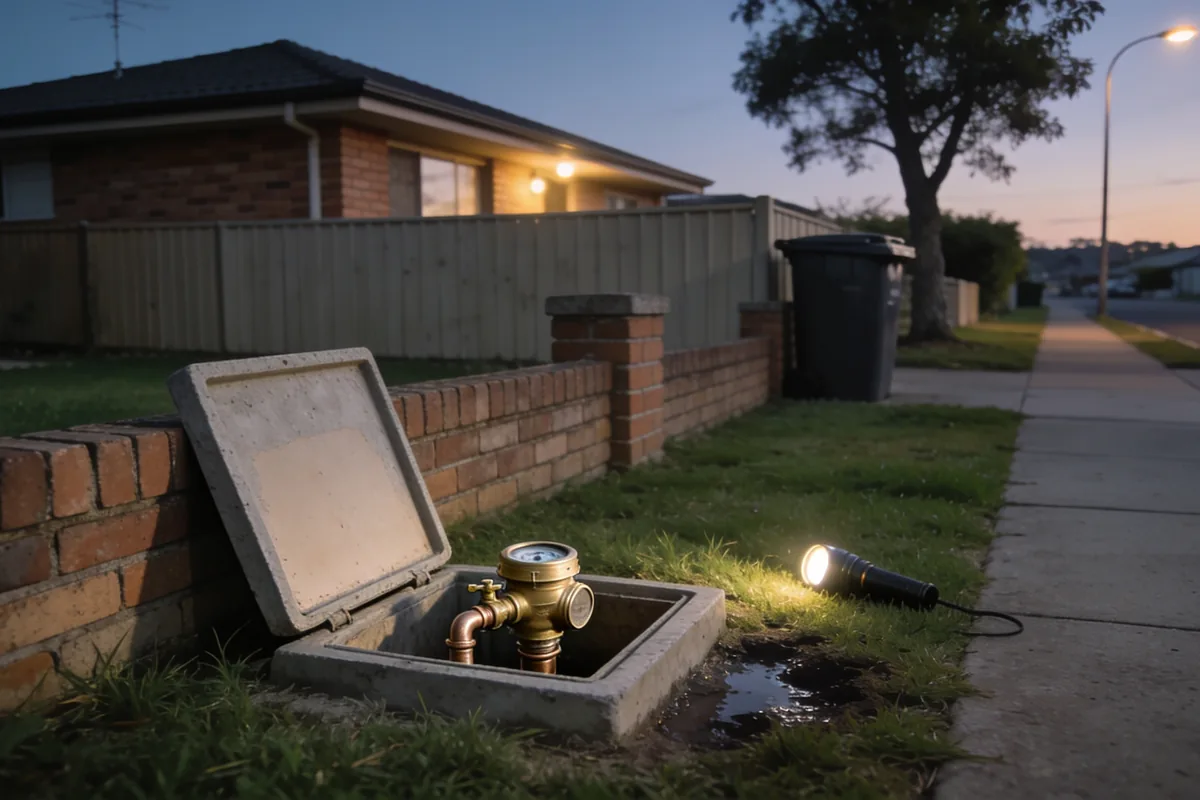
- Water that escapes between the meter and the tap costs money every day, and it can do it for months before anything shows.
- One test answers the first question, and it takes an evening and a morning to run.
- The toilet is the first place to look rather than the last, and the check for it takes about ten minutes.
- Four places account for most of it, and only one of them usually needs somebody else.
- And there is a point where doing more yourself stops being sensible, which this article is honest about.
If your bill has moved and nothing in the house looks different, or you can hear water moving somewhere at two in the morning when everything is turned off, you are in a very common and very unpopular situation. The good news is that the first question, whether water is escaping at all, is one a household can answer for itself with ten minutes and a torch. Most household leaks announce themselves on the bill, and the bill is the last place anyone thinks to look. Let us start with the test, because everything else follows from it.
The test, in the order that works
This is a water utility’s own published procedure, and it works because the meter does not care what you believe. It just counts.
Pick a time when nothing is going to use water. Overnight is the suggestion, and it is a good one, because it removes the car washing, the dishwasher and the long showers from the picture. The longer the gap between the two readings, the more a slow leak stands out against the ordinary background noise of a household using water.
Turn everything off. Every tap, inside and out, including the garden tap and the one behind the shed that you have not thought about since summer. Then let the toilets and any tanks fill completely before you start, because a cistern that is still filling will fool the test, and topping up takes longer than people expect.
Now read the meter, and read both sets of digits, the black ones and the red ones. Write them down or take a photo, because this is the step people get vague about. Then leave everything off overnight and read it again first thing in the morning, before anybody showers.
If the second reading is higher than the first, water has passed through the meter while the house was asleep. That is not a theory about your property or a reason to worry yet. It is arithmetic, and it means the search can be narrowed to a short list. And one honest note before the list: leaks can run underground for months before anything shows on the surface, which is why the meter is the instrument here and the bill is only the evidence.
The toilet first, every time
Start where the water most often is. The cistern is the one place in a house where water is held above a drain and released by a mechanism, and a valve that no longer seals properly will run a thin trickle down the back of the bowl where nobody ever looks. It is the most common cause of a mysteriously moving bill, and it is also the cheapest thing to rule in or out, which is why it gets its own section rather than a line in a list.
The check is a piece of paper. Put it at the back of the toilet bowl at least ten minutes after a flush. If it comes back wet, the toilet is leaking, and you have your answer without a plumber, a tool or a bill.
Two more checks worth doing the same evening, because this is the utility’s own method and it costs nothing. With every tap off, put your ear to a water pipe and listen for running water. And walk the whole yard looking for a patch that is damper, greener or springier than the rest of the lawn. A greener strip beside a buried line is often the first visible sign of water that has been escaping for weeks.
One thing worth knowing, and it is why the toilet goes first: a toilet losing water can do it continuously, all day, which is why a bill moves when nothing about the household’s habits has changed. It is also the one leak most people can hear for themselves if the house is quiet.
The other three places
After the toilet, work outward. Three places cover most of what is left.
A garden tap, or a hose fitting left weeping. The simplest of the lot, and the one people forget because it is outside and does not drip where anyone stands. Check the tap itself, the fitting, and any join you can see. A drip at the spout is visible and easy to put right; water escaping below ground at the fitting shows up as the damp patch instead.
An appliance. The washing machine and the dishwasher are the obvious two, but the fridge’s water line, if it has one, is easy to miss, and a hot water system can pass water continuously through a pressure-relief valve straight into a drain, without a single drop appearing on a floor. If you know the system is at the end of its life, the site’s From leaks to no heat: when to book hot water repairs covers that territory properly, and this article will leave it there.
And the pipe between the meter and the house. This is the one that matters most, because it is the one nobody can see. If the meter is still moving with everything off, and the toilets and taps have been ruled out, then the water may be escaping from an underground pipe, which is the utility’s own published conclusion at that point. Where does it go? Often a damp patch, sometimes a greener strip of lawn, and sometimes nowhere you can see for months.
What the test does not tell you
Now the honest part, because a method that oversold itself would be worse than no method at all.
The meter test tells you whether water is escaping. It does not tell you where. It will miss a slow leak inside the house that does not run all the time, and it cannot see a leak that only happens when one particular appliance is running. A leak that only shows while the dishwasher is on was never going to announce itself overnight, so it is worth repeating the check on a day the household is using everything as normal. And a meter that did not move overnight does not prove there is no leak. It proves that nothing was leaking while the house was asleep, which is a narrower and less comforting statement.
There are two cases where the reader will still be stuck after all of this. The leak that only appears under pressure, when a system is running and the line is full. And the noise that nobody can trace, which is its own kind of maddening. Both of those are the reason the second half of this article exists. The point of the test was never to make you do the plumber’s job. It was to give the plumber something to work with, and to stop the search from starting from nothing.
When it stops being a DIY job
Here is where the article draws its line, and it is a firm one.
Call somebody if you can see water coming out of a wall, a ceiling, a floor or a cabinet. At that point the damage is already happening, and the question is not where the leak is, it is who can get to it. Call somebody if the meter keeps turning once the house has been ruled out, because the utility’s own instruction at that point is to bring in a licensed plumber. And call somebody for anything that needs a pipe opened, a fitting changed or a wall cut, because that is their work, not yours.
The one safety line that is not negotiable, and it is the sentence to remember even if you forget the rest: do not use a tool on a pipe you cannot isolate. Water you cannot shut off is water that will find you, and no saved call-out is worth that afternoon.
When you ring, have these ready. The two meter readings and the times you took them, because the times turn two numbers into a story. What you have already checked, and what you found. How long the problem has been going on, and whether it is the bill that moved or the water you can see. A list like that turns the visit into a short job. And while you wait, the site’s Top signs your home pipes need repairs is the symptom list worth checking yourself against, and its Think you don’t need a plumber? Here’s what you might be overlooking covers the other jobs that quietly wait for a better moment.
Leak detection exists as a service because finding a buried leak is its own job, and it is worth asking, when you book, whether the person doing the work is registered for it. No fuss, just a question, the same way you would ask anyone working on your home. It is also the question a Werribee plumber who does leak detection across Melbourne’s west expects to hear, and the answer should be easy to give.
Where a leak is your problem and where it is not
This section matters because it is the reason the ten minutes are worth spending.
A water utility’s own published position is that a leak on the property side of the meter is the customer’s responsibility, including the water that was lost. Read that carefully, because it says two things: the repair is yours to arrange, and so is the charge for every litre that escaped while you were deciding. An unrepaired leak is a repair bill and a running cost at the same time, and the running cost does not stop. That is the sentence worth re-reading, because it is why the whole article pushes you to look tonight rather than at the end of the month.
What sits on the other side of the meter, who maintains it and who to ring about it are things that differ from area to area and property to property. So the correct move there is not to guess. Ring the water corporation for your property and ask, and they will tell you where their responsibility starts and yours begins. That answer, from them, will be better than anything this article could promise, because it depends on your meter, your boundary and your street.
The ten minutes that answer most of it
Here is the whole thing, short enough to read standing at the fence.
Turn everything off. Let the cisterns fill. Read both sets of digits and write them down, and keep them somewhere you will find them again, because a plumber will ask for them. Read again in the morning before anyone showers, and compare. Then check the toilet with a piece of paper, listen at a pipe, and walk the yard looking for the patch that does not match the rest. If the toilet is the answer, you have saved yourself a call. If the meter is still moving after all of that, you now have everything a plumber needs to start.
The bill is the last place anyone looks, and the meter is the first place that answers. Ten minutes with a torch is cheaper than another quarter of guessing.
Sources consulted: published water utility guidance on checking for leaks at home.
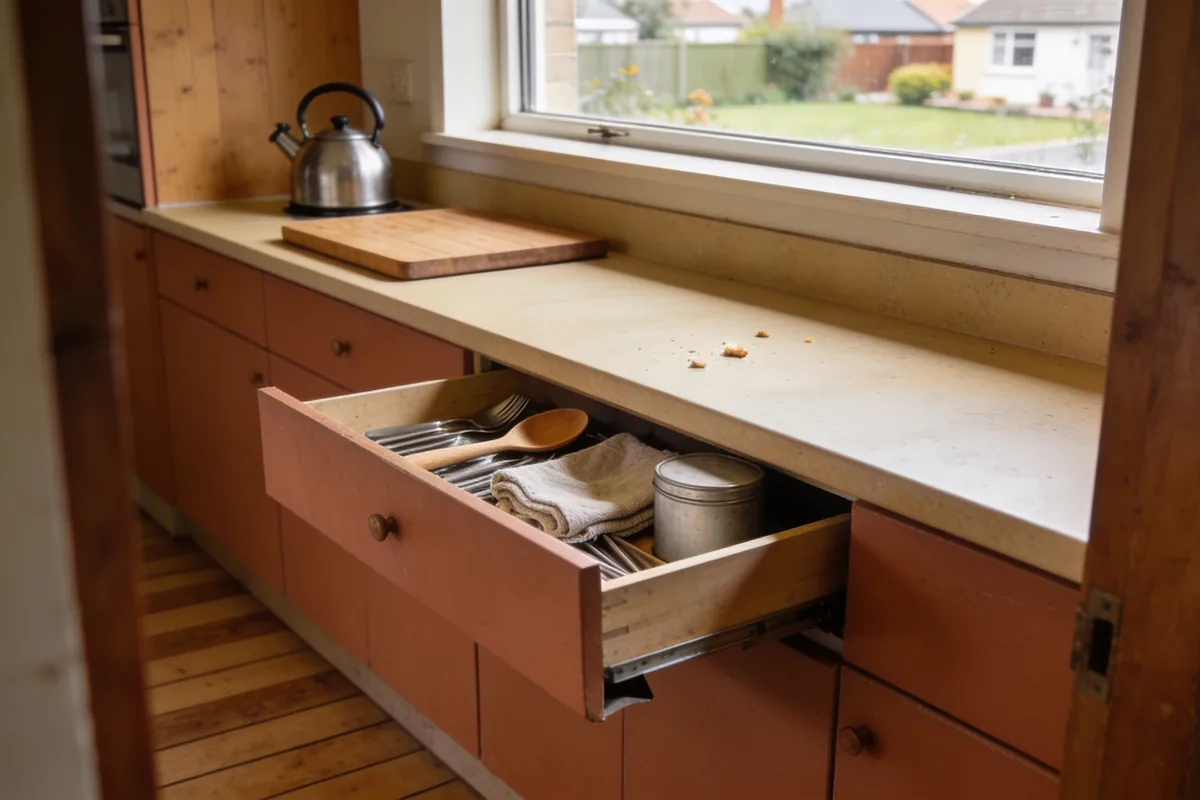
- A drawer is three things: the box, the front panel, and the runner that lets the box slide. Most of the trouble is in the third one.
- Most of what people blame on the drawer is alignment or load, and both are fixable without buying anything.
- The piece that came off in your hand is not always a broken runner. Look at what it is before you order.
- Two measurements and one count are all you need before you buy a replacement. Write them down first.
- And the honest line up front: plenty of these are a ten-minute fix, and one of them is genuinely a new box.
Something has gone wrong with this drawer, and you cannot tell whether it is a five-minute job or a new kitchen. If you are standing in front of it with a small piece of plastic in your hand, take a breath. The drawer itself is usually innocent, and it is not usually the thing that broke. Let us work out what actually happened before anybody buys anything.
What is actually under the drawer
Three parts, and it helps to know which is which before you start wiggling things.
The box is the container, the sides and base that hold the cutlery. The front panel is the face you pull on, and it carries nothing structural: its job is to look good and give you somewhere to put a handle. The runner, which plenty of people call a slider, is the mechanism that lets the box travel in and out. Most of what goes wrong lives there.
A runner is a two-part system. One part is fixed to the inside of the cabinet, one is fixed to the side or the underside of the box, and the two slide against each other on rollers or on ball bearings. Older Australian kitchens almost always have side-mount runners, screwed to the cabinet side and the outside of the box. Newer kitchens tend to use under-mount runners, which hide beneath the box.
Worth knowing before you blame the mechanism: the runner carries the whole load, and the load is heavier than it looks. A drawer full of cutlery, tools or tinned food speeds up everything below. If the drawer has been groaning for a while, the weight has been part of the story.
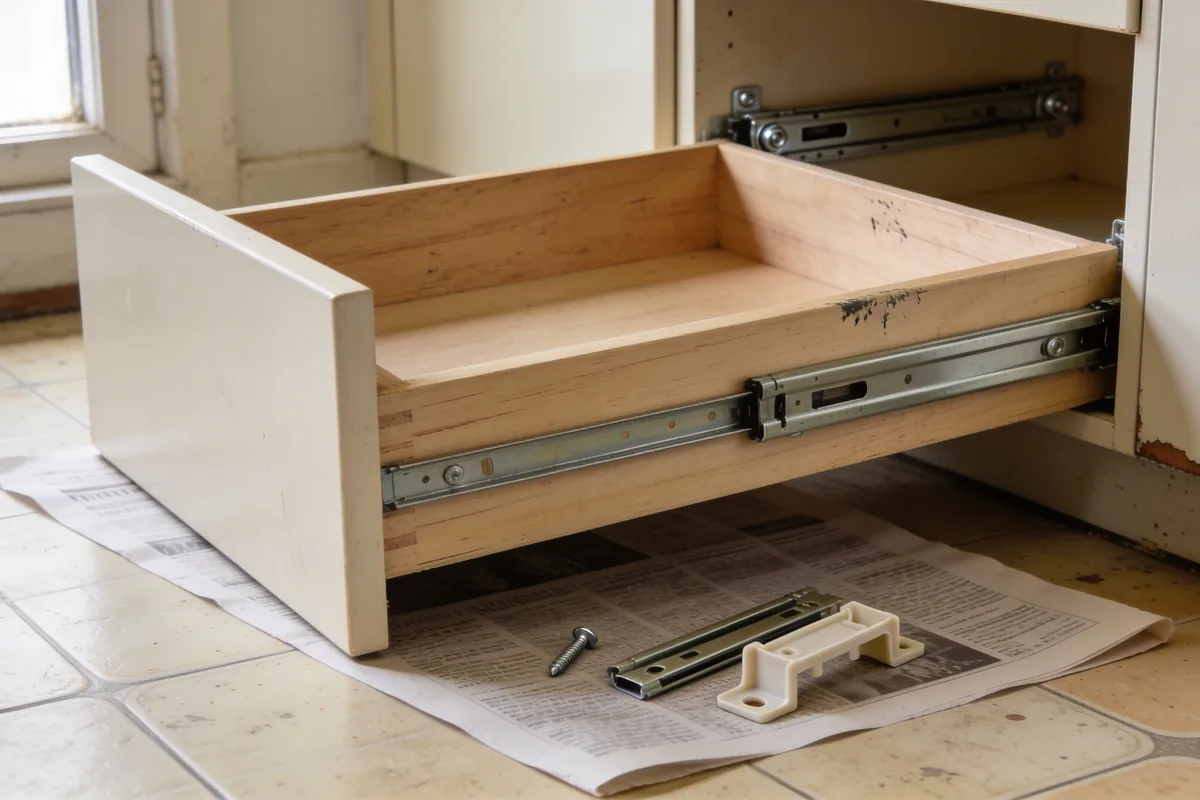
“The drawer catches and drops at one end”
The most common complaint in the whole kitchen, and almost never a lost part.
What has usually happened is that the drawer has come out of alignment. One runner is sitting a little higher, lower or further back than its partner, so the box twists as it travels, and one corner drops. The drawer did not lose anything. It just stopped agreeing with itself.
Check it like this. Pull the drawer right out. Some runners have a release lever or tab, usually on both sides, and squeezing them frees the box. Not every runner has one, in which case the box simply lifts out. With the box out, look at three things. Are both sides attached at the same height? Is one bracket bent or sprung? Has one side of the cabinet’s runner dropped out of its screw holes?
Now the fixes, in the order to try them.
Reseat the box first. Drop it back in and give it a firm push and a wiggle. A surprising number of drawers were never fully on, and behave perfectly once they are.
Tighten or reset the brackets next. If one side has worked loose, snug it up and try again. Small adjustments move a drawer more than you would think.
If a fixing screw has stripped its hole, the hole is the problem, and a bigger screw is not the answer. A fixing that has pulled out needs repair rather than force, and wood filler or a glued matchstick in the hole will hold a screw again.
Only replace the runners if the mechanism itself is worn, cracked or missing pieces. And if the front panel is the thing that looks lopsided, come back to this section, because the front is almost never the cause. It is just where the misalignment shows.
“The drawer is stiff, grindy or noisy”
Now the drawer that fights back. Four causes, usually in this order.
The runner is worn. Rollers flatten, a track bends, and ball bearings pick up grit and start to growl. A runner that has done decades of service has done its job, and replacing the pair is a legitimate answer, not a defeat.
The runner is overloaded. Every runner has a load rating, and it is a real property of the part rather than a marketing line. It is printed on the packaging of the replacement, so read it before you buy, and compare it with what the drawer holds day to day. Heavy stuff in the bottom drawer, cutlery in the middle: the load is not evenly spread, and the worst drawer wears fastest.
Something is caught. A cutlery tray can sit proud of the box, a screw can back out inside the cabinet, and sawdust or flour in the track will grind like sandpaper. Pull the drawer out and run your hand along the track. You will usually find the culprit in seconds.
And the last one, which is the unhappy one: the cabinet is out of square. An older carcass that has moved cannot be fixed with parts, and no new runner on the shelf will make it true again. Straighten what you can and accept that this drawer will never be the smooth one.
“The drawer slams, or will not stay closed”
The most straightforward symptom, with the most straightforward answer.
Soft close is a damper built into the runner that catches the last part of the travel and eases the drawer home. It is a property of the runner rather than of the drawer, which means it is replaced rather than repaired. There are add-on catches and dampers for some runners, and some drawers come with the feature built in.
Two other causes are worth a look. An uneven cabinet can leave the drawer running slightly downhill, so it will not hold position on its own, and a missing or worn latch is often the actual part to replace on an older kitchen. Check both first.
One decision point while you are here. If you are replacing the runners anyway, that is the moment soft close is cheapest to add, because it comes down to which part you carry home. If the runners are fine, it is not a job worth doing for its own sake.
And if what you secretly want is a kitchen that looks different rather than a drawer that behaves, that is a different job with its own rules, and the site’s The Finishing Touch That Defines Your Space: Choosing the Right Cabinet Hardware is the right place to start.
The part that came off in your hand
This section saves people money, because not every failure is a runner and not every loose piece is broken.
Three things fall off, and they mean three different things.
A plastic clip or bumper. This is usually a stop or a retainer, and it can often go straight back on. If it clips on, clip it on. Look at where it fell from before you look at a catalogue.
A bracket or a bracket tooth that has snapped. The bracket ties the runner to the box or the cabinet, and once the bracket is broken the assembly is finished. Order the pair.
A roller, or a strip of ball bearings that has come away from its track. Same verdict: the runner is finished, and the pair gets replaced.
Then the harder case, and this one deserves a moment. If the corners of the box are eroded, or the box has swollen and no longer sits square, the runner is not the problem and no runner will fix it. Chipboard swells when it gets wet, and a kitchen near a dishwasher or a leaky tap will do it slowly, a little at a time. When that happens, you have three options: a new box, moving the runner to sound material, or accepting that this drawer is now the shallow one for tea towels. All three are better than spending money on parts that cannot help.
The two numbers to write down
Before you buy anything, take two measurements and one count. That is the whole shopping list.
Measure the length of the runner, along the part. Then measure the depth it has to live in, inside the cabinet, from the front frame to the back panel. These are not the same number, and buying by the wrong one is the classic second trip to the shop. Write both down.
Then the count that is not a measurement: the sides. Runners are a matched pair, and both sides are replaced together, because a new runner against an old one is a drawer that still limps. If yours is an older cabinet, the new part’s fixing holes will not line up with the old ones. That is normal, and it is a drill problem rather than a wrong-part problem.
Take the two numbers to the counter, or the search box, and you have turned a guess into a purchase. It is the sort of question a Melbourne cabinet hardware supplier with a trade counter and an online store answers every day, and watch how carefully they ask the same questions back to you.
What to check before you buy anything
The compressed version, so you can close the tab and go and look.
Which of the three symptoms is it: catching and dropping, stiff and grindy, or slamming? Is the box itself sound, or has it swelled and gone soft? Is the front panel the thing that is lopsided, and if so, have you checked the alignment first? The front is usually innocent. Are the fixings still in sound material, or has one pulled out and left a hole that needs repairing? And have you written down the runner length and the cabinet depth?
That is the check. Most drawers that have annoyed somebody for a year are one pair of parts and twenty minutes of work. And if the answer turns out to be a new box, you have discovered that for the price of nothing, with the drawer still on the bench and the kettle still warm.
Sources consulted: cabinet runner technical documentation from a hardware manufacturer; trade supplier fitting guide.

Gutter Guards: What They Stop, and What They Never Will

The First Aid Kit You Already Own (and What Has Quietly Gone Off in It)

Car Air Conditioning in a Hot Town: What “Not Cold” Is Actually Telling You

The Science Behind Melbourne’s Unpredictable Climate: What’s Really Going On?

Plastic-Free Coffee Makers: Myth or Must-Have?

Zero Waste Toothpaste: What’s Worth the Switch and What to Look For
-
 Melbourne1 year ago
The Science Behind Melbourne’s Unpredictable Climate: What’s Really Going On?
-
Eco Friendly4 years ago
Plastic-Free Coffee Makers: Myth or Must-Have?
-
Eco Friendly4 years ago
Zero Waste Toothpaste: What’s Worth the Switch and What to Look For
-

 Automotive1 year ago
Wet Weather Tyres in Australia: What to Look For and When to Replace Them
-
 Eco Friendly4 years ago
Plastic Free Packaging: How to Keep Your Business Plastic Free
-
 Eco Friendly4 years ago
How Aussie Businesses Can Reduce Plastic Pollution
-

 Home & Garden1 year ago
Boost Productivity and Mood with a Deep Cleaned Space
-

 Food1 year ago
The 9 Best Foods and Drinks to Enjoy Before Bed for Restful Sleep