
Travel
Nobody Plans the Ride Home: Wedding Transport on the Mornington Peninsula

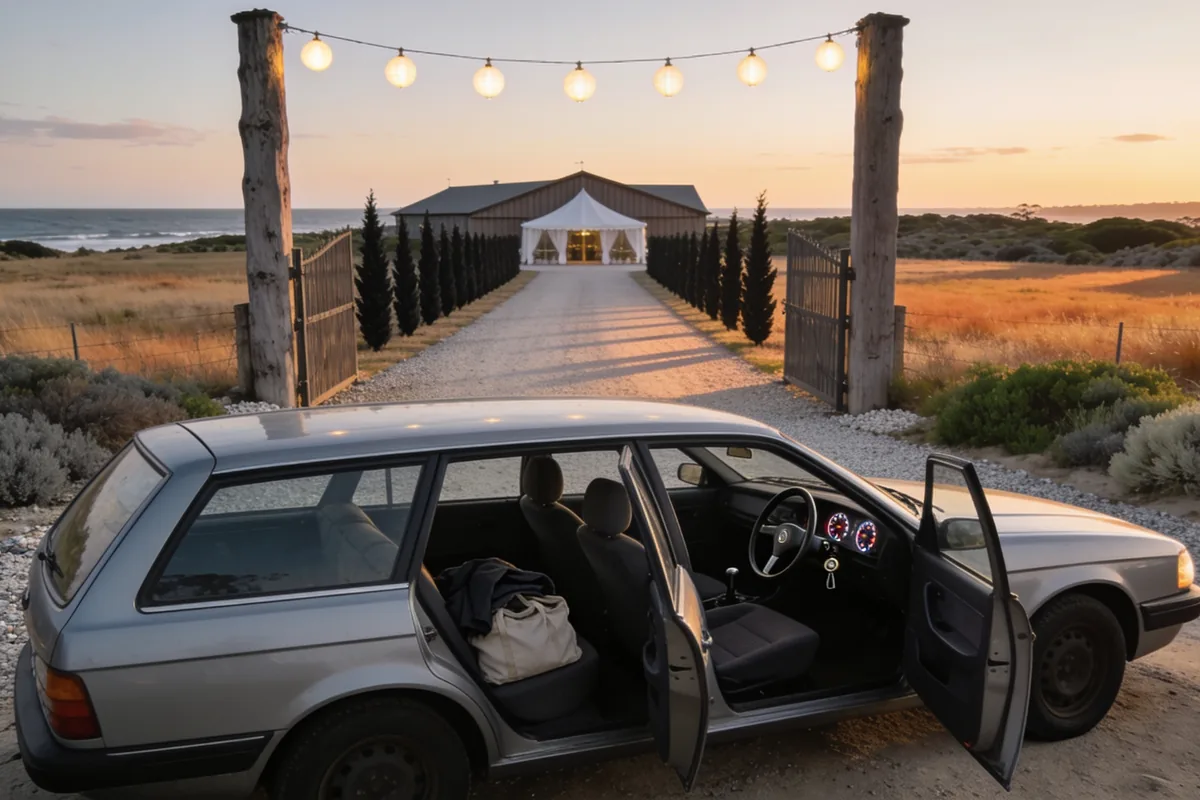
- On a wedding day, four different sets of people are travelling, and they are almost never travelling together.
- Two times cannot move: the ceremony, and the hour the music stops. Everything else bends around them.
- The couple’s car is the one part of the day that is already solved, and it is the only part anyone sells.
- The guests are the hard half, especially at a venue at the end of a gravel driveway with no rank and no street lights.
- And the ride home is the booking nobody makes, which is exactly why it is the one worth sorting before the invitations go out.
Somewhere in the middle of planning a wedding, usually around the point where the guest list is final and the venue is locked in, somebody looks up and realises that eighty people are expected to get themselves to a place most of them have never been, and home again, on a Saturday night. If that somebody is you, take a breath. The couple’s car is already arranged, because that is the part everyone thinks of. Everything else is the open half of the question, and it comes down to two times, four groups of people and the last hundred metres of the driveway.
Four groups of travellers, and only one of them is the couple
A wedding day does not move a crowd. It moves four small groups going to the same place, and each has a different problem.
The couple is the first group, and theirs is the easy one. The arrival is the part of a wedding that is conventionally arranged, down to the ribbon on the car, and it is the only piece of the day that has a whole industry selling it.
The bridal party is the second group. They have to be somewhere early, they get photographed somewhere else, and at some point before the ceremony one vehicle is expected to be in two places at once. That is what the day looks like before it starts, and it only works if somebody has thought about the order the morning happens in.
Guests from out of town are the largest and least predictable group. They have flown in, they are staying somewhere, and that somewhere may be a different town from the venue, which is what turns a short trip into a small logistics exercise. They are also the least likely to have any idea what they are doing when the night ends.
Then there are the locals, who will drive. They are the group most often left out of the counting, because everyone assumes they have it sorted, and they are the group nobody worries about until they are the ones who have had a big day. The mates who drove themselves are exactly the people you do not want behind the wheel at the end of a wedding, which is a conversation for the invitation stage rather than the door.
The honest summary of the four: the couple’s car is one booking, and the guests are the problem.
The two times that cannot move
Everything about a wedding bends around two fixed points, and only one of them is obvious.
The ceremony time is the first. It is set by a celebrant, a venue and a licence, not by the guests, and no amount of planning moves it. That is why the day is arranged around it, and why a vehicle that turns up late to the ceremony is the one delay a wedding cannot absorb.
The end time is the second, and it is the one nobody agrees on until it arrives. Every venue has a time when the music has to stop, and that time is set by the venue’s own arrangements rather than by anybody in the wedding party. It is, quietly, the single most useful number to have written down. The venue will tell you what time the music stops, and that number is the plan.
Now the part that catches people out: a booking is only as good as the group’s willingness to leave. A driver can be booked, paid and waiting, and the whole arrangement still depends on eighty people deciding to go home. That decision belongs with the guests before the day, not in a car park afterwards, and the way to agree it is to tell people the end time early and keep repeating it. Nobody minds leaving at a set time. People mind being surprised by one.
What a rural venue actually looks like at the end
Nothing on a supplier’s page carries this, and it is the half of the day the reader is really planning.
Picture the venue at eleven o’clock at night. The driveway is gravel or unsealed, with no lighting and no turning circle, so a vehicle that arrives nose-in has to reverse into darkness. The road outside has no verge, no street lights and no rank, so a vehicle has nowhere to wait between trips except further away than anyone will walk. The car park holds thirty cars, and a hundred guests are inside it. And the drop-off at the door is a five-minute stop rather than a park, because the next vehicle is already behind it in the line.
None of this is a problem on the way in. All of it is a problem on the way out. That is the useful thing to understand about a fixed venue: the same journey, to the same place, is two different bookings depending on the direction. The way in happens in daylight, spread across an afternoon. The way out happens at once, in the dark, with everyone tired and nobody in charge. And the surfaces underfoot, the mud at the gate after a wet week, are decided weeks earlier by weather nobody can order, which is the plain point behind the site’s The science behind Melbourne’s unpredictable climate: what’s really going on?. If you have only planned one version of the trip, plan the night-time one.
Getting the guests there is the easy half
Daylight is forgiving, but it is not the same job for every wedding, and four things decide what the job is.
The first is whether the accommodation and the venue are in the same place. A shuttle running between two nearby points is a different piece of work from a fleet covering four towns, and the difference is not the number of guests, it is where everyone is sleeping.
The second is whether anybody is arriving by train. There is no train line down the bay side of the Peninsula, so a guest coming from the city arrives by car or by a booked vehicle, and one staying in a holiday house on the other side of the ridge is a longer job than the map suggests. That is just what a wedding on this Peninsula involves, and it is why working out how the out-of-towners move is worth an evening before the invitations go out.
The third is parking. A venue with thirty spaces cannot take a hundred cars however willing everyone is. A drop-off plan is a perfectly good answer, as long as it was made before the night.
And the fourth is the one that gets missed: who is being left out of the plan. The grandmother. The person who does not drive any more. The family with small children. And the guest who is not drinking, who has quietly become the designated driver for six other people and does not yet know it. Build the plan around whoever can least easily get there, and everyone else fits around that. The vehicle is chosen by the person with the hardest trip, not the loudest voice.
The ride home is the booking nobody makes
If you take one thing from this article, take this one. The end of a wedding is structurally the hardest journey of the day, and almost nobody books it.
Think about why. By the end of the night, the group leaves in ones and twos rather than together, so the tidy maths of the morning are gone. Every venue in the region is emptying at the same time as yours. The person who arranged everything stopped counting hours ago. And the phone that was fully charged at four in the afternoon is nearly flat at eleven, just as it becomes the most important object in the evening.
Three habits fix most of it. Book the return at the same time as the outbound trip, because the return is the leg nobody re-books when it matters. Name the pickup point in daylight, out loud or in writing, because a dark gravel driveway is not an address and “meet out the front” means six different fronts. And put one person in charge of the last hour: one contact, one phone, one number the driver rings, so the leaving happens through a single conversation rather than forty.
Now the honest counterpoint, because not every wedding is this wedding. If everyone is staying on site, the end of the night is a walk to a cabin, and the last hour takes care of itself. Say which wedding you are having before booking anything, and plan for the one where people scatter in six directions. The arrangements that a Mornington Peninsula taxi service with maxis and wheelchair accessible vehicles builds for weddings are the return-leg kind: the booking made when the outbound trip is booked is the one that looks after everybody at the end. For the late-night half of the subject itself, the site’s Top taxi safety tips for night rides covers it properly.
The questions the venue cannot answer for you
This section is deliberately a list of questions rather than answers, because the venue knows things about its own property that no article can guess.
What time does the music have to stop? What is the driveway surfaced with, and is there lighting at the entrance? How many cars does the car park take? Can a larger vehicle turn around at the door, or does it need to stop on the road? Does the venue have a preferred transport provider, or any restriction on what can come up the drive? And what happens to cars left overnight, for the guest who decides not to drive?
Every one of those questions has a better answer from the venue than from anyone selling transport, including whoever you end up booking. Ask them before the day, write the answers down, and pass them to whoever is driving. The venue has run hundreds of these evenings. Use that.
What to have written down before the day
Here is the whole thing, compressed into the list you can keep on the fridge.
The ceremony time, and the time the music stops. The two addresses, with the door for each rather than just the street. Who is staying where, and which of them have no way of getting there without help. How many people need a seat rather than a lift, which are different numbers. A named pickup point for the end of the night, agreed with the guests rather than announced on the day. One person holding the booking, with a number everybody already has. And the return leg booked at the same time as the outbound trip, because it is the one nobody thinks to make and the one everybody needs.
The day runs on a schedule everyone else has already set. The only part of it you control is whether anybody is standing by the road at the end of it.







- A fare looks like one number. It is four or five things added together, and the meter starts before the vehicle moves.
- The parts change with the clock, the route and the day, which is why the same trip at breakfast and at midnight are two different prices.
- In Victoria, a maximum applies to a hail. A booked trip is not regulated at all, and that is not the same as being cheated.
- Most of the extras are ordinary commercial things, and every one of them is easier to ask about before you get in.
- The number is not the problem. The silence around it is.
You have probably met the gap between the number you were quoted and the number you paid. It happens often enough that people have quietly concluded the whole thing is a lottery, and that the only defence is suspicion. The useful correction is smaller and calmer than that: a fare is built from parts, the parts follow published rules for some trips and the operator’s own price for others, and a rider who knows which trip they are on can tell the difference between an expensive journey and a wrong number. Start with the parts.
Build the fare
Put in the numbers your operator has given you and this adds them up. It is your arithmetic, not a quote, and it is only as good as what you were told.
If this does not load: write down the amount the meter starts at, the rate per kilometre, the distance, any rate per minute, the time, and then every extra your operator has mentioned. Add them up and ask which ones the quote includes.
Enter the numbers you were given and your total will appear here.
Nothing above came from this page. Every number is yours.
Not in this total unless your operator told you: a higher rate at night or on a public holiday, a card surcharge, a charge when there are more passengers, a wait, or anything added after the vehicle stopped.
Your own arithmetic, not a quote and not a fare. Ask the operator what is included before you travel, and check the fare information displayed in the vehicle.
What a fare is actually made of
Four things, and none of them is mysterious once you have heard them named.
The flag fall is the amount the meter starts at before the vehicle moves. It is why a very short trip still costs something, and it is the part people react to first when the meter clicks over before they have left the kerb. It is also the same on every trip, whether the journey takes five minutes or fifty, which makes it the fairest part of the whole arrangement and the one nobody argues about.
Then the distance component, which is the rate that runs while the vehicle is moving, and the time component, which is the rate that runs while it is not. The second one is the part passengers never think about. A trip sitting in slow traffic is a trip being paid for in minutes as well as kilometres, which is why the same journey can cost more at five in the afternoon than at five in the morning.
And then the tariff, because the rate is not a single rate. It changes with the time of day, and with the day itself: weekends and public holidays are their own case, and the meter knows the difference even when nobody in the car does. That is why nine in the morning and one in the morning are two different prices for the same road. The honest one-line version of the whole section: the fare is designed to charge for the vehicle’s time, not just for your distance.
Why two identical trips cost different amounts
The same journey, twice, will rarely produce the same number, and there are four reasons.
The clock is the first. A trip at a busy hour is measured in minutes as much as distance, so the vehicle earns the same way a tradesperson does: by the hour, on top of the distance.
The route is the second, and it deserves an honest word. A driver who takes the longer road because the short one is stopped is not necessarily costing you more. The meter may be running either way, and the extra distance can be cheaper than the extra time. Route complaints are worth making where the meter clearly should not have been running, not where the roads were simply awful.
The tariff is the third. The rate changes with the time of day, so two identical trips taken six hours apart are priced under different rates.
And the extras are the fourth, which is a section of its own below. The sentence to hold on to from all this: a fare is an estimate until the vehicle stops. The only trips where the number is fixed before the vehicle moves are the booked ones, and that is the next section. Every trip also has a running cost behind it, and the site’s How much does it cost to charge an electric car at home in Australia? works through that arithmetic for the other kind of vehicle.
Booked, or hailed, and this is the crux
Here is the distinction every page of numbers leaves out, and it answers the reader’s real question: should this number have been fixed?
In Victoria, maximum fares apply to unbooked services. An unbooked service is one hailed on the street or taken from a rank, and for those trips the meter must be used and the fare is worked out from distance, journey duration and the time of travel. The maximums cover defined metropolitan and large regional zones, and the Mornington Peninsula is one of them, along with Frankston and Dandenong, Geelong, Ballarat and Bendigo. If your trip was a hail inside one of those zones, the meter was not optional and the fare was not an invention.
A booked service is a different thing. Fares for booked services, and for services provided outside those zones, are not regulated. The operator sets their own price, and a quoted or fixed fare is that price. It is not the meter under another name, and the two will only ever line up by coincidence. That is not a loophole and it is not a sign that something improper happened. It is simply a different commercial arrangement, and it is the one most trips to the airport and most pre-dawn rides are made under.
Which gives the reader two clean rules. If the trip is booked, ask what the price is before the vehicle arrives, and get the answer in writing if you can. If the trip is hailed, the meter is what applies, and it has to be on. One more thing in the same direction: fare information for unbooked services must be displayed inside the vehicle, clearly visible, and on the outer left-hand side. You are allowed to look at it. Very few people ever do. And for the late trip home itself, rather than its price, the site’s Top taxi safety tips for night rides is the place to look.
The extras, and which ones are legitimate
The list of extras is not a list of tricks. It comes from the rules, and it is short.
Some public holidays can carry a different rate. Electronic payments can carry a surcharge, and the cap on that surcharge is set rather than invented. Toll roads are passed through, because the toll was real. Airport rank fees exist at airports, for the same reason. And higher-occupancy charges can apply when there are more passengers in the vehicle, which is the one that most surprises a group booking a night out.
There is also a rule worth knowing on the meter itself: for an unbooked trip the meter must be used, and the tariff is meant to select itself. A driver choosing a tariff by hand is not doing what the rules require, and that is the single most useful compliance detail a passenger can carry.
Now the honest other side, because the article is not asking anyone to assume bad faith. A quoted price, a booking fee and a charge for waiting are ordinary commercial things, and a business that sets them is doing what every other business does. Your protection is not suspicion. It is asking first, and asking specifically, which is the same rule the site’s Avoid these sneaky fees when you rent a car applies to the other kind of hire.
What to ask, and when to ask it
These are things to say rather than things to check, because the asking is what fixes the number.
Is this a booked trip or a hail, because the answer decides which rules apply. What is the price, and is it for the vehicle or per person. Is there a booking fee, a toll on this route, an airport charge, or a surcharge for paying by card. Does the price change if the trip takes longer than expected, and what happens if you stop somewhere else on the way. How many passengers is that price for. And where is the fare information displayed, because on an unbooked trip you are entitled to see it.
None of those questions takes more than a minute, and all of them are easier at the start of the trip than at the end. A rider who has asked them is not being difficult or distrustful. They are doing what any sensible customer does before paying for something: finding out what the thing costs. They are ordinary questions, the kind a Mount Martha taxi and transfer service on the Mornington Peninsula answers before every booked trip. The fare is agreed, not discovered. The time to ask is before the doors close, not at the destination.
If it goes wrong
Written straight, without a threat, because the calm version is the useful one.
If the number seems wrong, note the time, the route, the vehicle and the fare, while the details are still fresh. The route matters less than the running meter, but it is worth writing down which way the vehicle went. Then start where the rules start: the operator or the network, because that is where a complaint begins. If it is not resolved there, the state regulator takes it further, and its name sits in the sources line at the foot of this article.
One honest limit, and it is the reason the rest of this piece exists. A fare that felt high is not evidence of anything on its own. Some trips genuinely cost more, and a rider who knows what a fare is made of is the rider who can tell the difference between an expensive trip and a wrong number.
What to ask before you get in
The compressed version, kept short because the asking is the whole point.
Booked or hailed. The price for the vehicle rather than per person. What is included in it and what is not. How many passengers it covers. Whether there is a booking fee. What happens if the trip runs longer. And, for a booked car, a phone number for the operator that will be answered if plans change.
A number will never be a mystery to a rider who has asked those questions. All a fare can be is agreed.
Sources consulted: Safe Transport Victoria fares and levies information; the Commercial Passenger Vehicle Act 2017 (Vic).


- An accessible taxi is not a different kind of trip. It is the same trip with a booking practice attached.
- There is a Victorian subsidy for accessible taxi fares, and most people who could use it have never heard of it.
- The three things that decide whether an evening works: when you book, what you ask for, and what you do when there is no car.
- The barrier is usually not the vehicle. It is that nobody told you there was a way to arrange one.
There is a particular kind of tired that comes from wanting to go somewhere and not being sure you can get home. If you know it, or if you are the person who books trips for someone you love, this article is for you. Getting around in a wheelchair, or with a walker, or with a mobility scooter, is not impossible and it is not mysterious. It is simply booked rather than hailed, and once you know how the booking works, most of the uncertainty goes away.
What an accessible trip actually involves
An accessible vehicle takes a wheelchair or a mobility aid into the vehicle itself, rather than folding it into the boot. That is the whole idea, and it changes what you need to say when you book.
The arrangements differ from vehicle to vehicle and operator to operator. Some take a passenger seated in their chair. Some expect a transfer to a seat. That difference sounds technical on paper, and it is the single most practical thing to sort on the phone, because it decides which vehicle you need and how long the pickup takes.
The two things you control are what you ask for and when you ask. Here is the sentence that changes the most: this is a booking culture, not a hailing culture. An accessible vehicle is a smaller part of any fleet than a sedan, so it is arranged ahead rather than flagged down. That is not you asking for a favour. It is simply how the service works best, for everyone.
And it is worth saying who might be reading this. It is often not the passenger. It is a son or daughter, a neighbour, a support worker or a carer doing the ringing, and that is a different job with its own section further down. If that is you, the rest of this article is written with you in mind, because the booking call is a skill, and it belongs to whoever makes it.
The Victorian subsidy, explained
If you live in Victoria and you or someone you care for has limited mobility, there is a government subsidy for taxi fares that a surprising number of people have never been told about. It is called the Multi-Purpose Taxi Program, and it is worth five minutes of your time.
The program supports Victorians with limited mobility by subsidising taxi fares on eligible trips. The structure of the subsidy is a share of the fare, up to a cap, so the Government’s own page is the place to confirm the current figure before you plan around it. Applications and information are handled by Safe Transport Victoria, which is where the process starts.
Two things about how it sits are worth knowing. It is not charity and it is not a discount card; it is a subsidy the state provides for eligible trips, and asking about it is an ordinary thing to do. And the subsidy attaches to the passenger, not to a company, so it travels with you rather than tying you to one operator. And wheelchair-accessible operators and drivers continue to be paid what is called the lifting fee, which is the Government’s own acknowledgement that an accessible trip takes longer and costs more to provide. Hold on to that fact, because it changes how a refused booking reads. It is a fleet arithmetic problem, not a judgement about you.
You may also have heard about the NDIS rollout in Victoria and wondered what it means for the subsidy. The Government’s own line during the transition is that there is no change to the way users access it, and that is as far as this article needs to go on that subject. What you can use the subsidy for, whether you are eligible, and how it is applied are all questions with answers that change, so ask Safe Transport Victoria or ask when you book, rather than trusting a blog written months ago.

How to book, in the order that works
This is the part that answers the question people actually ask, which is not “what is the subsidy” but “what do I say when I ring”. So ring with the details ready, rather than with a general request.
The pickup address, and which door. The time you need to be at the destination, not the time you would like to leave. Whether the passenger stays in their chair or transfers to a seat, because that is a different vehicle and a different amount of time. Whether a companion is travelling. Whether there is luggage, a walking frame, an oxygen bottle or a folded mobility scooter. And a phone number that will actually be answered on the day.
That list is the one a Castlemaine cab service with a wheelchair-accessible vehicle that covers the Mount Alexander Shire works through when a booking is taken, and it is a good one to borrow wherever you are.
Then the two habits that improve your odds more than anything else. Book as far ahead as you can, and book the return leg at the same time as the outbound one. The outbound trip is usually easy. The return is where a plan falls over, because it happens at whatever hour the day finishes, not at an hour that suits a fleet.
One more detail on the booking: if the person you are arranging this for is coming home from hospital, say so. Discharge times move, and an operator would rather plan around that than discover it on the day.
And the honest workaround, which comes from people who use accessible transport every week: if a driver has been good, ask them how they like to be booked next time. A known driver is the closest thing to a guarantee you can arrange yourself. It is not a promise, and it is a much better plan than ringing cold at ten at night.
The honest half: what you cannot control
No article about accessible transport is honest if it stops at the booking tips. So here is the other half, without dressing it up.
A fleet is finite, and the accessible part of it is smaller than the rest. Demand concentrates in the evenings and on weekends, exactly when you would like to go out. Weather, hospital discharge times and events all pull on the same small number of vehicles at once. If you have ever booked and waited, and then been told there is nothing, that was not bad luck you caused. It is arithmetic.
What you can do about it is what this section is for. Ring earlier in the day for an evening trip, so you are in the plan from the start. Ask what the operator’s fallback is when they have nothing available, because some have arrangements with other operators and some do not, and it is a fair question. Keep a second number. And if a booking fails, say so to the operator rather than quietly giving up, because the record is the only thing that ever changes a fleet.
The goal is not a perfect system. It is a week where you have a plan B and you are not deciding whether to go out based on whether you can get home. For the evening half of the equation, the site’s Top taxi safety tips for night rides covers the getting-home-late question well, and this article is staying with access. Transport also sits inside a wider set of support arrangements, and the site’s The future of disability support: how NDIS daily life support is evolving looks at that side of things as it changes.
Booking for someone else
If you are the one making the call for a parent, a partner or a client, this section is for you, because it is a different job from booking for yourself.
Before you ring, have these ready. The passenger’s address, including the unit number and which entrance, because “number 4 on the main road” is not enough for a driver at night. Whether they will be ready at the door or need a hand out to the vehicle. How mobile they are on the day, as opposed to usually. Whether a frame or a chair is coming with them. And what the appointment time actually is, rather than the time they were told to arrive.
The two things people get wrong on someone else’s behalf are small and expensive. Booking for the appointment time rather than for the time they need to be there, which is earlier. And not telling the operator that the passenger needs assistance from the door, which is the difference between a two-minute pickup and a ten-minute one.
The operator cannot plan for what they are not told, so be specific rather than polite. “Mum uses a walker and will need a minute at the door” is a better booking than “she should be fine”. And write the details down somewhere the passenger can see them, so they are not the one reciting an address to a driver on the day.
Out of town, and the trips that are not the local run
If you are in a regional town or a shire rather than the city, one more shape of trip is worth thinking about in advance.
A hospital or specialist appointment out of town, an airport run, a wedding at a rural venue: each is a longer booking, and each has a return leg that is harder than the outbound one. The accessible fleet is smaller out here and the distances stretch the day, which makes arranging everything further ahead more important, not less.
This part stays simple on purpose. There is no timetable to memorise and no distance arithmetic to do. The rule is the same one from earlier, only with more weight on it: on a longer trip, the return leg is the whole booking. Sort it when you sort the outbound, and the day stops being a gamble.
And if the destination is somewhere a driver may not know, offer a landmark as well as the address. Rural addresses and maps have a complicated relationship, and a described turn-off is worth three postcodes.
What to ask before you book the trip
Five questions, and you can ask all of them in one phone call.
Is the vehicle available for the time I need, and what happens if it is not? Does the passenger stay in their chair, and is that something the driver is set up for? Is a companion travelling, and does that change the booking? Is there a return leg, and can it be booked now? And am I eligible for the subsidy, and how do I claim it? That last one has a name attached: the Multi-Purpose Taxi Program, with Safe Transport Victoria as the place to start.
You are not asking for a favour when you do this. You are booking a transport service, and the more specific the booking, the better it works. That is the whole of it, and it is a much steadier feeling than hoping.
Sources consulted: Victorian Government information on the Multi-Purpose Taxi Program; Safe Transport Victoria.
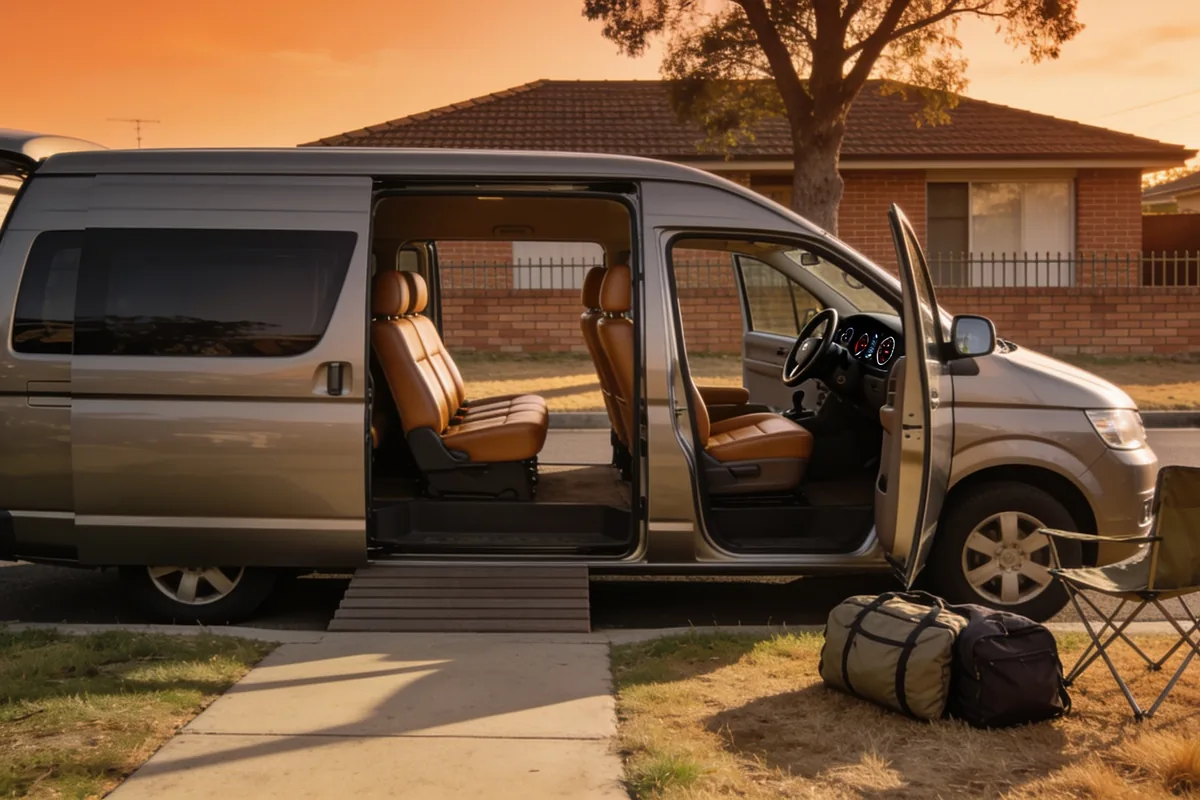
- The first number that matters is not how many people are coming. It is how many seats you can actually use once the restraints and the luggage are in.
- A bigger vehicle is often the answer, and it is not automatically the answer, because parking at the other end is part of the trip too.
- Three questions before anyone books: how many people, how much is coming with them, and how everyone is getting home.
- The group that sorts the return leg at the same time as the outbound one is the group that has a good night.
There is a moment in every group plan when someone finally asks the question out loud: so, how are we all getting there? Usually it is a wedding, a birthday, a works night out or a sporting team, and usually it is about three weeks to go. If you are the person who just got handed this question, take heart. Working out the vehicles is honestly just counting and a few good questions, and you can do the whole thing sitting at the kitchen table with a cup of tea.
Before the group travels
0 of 12If you are the one organising this, these are the things to settle before you book. Tick each one as you do it, and the count keeps track.
General information. Capacity, availability and access arrangements differ between vehicles and operators, so confirm them with whoever you book.
Count people, then count seats that can actually be used
Start with the people, because that part is easy. Then slow down, because the second count is the one that changes the booking.
A seat on a spec sheet is not always a seat you can use. The front passenger seat disappears if a rear-facing child restraint has taken the space behind it. The middle seat in the back row is not really a seat once the two outer ones hold restraints. The third row of a people mover is gone the moment it is folded down to make room for the luggage. And every vehicle being driven by someone in your own group comes with a driver’s seat that is not available to anybody else.
So the arithmetic goes: bodies first, then subtract everything that is not really a seat. What is left is the number you are actually booking for. Write that number down and send it to the group, because half the muddle in these plans comes from people counting different versions of the same list.
There is one more thing worth saying plainly, because it is easy to miss. A group of eight in two cars is not the same journey as a group of eight in one vehicle. The second car has its own driver, its own parking problem, its own departure time, and its own passenger who will be checking their phone at 11pm wondering where everyone is. Sometimes that is fine. Sometimes it is the whole night. Knowing which one you are in is half the plan.
When one larger vehicle wins, and when it does not
Let us be fair to both options, because the answer genuinely goes both ways.
One larger vehicle wins when the group is arriving and leaving together. It wins when the destination has nowhere much to park, which is most venues with a decent dance floor. It wins when nobody wants to be the driver, when there is a firm time at both ends, and when the group includes someone who would otherwise quietly be left out of the plan because they cannot drive themselves.
Two or more cars win when the group is going to split up at the end, because it always does. They win on a short trip when the cars are already there and already paid for. They win when someone is leaving early or arriving late. And they win when the group is big enough that one vehicle would have to run twice, which turns a simple trip into a logistics exercise nobody signed up for.
And here is the sentence a transport operator might not thank me for: for a small group in the middle of the day, with parking at both ends, two cars is often the sensible answer. That is worth believing, because it is coming from someone with no reason to pretend a vehicle is always needed.
The things that decide the vehicle, not the count
The count gives you a number. The next five things give you the actual plan, and they are the ones people leave until too late.
Access needs. If anyone uses a wheelchair or a mobility aid, the vehicle has to be right for it, and that is a request made when you book rather than something to raise at the kerb. Say it at booking time, and say what the aid is, because “we have someone with a walker” and “we have someone in a wheelchair” lead to different vehicles.
Child restraints. Work out how many children need one, and ask who fits them. And a gentle reminder: the requirements for child restraints are set by your state or territory, so check your own transport authority rather than trusting a blog.
Luggage, counted in volume rather than in bags. A pram, a portacot, a cricket kit and a folded marquee are each bigger than a suitcase, and the measurement that matters is the boot with all the seats up. If people are flying in for the event, their bags will be bigger than everyone assumed, which is a law of nature.
The venue’s parking, which is the thing nobody checks until the cars arrive. This is not a small detail: moving people to and from an event site is planned work rather than an afterthought, which is the point the site’s The hidden work behind safe road projects and public events makes from the other side of the clipboard. A drop-off plan is a perfectly good answer; just make it before the night, not during it.
And the person who is going to do the driving. Ask them directly, early, rather than discovering on the day that the plan rested on someone who never agreed to it. On a rural or outer-suburban run the drive is longer than the map makes it look, so that person’s goodwill is part of the calculation. Ask when the venue empties, too. If half the shire is leaving at once, the drop-off plan matters more than the size of the vehicle.
What to have ready when you book
When you ring to book, have these in your hand. It takes ten minutes and it turns a vague enquiry into a booking that works.
The pickup address, and which door. A venue with two entrances and a group milling around both of them loses fifteen minutes before anyone has even left.
The time the vehicle needs to be there, rather than the time everyone would like to leave. Those are almost never the same number, and the vehicle one is the one that counts.
How many people, and how many of them are children. How many bags, and what the biggest single item is. Whether anyone needs a wheelchair accessible vehicle or a child restraint, asked at this moment, which is the moment it can actually be arranged.
Then two questions that are really about expectations. Is the price for the vehicle or per person? And can the return leg be booked at the same time, because the answer to that one decides how peaceful your evening is.
That is the same list a Bacchus Marsh and Darley cab service that runs group travel and airport transfers works through when a booking is taken, and it is a good list to borrow. Ask for a number you can ring on the night, too, because bookings are made in offices and problems happen in car parks. And one caveat from the honest end of the industry: capacity differs between vehicles and operators, so the number to ask about is the one on the vehicle you are booking, not a generally assumed figure.
The return leg, and why it is the whole plan
If you take one thing from this article, take this. The outbound trip usually looks after itself. The return leg is where group plans go to die.
Think about why. By then, the group is leaving at four different times. The people who planned nothing are still planning nothing, and now they are your problem as well. And you, the organiser, are tired and have long since stopped counting heads.
Two habits fix most of it. Book the return at the same time as the outbound, with a pickup point named rather than assumed, because “meet out the front” means six different fronts at a venue that size. And nominate one person as the contact for both legs, so the driver is ringing one phone rather than five.
The plan that works is the one where nobody has to make a decision after the event. For everything about keeping the night itself safe, the site already has that ground covered well in its Top taxi safety tips for night rides, and this article is staying on the logistics side of the kerb.
What to sort before the group travels
Here is the whole thing, compressed for the night before you book.
Count the people, then count the usable seats. Name the biggest single item of luggage and check it fits with all the seats up. Decide on any access or child-restraint requests and make them when you book. Find out where the vehicle can actually stop at the other end. Book the return leg at the same time as the outbound one, from a named pickup point. Choose one contact person who will actually answer their phone. And send the plan to everyone, including the address and the time, so nobody is asking you on the night.
None of it is hard, and all of it is easier now than on the evening itself. The trip that goes smoothly is not the one with the biggest vehicle. It is the one where somebody asked these questions a week early, and this week, that somebody is you.
Sources consulted: your state or territory transport authority’s information on accessible taxis.

A Taxi Fare Is Not One Number: How Yours Is Actually Worked Out

Nobody Plans the Ride Home: Wedding Transport on the Mornington Peninsula

Mouthguards: Which Type, Who Needs One, and How to Look After It

The Science Behind Melbourne’s Unpredictable Climate: What’s Really Going On?

Plastic-Free Coffee Makers: Myth or Must-Have?

Zero Waste Toothpaste: What’s Worth the Switch and What to Look For
-
 Melbourne1 year ago
The Science Behind Melbourne’s Unpredictable Climate: What’s Really Going On?
-
Eco Friendly4 years ago
Plastic-Free Coffee Makers: Myth or Must-Have?
-
Eco Friendly4 years ago
Zero Waste Toothpaste: What’s Worth the Switch and What to Look For
-
 Automotive1 year ago
Wet Weather Tyres in Australia: What to Look For and When to Replace Them
-
 Eco Friendly4 years ago
Plastic Free Packaging: How to Keep Your Business Plastic Free
-
 Eco Friendly4 years ago
How Aussie Businesses Can Reduce Plastic Pollution
-

 Home & Garden1 year ago
Boost Productivity and Mood with a Deep Cleaned Space
-

 Financial1 year ago
How to Secure the Best Car Finance Deal: Tips for Negotiating and Saving Money