
Science & Nature
Daylight Saving 2026: When Australia’s Clocks Go Forward and How to Protect Family Sleep

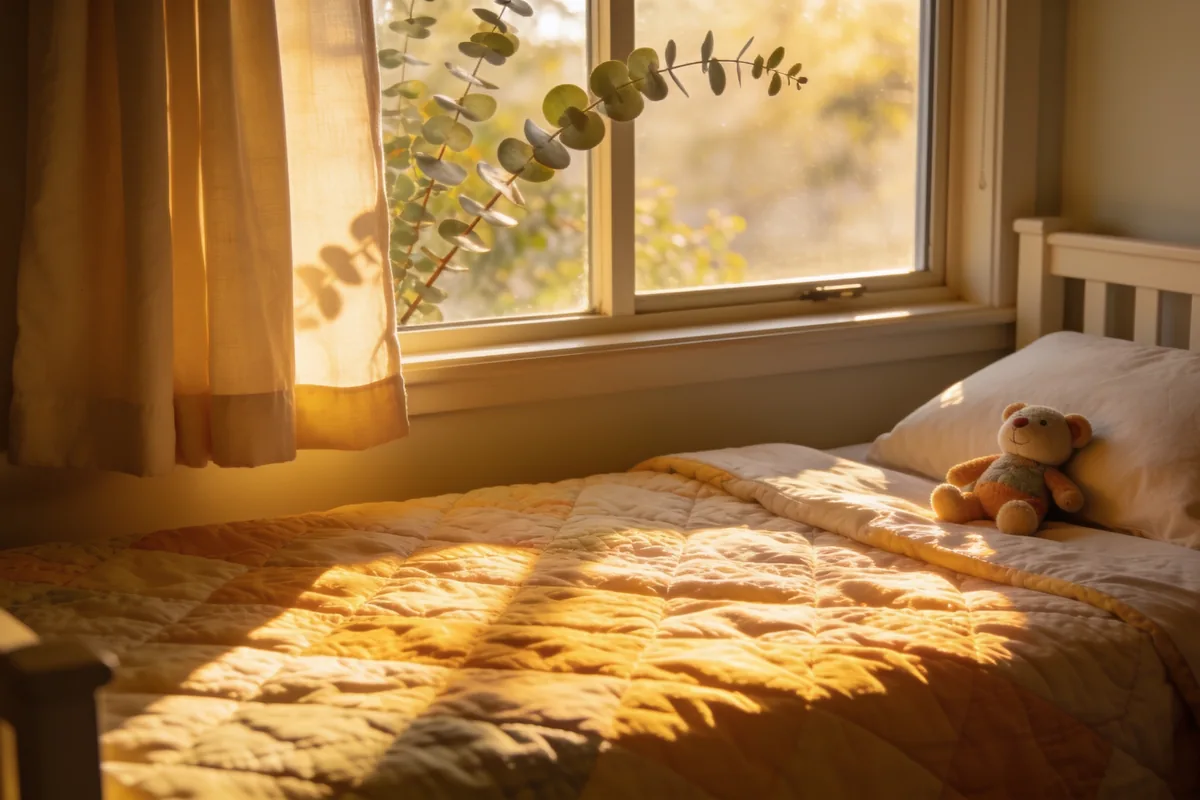
There is a moment every parent knows. The clocks jump forward overnight, and the house wakes up bright an hour earlier than it should. The little one is at the bedroom door at what your watch calls 6am and what their body still thinks is 5am, and for the next few days everyone is tired and a little short with each other.
The quiet dread is not really the time change. It is the week of sleep chaos that follows it. This article answers the two questions underneath that dread: when do the clocks change, and how do you get the family through the first week without wrecking everyone’s sleep. The good news is that you can start tonight, not on the night. Most of the work happens in the week before.
When it happens and who it applies to
The facts are simple, so here they are in one place.
Daylight saving starts on Sunday 4 October 2026 at 2am, when clocks go forward to 3am in New South Wales, Victoria, South Australia, Tasmania and the Australian Capital Territory, plus Norfolk Island. Queensland, Western Australia and the Northern Territory do not change their clocks.
- New South Wales, Victoria, South Australia, Tasmania, ACT and Norfolk Island: clocks go forward.
- Queensland, Western Australia and Northern Territory: no change.
Most phones, computers and smart devices sort themselves out overnight. The analogue clock in the kitchen, the one on the oven and the one in the car do not, so set those before you go to bed on Saturday night or you will discover the oven clock is wrong at the worst possible moment on Sunday.
One gentle note for families in the states that do not change. If your work, your school or your relatives are in an observing state, the shift shows up differently for you, in phone calls made an hour off and meeting times that suddenly move. The disruption is real, it just lives in the calendar rather than the bedroom. It helps to remember that this is not a mistake on your part. It is simply what happens when two parts of the country run on different time for half the year.
Spring is the season doing two things at once, after all. It brings the earlier morning light that makes this change feel abrupt, and it brings a sun that is stronger than the air temperature suggests. The same point I made in my piece on getting sunburnt in winter in Australia applies now, as the days lengthen and the UV climbs before it feels like it should.
Why one hour feels like jet lag
Here is the gentle science, kept short and plain.
Everyone carries a body clock that runs on light, not on the kitchen clock. When the clock on the wall jumps forward an hour, the body clock does not jump with it. For a few days the two disagree, and that disagreement feels like a mild version of flying east, which is the direction that tends to hit people hardest.
Children feel this more than adults, because their body clocks are still learning to be steady. Yours has had decades of practice at adjusting. A toddler’s has not, which is why a one-hour change can land on a small household like a much bigger one.
Springing forward is usually the harder of the two changes, and there are two reasons. The hour is lost from the morning, so the body clock is asked to start later than it expects. And the evenings stretch longer and brighter, which pushes little ones, and grown-ups too, towards a later bedtime than their bodies are ready for. The kitchen clock says one thing. The body clock says another. For a few days, the body clock wins, and everyone feels it.
The plan for the week before
This is the part that actually helps, and it is worth doing properly.
From about a week out, nudge bedtime and morning wake-up earlier by ten to fifteen minutes each day. You are not trying to change the whole schedule at once. You are moving the body clock in small steps so it lands closer to the new time before the change actually arrives. A child who goes to bed at 7.30pm becomes a child who goes to bed at 7.15pm, then 7pm, then 6.45pm, and by the night of the change their body is nearly where it needs to be.
The wake-up end matters just as much as the bedtime end, and it is the one parents forget. If you only move bedtime earlier but let everyone sleep in, the body clock does not shift. So bring the morning wake-up along at the same gentle pace, even on the weekend, even when it is tempting to let a sleepy child lie in. The two ends move together, and that is what makes the nudge work.
Keep the bedtime routine steady through all of it. Bath, book, bed, the same order every night. The routine is the anchor, and children settle into it faster than they settle into any single change. In the last day or two, move meals along with the new schedule as well, because appetites run on the same internal clock as sleep.
The goal is not perfection. It is a softer landing. If you only manage a few nights of nudging, that is still a few nights your child’s body clock used to get closer, and it is genuinely better than doing nothing.
The first few days after
Expect a few cranky mornings, because they are normal. Expect tiredness at the old bedtime, and appetites running on the old clock for a little while. None of that means you have done it wrong. It means the change happened, and bodies take a few days to catch up.
The classic early start happens on the first morning, when the child who usually wakes at 6.30am arrives at 5.30am by the new clock, bright-eyed and ready to play. Resist the urge to start the day. Keep the room dim, keep your voice low and your company boring, and treat it as a middle-of-the-night visit rather than a wake-up call. If you do not turn it into breakfast time, their body clock gets the message that morning has not actually arrived.
Keep the routine anyway, even on the rough days. Get bright morning light in early, once the real morning arrives, which means opening the curtains and getting outside rather than sitting in a dim kitchen. Morning light is the strongest signal a body clock has, and it is the fastest way to help everyone reset. Hold the line on screens before bed, because the bright evenings are already pushing bedtime later and screens make that pull stronger. And if a young child needs a slightly earlier dinner to make an earlier bedtime work, that is fine. Let the day end a little sooner for a few nights.
Be patient with the first week. It usually settles within a few days, not overnight, and the families who ride it out calmly get there faster than the ones who fight it.
The grown-ups too
Adults lose the same hour, and the Monday after the change is a known sleepy commute. There is no point pretending otherwise.
So set the manual clocks before you go to bed on Saturday night, rather than leaving them for Sunday morning when you are already confused. Go to bed at a sensible time that night, even if it does not feel late yet, because your body clock is about to lose an hour it did not volunteer. And take the first morning gently, which means the same bright light advice applies to you as to the children. Get outside, keep the coffee coming, and do not schedule anything important for early Monday if you can help it.
If you drive to work, give yourself a little more patience on the Monday commute, because everyone else on the road is running on the same lost hour. The body clock does not skip the hour for anyone. Kindness to yourself in the first few days is not a luxury. It is the same patience you are giving the kids, aimed in the right direction.
When it is more than the clock
Most families are back to normal within a week, and the crankiness settles into the usual rhythm. Sometimes it does not.
If sleep is still badly disrupted after about a week, or a child is struggling more than the usual adjustment, that is worth a chat with a GP or a child health nurse. You are not overreacting to ask. Sleep problems that outlast the change are not about the clock anymore, and a professional who knows your child is the right person to sort out what is actually going on. This is especially true if your child was already a tricky sleeper before the clocks changed, because the change can simply be the thing that tips an existing struggle over the edge.
This article is general information, and that line matters here. It is not medical advice, and it is not a way to diagnose a sleep problem from a blog post. It is a calm plan for a normal, annual disruption, and the reassurance that most families come through it without any help at all.
Your body clock needs a week, not a minute
The clock change is a small, annual, very normal disruption. It is not a test of your parenting, and it is not a sign that your child is a difficult sleeper. It is one hour, and a little planning in the week before takes most of the sting out of it.
You do not need to be a sleep expert. You need to be consistent for a few days and kind for a few more, and that is well within your reach. Nudge the bedtimes, hold the routine, get the morning light in, and give it a week. Give your body clock that week, and the brighter mornings will do the rest. If the science of the season interests you beyond the bedroom, my guide to how bushfires start and spread looks at the louder way spring announces itself in Australia.
Sources:
- NSW Government – Daylight saving (dates and observing states)
- Raising Children Network – Sleep and settling (bedtime routines)
- ACT Government – Daylight saving in the ACT





The short version
A bushfire needs three things: fuel, heat and oxygen. Take away any one of them and the fire goes out. Most bushfires in Australia are started by human activity or by lightning. After that, the fire stops being about how it started and becomes about the weather and the landscape, which decide whether it stays a small blaze or turns into a major fire event. Wind feeds it oxygen and carries embers ahead of it. Low humidity dries the fuel so it catches easily. High temperature pre-heats everything in its path. When those conditions line up, forecasters use a specific term for it: fire weather.
That is the whole picture in a paragraph. This article fills in the details, because understanding how fire behaves is the same knowledge the authorities use to warn communities, and it explains the orange skies and smoke haze that most Australians have seen at some point.
The fire triangle
Every fire, from a campfire to a bushfire, runs on the same three ingredients. Firefighters call it the fire triangle, and it is the simplest way to understand what is burning and how to stop it.
Fuel is anything that can burn. In the Australian bush that means grass, leaves, bark, twigs, dead wood and the fine material on the forest floor. Australian vegetation is exceptionally good at being fuel. Many of our native plants have evolved with fire and are loaded with volatile oils, the reason eucalyptus leaves burn so readily. A forest floor covered in leaf litter and bark is a fire waiting for a spark.
Heat is the ignition source, the spark or flame hot enough to start the fuel burning. It can be a lightning strike, a spark from machinery, a fallen powerline, a campfire or a deliberately lit match. The heat does not need to be dramatic. In hot, dry conditions, even a small heat source can ignite fine, dry fuel within seconds.
Oxygen comes from the air around the fire. Fire needs oxygen to keep burning, which is why wind matters so much. More oxygen reaching the fire means it burns hotter and faster, and why one of the first things firefighters do is try to starve a fire of the conditions it needs.
Remove any one side of the triangle and the fire cannot sustain itself. Firefighters use water and dirt to remove heat. They create firebreaks to remove fuel. Wind is the hardest to control, which is why the worst fire days are always windy days.
How most bushfires actually start
People start most bushfires. That is the uncomfortable, well-documented reality, and it is worth stating plainly. The human causes fall into a few categories.
Accidental ignitions are common. A spark from a mower or a grinder on a hot day, a chainsaw cutting through dry grass, a vehicle exhaust touching cured grass, a campfire left smouldering, a cigarette dropped from a car window. Powerlines also cause fires when they fall or swing together in high winds and throw sparks into dry fuel below. Each of these is a small event with the wrong timing, and on a bad day that is all it takes.
Deliberate lighting is a smaller share of the total but it happens every fire season, and it is the hardest for authorities to predict. When a fire is lit on purpose in dry, windy conditions, it can become dangerous very quickly.
Lightning is the other major cause, and it is the one that starts the largest fires in remote areas. Dry lightning, which is a thunderstorm that produces little or no rain, is the most dangerous kind. The strike hits dry bushland, and because there is no rain to dampen the fuel, the fire can smoulder and spread for days before anyone notices it. By the time it is seen, it may already cover a large area and be very hard to control.
The proportions shift from year to year and region to region, and the state fire authorities publish the causes of the fires they investigate. The honest generalisation is that in settled areas, human activity dominates, while in remote parts of the country, lightning is responsible for a large share of the area burned.
Why some fires spread slowly and others explode
This is where the weather takes over, and it is the section that explains why the same kind of spark produces a different outcome on different days.
The first ingredient is wind. Wind does two things. It feeds the fire extra oxygen, making it burn hotter, and it carries burning embers ahead of the fire front. Those embers can travel more than a kilometre in front of the main fire, starting spot fires that suddenly appear well ahead of the flames. A fire driven by strong wind is not a slow-moving wall of flame. It is a fast-moving front throwing embers in every direction.
The second ingredient is humidity, or rather the lack of it. Dry air pulls moisture out of the fuel. When the fuel is already dry, the fire catches easily and burns intensely. When the humidity is high, the fuel holds moisture and is much harder to ignite. This is why fire danger is higher on hot, dry days and why a cool change can take the edge off a fire.
The third ingredient is temperature. High temperatures pre-heat the fuel in front of the fire, driving out moisture and making everything more flammable. A 40 degree day does not just feel hot to people. It literally prepares the bush to burn.
Slope is the factor that surprises people, because it is not weather at all. Fire runs faster uphill than downhill or on flat ground. As the fire climbs a slope, the flames reach up the hill and pre-heat the fuel above them, pulling the fire forward. Firefighters talk about this constantly, because a fire on a steep slope in wind can move with terrifying speed.
The type of fuel matters just as much as the weather. Grass fires move fast but burn low and pass quickly. A grass fire can race across open country at a speed people cannot outrun, which is why grass fires are so dangerous in farming areas. Forest fires burn more slowly at the front but with far more intensity, because there is more fuel stacked up, and they keep burning in the ground and in the trunks long after the main front has passed. Understanding which kind of fire is possible in your area is part of understanding your risk.
All of these ingredients feed into the fire danger rating system, the scale from low to catastrophic that appears on signs and in weather forecasts. The rating tells you how dangerous a fire would be if one started, based on the weather that day. When the rating reaches severe or above, the safest response is to leave early, because that is the point where a fire can outrun any attempt to fight it.
When forecasters talk about fire weather, they mean these conditions lining up: strong wind, low humidity and high temperature. The Bureau of Meteorology issues fire weather warnings when the combination is dangerous, and state fire authorities use the same information to declare a Total Fire Ban. A Total Fire Ban means exactly what it sounds like. Lighting a fire in the open, including a campfire or a backyard fire pit, is banned for the day because the conditions make any fire too risky. If you see a Total Fire Ban declared, that is the day to check your bushfire plan and avoid any activity that could throw a spark.
Why the sky turns orange and red
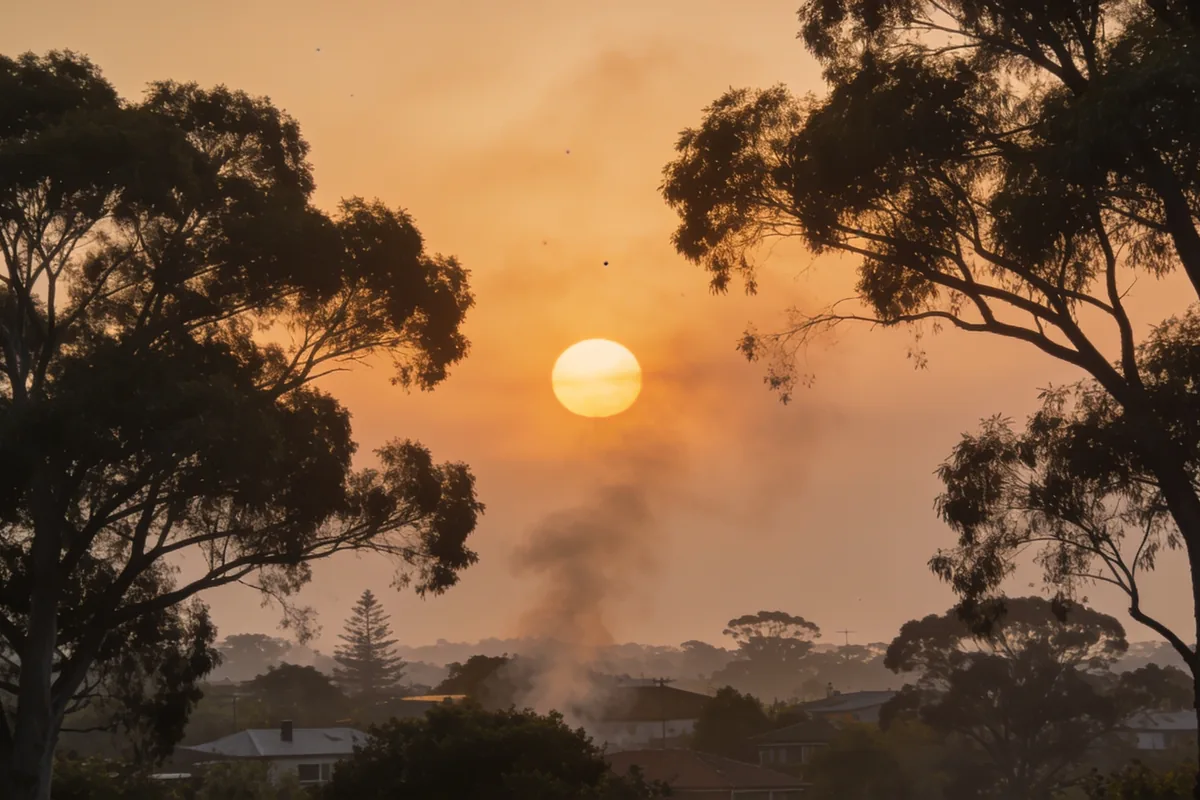
Almost every Australian remembers the first time they saw a bushfire sky. The light goes strange, the sun turns into a red disc you can look at directly, and the whole sky takes on an orange or grey-orange glow. It looks apocalyptic. The science is actually straightforward, and it is the same physics that makes sunsets red.
Light from the sun is white because it contains all the colours of the spectrum. As that light travels through the atmosphere, it collides with particles in the air, and different colours get scattered by different amounts. The tiny molecules of the air itself scatter blue light far more than red light. That is why a clear sky is blue: the blue light is being scattered in every direction and reaches your eyes from all over the sky.
Smoke changes the equation by filling the air with particles that are much larger than air molecules. Those larger particles scatter the longer wavelengths, the red and orange end of the spectrum, much more effectively. So when smoke fills the air between the sun and your eyes, the blue light is scattered away and the red and orange light comes through, which is why the sky and the sun take on that fiery colour.
A sunset is the same trick without the smoke. When the sun is low on the horizon, its light travels through far more atmosphere to reach you, and the blue light gets scattered out along the way, leaving the reds and oranges. Bushfire smoke does the same thing during the day. The thicker the smoke and the lower the sun, the stronger the effect. That is why the worst orange skies tend to happen in the morning and late afternoon, when the sun is low and the smoke is thick.
What smoke haze actually is and where it goes
Smoke haze is what remains after the fire has passed and the smoke has drifted. It is made of fine particles, most of them far smaller than a human hair, carried downwind by the same weather systems that drive the fire. Those particles can travel for hundreds of kilometres. A fire in one region can put a brown-grey haze over a city on the other side of the state, which is why people far from any flames still smell smoke and see a milky sky.
The haze looks the way it does because of the same light physics described above. The fine particles scatter the light and wash out the colours, giving everything a flat, hazy quality. The smell is the particles themselves, and it lingers because the air is full of them.
The health advice around smoke haze is straightforward and worth repeating. The fine particles in bushfire smoke can irritate the lungs, and they are harder on people with asthma, other breathing conditions, heart conditions, older adults and young children. Health departments advise people in those groups to limit time outdoors when the smoke is thick, keep windows closed, and follow their doctor’s or the health department’s advice. Smoke haze is also connected to the wider question of what is in the air we breathe, the same subject as the science of how rain and pollen affect allergies, because both come down to tiny particles travelling through the air and into our lungs.
For most healthy people, a few hazy days are an inconvenience rather than a health crisis. But the haze is a useful reminder that a bushfire’s reach is much wider than its flames. The fire may be in one valley, while its effects are felt across an entire region.
Read the sky, check the warnings
The science in this article is the same knowledge that fire authorities use every day to keep communities safe, and it has a practical job to do.
When you understand the fire triangle, you understand why a Total Fire Ban matters. When you understand fire weather, you understand why one hot, windy day is dangerous while another is not. When you understand how smoke scatters light, an orange sky stops being a mystery and becomes information about what is in the air and where it came from. Understanding the science does not make a bushfire less serious. It makes the warnings make sense, and it lets you read the sky with a calmer, more informed eye.
If a fire does threaten your area, the state fire authority is the source for current warnings. The Bureau of Meteorology provides the fire weather forecasts. Both publish clear, up-to-date information, and both are worth checking before and during any high-risk period. The same is true of the climate that shapes these conditions, which is a subject of its own, and the science behind Australia's unpredictable weather is worth reading alongside this one.
Fire season is a fact of Australian life. The science does not remove the danger, but it removes the confusion. It explains the sights in the sky, the warnings on the news and the reason some days demand more care than others. That understanding is free, it applies everywhere in the country, and it is the calmest possible way to approach a subject that can otherwise feel overwhelming.
Sources:
- CSIRO, Bushfire behaviour and management
- Bureau of Meteorology, Fire weather and warnings
- Australasian Fire and Emergency Service Authorities Council (AFAC)

The short honest answer
Yes, you can get sunburnt in winter in Australia. But the honest answer is more interesting than a plain yes or no, because it depends on where you are and what you are doing. In Hobart on an overcast July day, you almost certainly will not burn. In Cairns at midday, even in winter, you can. Out on the snowfields, you genuinely can, and the cold air will not save you.
The one number that decides it is not the temperature. It is the UV Index. Sunburn comes from ultraviolet radiation, and UV is not the same thing as heat. A cool day can still carry burning UV, and a warm one can carry almost none. That single fact is what busts the whole “it is winter, the sun must be weak” assumption.
So here is the rule that does the real work, from the Cancer Council: check the UV Index, and protect your skin when it is 3 or above. Below 3, most people do not need daily sun protection. At 3 and above, you do. Winter or summer, that number decides, not the season and not the thermometer.
One line before we go. This is general health information, not medical advice. The UV Index for your exact location on your exact day is the thing to check, rather than trusting any general article, including this one.
How sunburn actually works
Sunburn is skin damage caused by UV radiation. The sun puts out several kinds of ultraviolet light, and the two that matter for your skin are UVA and UVB. UVB is the main driver of burning. UVA penetrates deeper and is the big driver of ageing. Both do damage, and both are invisible. You cannot see UV arriving. You can only feel the result, hours later.
Here is the part that confuses almost everyone. UV is not heat. The warmth you feel from the sun comes from infrared radiation, which is a completely different part of the spectrum. That is why the two come apart so easily. A cold, windy, overcast day can carry the same UV as a warm one, because cloud cover does not reliably block UV. Thin cloud lets most of it straight through, and patchy cloud can actually push UV up, because sunlight reflects off the edges of the clouds and reaches you from more angles.
That is why “it does not feel hot” is a useless safety test, and why “there are clouds, I will be fine” is a myth rather than a rule. Your skin does not care how the air feels. It cares about UV, and UV does not send a temperature warning ahead of itself.
The other thing worth knowing is that sunburn takes hours to appear. You can burn at lunchtime and not see the redness until dinner. By then the damage is done, which is exactly why prevention beats reaction. You cannot undo a burn once it shows up. You can only treat the symptoms and wait for the skin to repair itself.
What winter UV looks like in Australia
Australia is a very big country, and its winter UV is not the same everywhere. The honest version of this article lives in the gap between the north and the south.
In the tropics and the far north, the UV Index stays at 3 or above every single day of the year, winter included. Cairns, Darwin, Broome, they do not get a winter break from UV. Sun protection in those places is a year-round habit, not a summer one. Winter is exactly when it catches newcomers out, because the cooler air makes them assume the sun has weakened. It has not.
In the southern capitals the picture is genuinely different. Melbourne, Hobart, Adelaide and Canberra all average a UV Index below 3 through the winter months. For most people on an ordinary southern winter day, daily sunscreen is not needed, because the UV simply is not high enough to cause burning in a normal amount of time outdoors. That is the reassuring half of the answer, and it is true.
This is also where the science of how Melbourne’s weather actually behaves becomes relevant. Melbourne is famous for four seasons in one day, and the UV follows the same restless pattern. The index can sit low on a grey morning, then climb by lunchtime if the clouds clear, or do the reverse. The weather changes, and the UV changes with it, which is exactly why the science of a city’s unpredictable climate and what is really going on with it matters more than a simple rule of thumb.
The upshot is that there is no single Australian answer. There is a northern answer and a southern answer, and the only way to know which applies to you on any given day is to check the number for your own postcode.
The situations where winter sunburn is real
So when does winter sunburn actually happen? The exceptions are specific, and each one tends to catch people out precisely because it feels safe.
A clear sunny day in late winter. As the weeks edge towards spring, the UV climbs even in the south. A cloudless August day in Melbourne can push the UV Index to 3 or above in the middle of the day, especially around noon. If you are outside for hours, a garden working bee, a beach day, a long lunch on a deck, you can burn.
High altitude. UV gets stronger with elevation, because there is less atmosphere above you to filter it. The alpine snowfields sit well above sea level, which means the UV there is meaningfully stronger than the same latitude down at the coast. Skiing and snowboarding are prime winter burn territory for exactly this reason, and the freezing air does nothing to protect you.
Snow and water reflection. Snow reflects up to eighty percent of UV, so on a snowfield the radiation hits you from below as well as from above. Water does the same thing. That double dose is why you can burn out on the snow or on the water on a day when the UV alone would not have worried you. It is not just the sun overhead. It is the sun bouncing back off the surface under your feet.
Long days outside. Even at a moderate UV level, hours of exposure add up. A UV Index of 2 might not burn you in twenty minutes, but a full day working outside, fishing from a boat, hiking a track or watching a day of sport can still deliver enough accumulated UV to damage skin.
Very fair skin. People who burn easily in summer burn easily in winter too. If you are pale, freckled, or have a history of burning, your skin’s tolerance does not take a seasonal holiday. The UV 3 rule is a general guide, and the fairer your skin, the more carefully you should treat the days that sit near the line.
The myths that leave people burnt
Time to bust the ones that actually get people into trouble. Each of these sounds completely reasonable, and each one has a hole in it.
“Cold means safe.” Cold air does not block UV. The UV Index can sit at 3 on a crisp winter morning, and the cold only hides the damage until the redness shows up later.
“Cloudy means safe.” Cloud cover is unreliable. Thin cloud lets most UV through, and broken cloud can reflect and increase it. Overcast is not a sunscreen.
“I tan, so I cannot burn.” A tan is a sign of UV damage, not a shield against it. People with olive or darker skin burn less easily than very fair skin, but they still damage, and they can still burn with enough exposure.
“Sunscreen is only for summer.” Sunscreen is for whenever the UV Index is 3 or above, which in northern Australia is every day of the year. The season is not the trigger. The number is.
“I am inside all week, so it does not matter.” A working week indoors does not erase a weekend of high-UV hours outside. Your skin accumulates UV damage over a lifetime, not a single week, and every unprotected high-UV session adds to the total.
Spot the pattern behind all five myths and you have the whole lesson. Each one substitutes a feeling, cold, cloud, a tan, a season, a routine, for the actual measure. And the actual measure, the UV Index, does not care about any of those feelings.
Check the number, not the thermometer
Here is the habit that replaces every myth on the list. Before you spend serious time outdoors in winter, check the UV Index for your location. The Bureau of Meteorology publishes it as part of its daily forecasts, and the SunSmart app gives you the sun protection times for your suburb, telling you the window each day when the UV is at 3 or above.
When the number is below 3, enjoy the winter sun. It is genuinely good for you, the daylight, the vitamin D, the mood lift, and most people in southern Australia do not need daily sun protection through winter. This is not an article telling you to live in fear of the sun. The sun is not the enemy. Unprotected high-UV exposure is the thing to manage.
When it is 3 or above, treat it like a summer day. Sunscreen on exposed skin, a hat, sunglasses, and shade in the middle of the day. On a long outdoor winter day, a ski trip, a fishing charter, a day walking the snowfields, apply it the way you would in January. The combination of altitude, reflection and long hours can push a moderate UV reading into genuine burning territory, and that is exactly the scenario winter sunburn stories are made of.
The goal is not to be scared of the sun. It is to know when the sun is actually doing damage, and to act on the number rather than on the weather. Cold air lies to you. Clouds lie to you. The UV Index does not, which is why it is the only sun-safety test worth trusting all year round.
Sources:
- Cancer Council Australia, Sun protection and the UV Index
- Bureau of Meteorology, UV knowledge centre
- ARPANSA, Ultraviolet radiation and the UV Index

Bridging Visas: What You Are On While You Wait, and What It Actually Lets You Do

Your NDIS Plan Reassessment: What Happens, and What to Have Ready

Bring the Seat or Hire One? What to Sort Before You Book a Car for the Family

The Science Behind Melbourne’s Unpredictable Climate: What’s Really Going On?

Plastic-Free Coffee Makers: Myth or Must-Have?

Zero Waste Toothpaste: What’s Worth the Switch and What to Look For
-
 Melbourne1 year ago
The Science Behind Melbourne’s Unpredictable Climate: What’s Really Going On?
-
Eco Friendly4 years ago
Plastic-Free Coffee Makers: Myth or Must-Have?
-
Eco Friendly4 years ago
Zero Waste Toothpaste: What’s Worth the Switch and What to Look For
-
 Automotive1 year ago
Wet Weather Tyres in Australia: What to Look For and When to Replace Them
-
 Eco Friendly4 years ago
Plastic Free Packaging: How to Keep Your Business Plastic Free
-
 Eco Friendly4 years ago
How Aussie Businesses Can Reduce Plastic Pollution
-

 Home & Garden1 year ago
Boost Productivity and Mood with a Deep Cleaned Space
-

 Food1 year ago
The 9 Best Foods and Drinks to Enjoy Before Bed for Restful Sleep