Travel
Are Cruises a Good Choice for Families and Groups? What to Know Before You Book


There is a lot to like about the idea of a cruise. One booking covers accommodation, meals and entertainment, the ship moves overnight so you wake up somewhere new, and there is genuinely something for every age. For a family with young children, a group of friends or a multi-generational gathering, that convenience is a real draw.
But cruises are also a big investment, and they are not the right answer for every group. The food and activities are not always included in the way people expect, the itinerary is fixed, and a week on a ship is a very different holiday from a week exploring on land. Here is a balanced look at what cruises do well, where they get complicated, and what to check before you hand over your money.
What cruises genuinely do well
For families, the biggest plus is that everyone is entertained. Most ships run supervised kids’ clubs split by age group, which gives children a place to play and parents a few hours to themselves. Water parks, arcades, family movie nights and themed parties keep younger ones busy, while teens get their own lounges and social events. Adults have spas, shows, dining rooms and quiet corners. The range is hard to match in a single resort, let alone a land-based tour.
For groups, a cruise solves the logistics problem. Everyone sleeps on the same ship, so there is no coordinating separate hotels, and meals are in the same dining room rather than negotiated restaurant by restaurant. People can spend the day doing their own thing, then meet up for dinner, which suits groups with very different interests. The ship also moves you between destinations while you sleep, so you pack and unpack once.
Where cruises get complicated
The catch is that a cruise holiday is not as all-inclusive as the marketing suggests. The base fare covers the cabin, most meals and the core onboard activities, but a long list of extras add up quickly: shore excursions, speciality dining, drinks, wi-fi, spa treatments and gratuities. Families and groups should total those before comparing the price with a land-based holiday, because the headline fare is rarely what you actually spend.
Then there is the itinerary. A cruise visits the ports the ship is scheduled to visit, on the days it is scheduled to be there, for the hours the schedule allows. You cannot linger in a place you love or skip one you do not. For groups that like to travel slowly and make it up as they go, that fixed structure can feel restrictive rather than relaxing.
Cabin size is another reality check. Cabins are compact, and while families can book suites or adjoining rooms, that pushes the price up. Anyone prone to seasickness should think carefully too. Modern ships are stabilised and most people adjust, but rough weather still happens, and being confined to a ship in a swell is not how anyone wants to spend a holiday.
Finally, think about what the group actually enjoys. A cruise suits people who are happy to be entertained on board. If your group would rather hike, explore cities on foot or sit in a quiet cafe watching the world go by, the constant hum of a ship might not be the match it first appeared to be.
What to check before you book
Ask what is actually included before you compare prices. Meals in the main dining room are usually covered, but speciality restaurants, drinks, excursions and gratuities often are not. Get the full list in writing.
Match the ship to the group. Some lines are built around family entertainment, while others lean towards adults, quiet dining and longer cruises. Read reviews from people travelling in a similar style to you rather than trusting the brochure.
Choose cabins with an eye on space. Families often do better with a suite or adjoining cabins than with everyone squeezed into one room, and balconies add a private outdoor space that makes a big difference on longer cruises.
Book excursions with care. Ship-organised tours are convenient and guaranteed to get you back before departure, but they cost more than arranging your own. For a group, decide in advance whether you want to stick together on organised tours or split up and explore independently.
Prepare for motion. If anyone in the group is prone to seasickness, pick a route in calmer waters, choose a cabin in the middle of the ship on a lower deck, and bring remedies rather than hoping for the best.
Questions about cruising with family and groups
Is a cruise good value for a large group? It can be, because one fare covers accommodation and most meals, and group discounts are often available. But add up the extras first, because excursions, drinks and gratuities can turn a good deal into an expensive one.
How do you keep a family entertained on a cruise? Kids’ clubs, pools and family activities cover most of it, and multi-generational ships run events designed to bring the whole group together. The range of options is one of the genuine strengths of cruising.
Can you get time alone on a cruise with a group? Yes, more easily than on most group holidays. Everyone can follow their own schedule during the day and meet up later, which suits groups that want both time together and independence.
Do cruises suit people who do not like organised tours? It depends. The ship itself is fairly structured, and shore time is limited by the port schedule. If you prefer slow, flexible travel, a cruise may feel constraining no matter how good the ship is.
Book the trip that fits how you travel together
A cruise can be a wonderful choice for a family or a group, and for many people it is exactly the right holiday. The meals, the entertainment and the ease of waking up somewhere new are hard to beat. But it works best when the group knows what it is signing up for: the extras, the fixed itinerary, the compact cabins and the constant activity. Go in with a clear budget that includes the add-ons, match the ship to the people on it, and be honest about how your group likes to travel. Do that, and a cruise is a holiday everyone will remember. Do not, and it is an expensive way to learn what you actually want. The ship will still be there next year, so choose the trip that fits, not the one that photographs well.



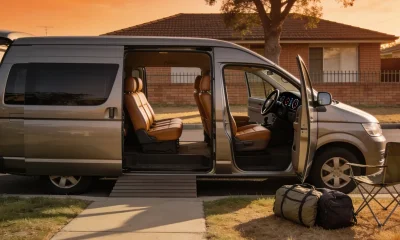

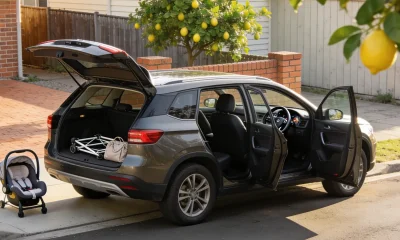



- An accessible taxi is not a different kind of trip. It is the same trip with a booking practice attached.
- There is a Victorian subsidy for accessible taxi fares, and most people who could use it have never heard of it.
- The three things that decide whether an evening works: when you book, what you ask for, and what you do when there is no car.
- The barrier is usually not the vehicle. It is that nobody told you there was a way to arrange one.
There is a particular kind of tired that comes from wanting to go somewhere and not being sure you can get home. If you know it, or if you are the person who books trips for someone you love, this article is for you. Getting around in a wheelchair, or with a walker, or with a mobility scooter, is not impossible and it is not mysterious. It is simply booked rather than hailed, and once you know how the booking works, most of the uncertainty goes away.
What an accessible trip actually involves
An accessible vehicle takes a wheelchair or a mobility aid into the vehicle itself, rather than folding it into the boot. That is the whole idea, and it changes what you need to say when you book.
The arrangements differ from vehicle to vehicle and operator to operator. Some take a passenger seated in their chair. Some expect a transfer to a seat. That difference sounds technical on paper, and it is the single most practical thing to sort on the phone, because it decides which vehicle you need and how long the pickup takes.
The two things you control are what you ask for and when you ask. Here is the sentence that changes the most: this is a booking culture, not a hailing culture. An accessible vehicle is a smaller part of any fleet than a sedan, so it is arranged ahead rather than flagged down. That is not you asking for a favour. It is simply how the service works best, for everyone.
And it is worth saying who might be reading this. It is often not the passenger. It is a son or daughter, a neighbour, a support worker or a carer doing the ringing, and that is a different job with its own section further down. If that is you, the rest of this article is written with you in mind, because the booking call is a skill, and it belongs to whoever makes it.
The Victorian subsidy, explained
If you live in Victoria and you or someone you care for has limited mobility, there is a government subsidy for taxi fares that a surprising number of people have never been told about. It is called the Multi-Purpose Taxi Program, and it is worth five minutes of your time.
The program supports Victorians with limited mobility by subsidising taxi fares on eligible trips. The structure of the subsidy is a share of the fare, up to a cap, so the Government’s own page is the place to confirm the current figure before you plan around it. Applications and information are handled by Safe Transport Victoria, which is where the process starts.
Two things about how it sits are worth knowing. It is not charity and it is not a discount card; it is a subsidy the state provides for eligible trips, and asking about it is an ordinary thing to do. And the subsidy attaches to the passenger, not to a company, so it travels with you rather than tying you to one operator. And wheelchair-accessible operators and drivers continue to be paid what is called the lifting fee, which is the Government’s own acknowledgement that an accessible trip takes longer and costs more to provide. Hold on to that fact, because it changes how a refused booking reads. It is a fleet arithmetic problem, not a judgement about you.
You may also have heard about the NDIS rollout in Victoria and wondered what it means for the subsidy. The Government’s own line during the transition is that there is no change to the way users access it, and that is as far as this article needs to go on that subject. What you can use the subsidy for, whether you are eligible, and how it is applied are all questions with answers that change, so ask Safe Transport Victoria or ask when you book, rather than trusting a blog written months ago.

How to book, in the order that works
This is the part that answers the question people actually ask, which is not “what is the subsidy” but “what do I say when I ring”. So ring with the details ready, rather than with a general request.
The pickup address, and which door. The time you need to be at the destination, not the time you would like to leave. Whether the passenger stays in their chair or transfers to a seat, because that is a different vehicle and a different amount of time. Whether a companion is travelling. Whether there is luggage, a walking frame, an oxygen bottle or a folded mobility scooter. And a phone number that will actually be answered on the day.
That list is the one a Castlemaine cab service with a wheelchair-accessible vehicle that covers the Mount Alexander Shire works through when a booking is taken, and it is a good one to borrow wherever you are.
Then the two habits that improve your odds more than anything else. Book as far ahead as you can, and book the return leg at the same time as the outbound one. The outbound trip is usually easy. The return is where a plan falls over, because it happens at whatever hour the day finishes, not at an hour that suits a fleet.
One more detail on the booking: if the person you are arranging this for is coming home from hospital, say so. Discharge times move, and an operator would rather plan around that than discover it on the day.
And the honest workaround, which comes from people who use accessible transport every week: if a driver has been good, ask them how they like to be booked next time. A known driver is the closest thing to a guarantee you can arrange yourself. It is not a promise, and it is a much better plan than ringing cold at ten at night.
The honest half: what you cannot control
No article about accessible transport is honest if it stops at the booking tips. So here is the other half, without dressing it up.
A fleet is finite, and the accessible part of it is smaller than the rest. Demand concentrates in the evenings and on weekends, exactly when you would like to go out. Weather, hospital discharge times and events all pull on the same small number of vehicles at once. If you have ever booked and waited, and then been told there is nothing, that was not bad luck you caused. It is arithmetic.
What you can do about it is what this section is for. Ring earlier in the day for an evening trip, so you are in the plan from the start. Ask what the operator’s fallback is when they have nothing available, because some have arrangements with other operators and some do not, and it is a fair question. Keep a second number. And if a booking fails, say so to the operator rather than quietly giving up, because the record is the only thing that ever changes a fleet.
The goal is not a perfect system. It is a week where you have a plan B and you are not deciding whether to go out based on whether you can get home. For the evening half of the equation, the site’s Top taxi safety tips for night rides covers the getting-home-late question well, and this article is staying with access. Transport also sits inside a wider set of support arrangements, and the site’s The future of disability support: how NDIS daily life support is evolving looks at that side of things as it changes.
Booking for someone else
If you are the one making the call for a parent, a partner or a client, this section is for you, because it is a different job from booking for yourself.
Before you ring, have these ready. The passenger’s address, including the unit number and which entrance, because “number 4 on the main road” is not enough for a driver at night. Whether they will be ready at the door or need a hand out to the vehicle. How mobile they are on the day, as opposed to usually. Whether a frame or a chair is coming with them. And what the appointment time actually is, rather than the time they were told to arrive.
The two things people get wrong on someone else’s behalf are small and expensive. Booking for the appointment time rather than for the time they need to be there, which is earlier. And not telling the operator that the passenger needs assistance from the door, which is the difference between a two-minute pickup and a ten-minute one.
The operator cannot plan for what they are not told, so be specific rather than polite. “Mum uses a walker and will need a minute at the door” is a better booking than “she should be fine”. And write the details down somewhere the passenger can see them, so they are not the one reciting an address to a driver on the day.
Out of town, and the trips that are not the local run
If you are in a regional town or a shire rather than the city, one more shape of trip is worth thinking about in advance.
A hospital or specialist appointment out of town, an airport run, a wedding at a rural venue: each is a longer booking, and each has a return leg that is harder than the outbound one. The accessible fleet is smaller out here and the distances stretch the day, which makes arranging everything further ahead more important, not less.
This part stays simple on purpose. There is no timetable to memorise and no distance arithmetic to do. The rule is the same one from earlier, only with more weight on it: on a longer trip, the return leg is the whole booking. Sort it when you sort the outbound, and the day stops being a gamble.
And if the destination is somewhere a driver may not know, offer a landmark as well as the address. Rural addresses and maps have a complicated relationship, and a described turn-off is worth three postcodes.
What to ask before you book the trip
Five questions, and you can ask all of them in one phone call.
Is the vehicle available for the time I need, and what happens if it is not? Does the passenger stay in their chair, and is that something the driver is set up for? Is a companion travelling, and does that change the booking? Is there a return leg, and can it be booked now? And am I eligible for the subsidy, and how do I claim it? That last one has a name attached: the Multi-Purpose Taxi Program, with Safe Transport Victoria as the place to start.
You are not asking for a favour when you do this. You are booking a transport service, and the more specific the booking, the better it works. That is the whole of it, and it is a much steadier feeling than hoping.
Sources consulted: Victorian Government information on the Multi-Purpose Taxi Program; Safe Transport Victoria.
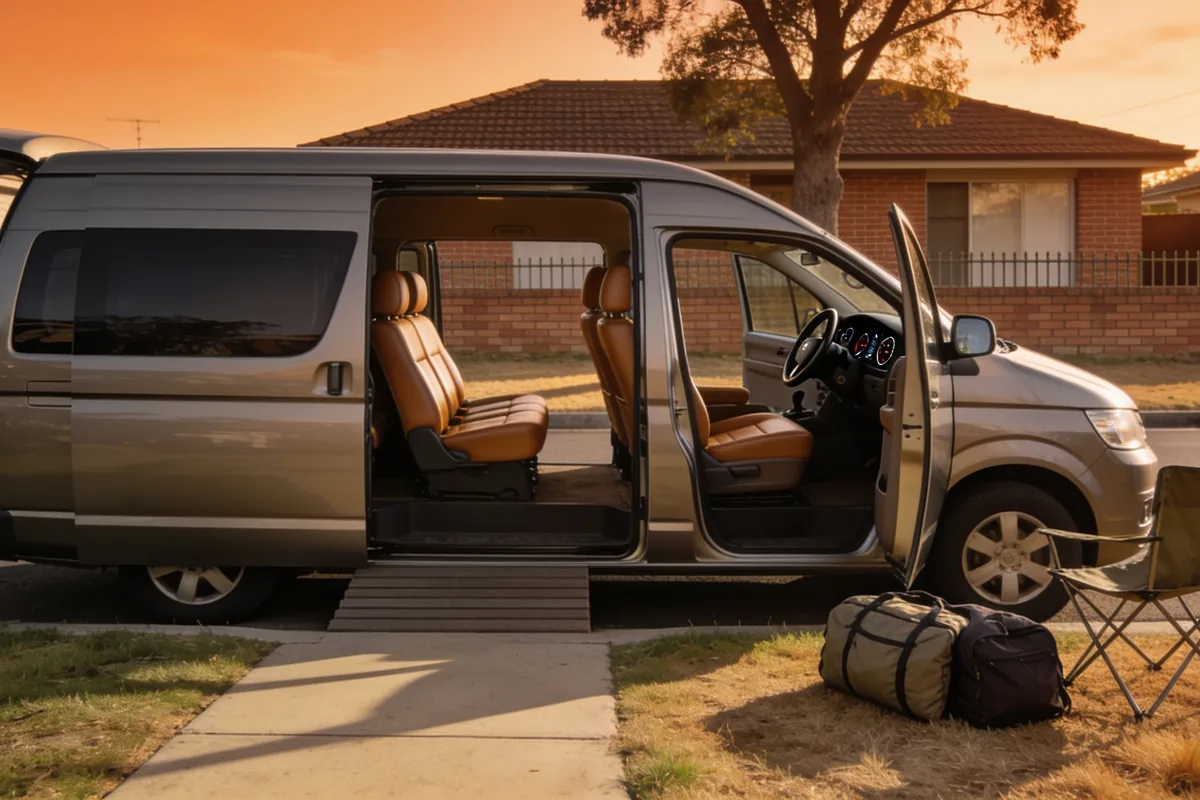
- The first number that matters is not how many people are coming. It is how many seats you can actually use once the restraints and the luggage are in.
- A bigger vehicle is often the answer, and it is not automatically the answer, because parking at the other end is part of the trip too.
- Three questions before anyone books: how many people, how much is coming with them, and how everyone is getting home.
- The group that sorts the return leg at the same time as the outbound one is the group that has a good night.
There is a moment in every group plan when someone finally asks the question out loud: so, how are we all getting there? Usually it is a wedding, a birthday, a works night out or a sporting team, and usually it is about three weeks to go. If you are the person who just got handed this question, take heart. Working out the vehicles is honestly just counting and a few good questions, and you can do the whole thing sitting at the kitchen table with a cup of tea.
Before the group travels
0 of 12If you are the one organising this, these are the things to settle before you book. Tick each one as you do it, and the count keeps track.
General information. Capacity, availability and access arrangements differ between vehicles and operators, so confirm them with whoever you book.
Count people, then count seats that can actually be used
Start with the people, because that part is easy. Then slow down, because the second count is the one that changes the booking.
A seat on a spec sheet is not always a seat you can use. The front passenger seat disappears if a rear-facing child restraint has taken the space behind it. The middle seat in the back row is not really a seat once the two outer ones hold restraints. The third row of a people mover is gone the moment it is folded down to make room for the luggage. And every vehicle being driven by someone in your own group comes with a driver’s seat that is not available to anybody else.
So the arithmetic goes: bodies first, then subtract everything that is not really a seat. What is left is the number you are actually booking for. Write that number down and send it to the group, because half the muddle in these plans comes from people counting different versions of the same list.
There is one more thing worth saying plainly, because it is easy to miss. A group of eight in two cars is not the same journey as a group of eight in one vehicle. The second car has its own driver, its own parking problem, its own departure time, and its own passenger who will be checking their phone at 11pm wondering where everyone is. Sometimes that is fine. Sometimes it is the whole night. Knowing which one you are in is half the plan.
When one larger vehicle wins, and when it does not
Let us be fair to both options, because the answer genuinely goes both ways.
One larger vehicle wins when the group is arriving and leaving together. It wins when the destination has nowhere much to park, which is most venues with a decent dance floor. It wins when nobody wants to be the driver, when there is a firm time at both ends, and when the group includes someone who would otherwise quietly be left out of the plan because they cannot drive themselves.
Two or more cars win when the group is going to split up at the end, because it always does. They win on a short trip when the cars are already there and already paid for. They win when someone is leaving early or arriving late. And they win when the group is big enough that one vehicle would have to run twice, which turns a simple trip into a logistics exercise nobody signed up for.
And here is the sentence a transport operator might not thank me for: for a small group in the middle of the day, with parking at both ends, two cars is often the sensible answer. That is worth believing, because it is coming from someone with no reason to pretend a vehicle is always needed.
The things that decide the vehicle, not the count
The count gives you a number. The next five things give you the actual plan, and they are the ones people leave until too late.
Access needs. If anyone uses a wheelchair or a mobility aid, the vehicle has to be right for it, and that is a request made when you book rather than something to raise at the kerb. Say it at booking time, and say what the aid is, because “we have someone with a walker” and “we have someone in a wheelchair” lead to different vehicles.
Child restraints. Work out how many children need one, and ask who fits them. And a gentle reminder: the requirements for child restraints are set by your state or territory, so check your own transport authority rather than trusting a blog.
Luggage, counted in volume rather than in bags. A pram, a portacot, a cricket kit and a folded marquee are each bigger than a suitcase, and the measurement that matters is the boot with all the seats up. If people are flying in for the event, their bags will be bigger than everyone assumed, which is a law of nature.
The venue’s parking, which is the thing nobody checks until the cars arrive. This is not a small detail: moving people to and from an event site is planned work rather than an afterthought, which is the point the site’s The hidden work behind safe road projects and public events makes from the other side of the clipboard. A drop-off plan is a perfectly good answer; just make it before the night, not during it.
And the person who is going to do the driving. Ask them directly, early, rather than discovering on the day that the plan rested on someone who never agreed to it. On a rural or outer-suburban run the drive is longer than the map makes it look, so that person’s goodwill is part of the calculation. Ask when the venue empties, too. If half the shire is leaving at once, the drop-off plan matters more than the size of the vehicle.
What to have ready when you book
When you ring to book, have these in your hand. It takes ten minutes and it turns a vague enquiry into a booking that works.
The pickup address, and which door. A venue with two entrances and a group milling around both of them loses fifteen minutes before anyone has even left.
The time the vehicle needs to be there, rather than the time everyone would like to leave. Those are almost never the same number, and the vehicle one is the one that counts.
How many people, and how many of them are children. How many bags, and what the biggest single item is. Whether anyone needs a wheelchair accessible vehicle or a child restraint, asked at this moment, which is the moment it can actually be arranged.
Then two questions that are really about expectations. Is the price for the vehicle or per person? And can the return leg be booked at the same time, because the answer to that one decides how peaceful your evening is.
That is the same list a Bacchus Marsh and Darley cab service that runs group travel and airport transfers works through when a booking is taken, and it is a good list to borrow. Ask for a number you can ring on the night, too, because bookings are made in offices and problems happen in car parks. And one caveat from the honest end of the industry: capacity differs between vehicles and operators, so the number to ask about is the one on the vehicle you are booking, not a generally assumed figure.
The return leg, and why it is the whole plan
If you take one thing from this article, take this. The outbound trip usually looks after itself. The return leg is where group plans go to die.
Think about why. By then, the group is leaving at four different times. The people who planned nothing are still planning nothing, and now they are your problem as well. And you, the organiser, are tired and have long since stopped counting heads.
Two habits fix most of it. Book the return at the same time as the outbound, with a pickup point named rather than assumed, because “meet out the front” means six different fronts at a venue that size. And nominate one person as the contact for both legs, so the driver is ringing one phone rather than five.
The plan that works is the one where nobody has to make a decision after the event. For everything about keeping the night itself safe, the site already has that ground covered well in its Top taxi safety tips for night rides, and this article is staying on the logistics side of the kerb.
What to sort before the group travels
Here is the whole thing, compressed for the night before you book.
Count the people, then count the usable seats. Name the biggest single item of luggage and check it fits with all the seats up. Decide on any access or child-restraint requests and make them when you book. Find out where the vehicle can actually stop at the other end. Book the return leg at the same time as the outbound one, from a named pickup point. Choose one contact person who will actually answer their phone. And send the plan to everyone, including the address and the time, so nobody is asking you on the night.
None of it is hard, and all of it is easier now than on the evening itself. The trip that goes smoothly is not the one with the biggest vehicle. It is the one where somebody asked these questions a week early, and this week, that somebody is you.
Sources consulted: your state or territory transport authority’s information on accessible taxis.

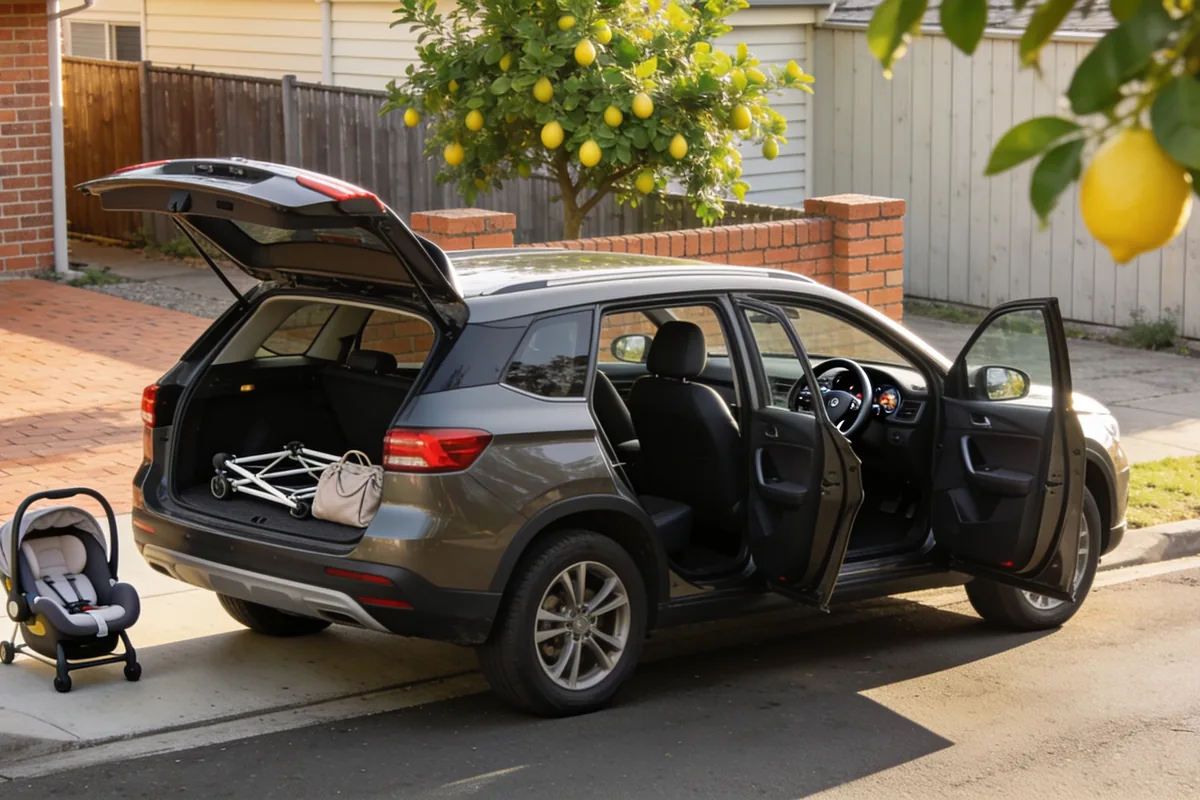
- Three questions decide the whole booking: how many bodies, how big the smallest ones are, and how much is coming with you.
- Bringing the seat and hiring one each solve a different problem, and the answer usually comes down to how you are arriving at the car.
- A bigger car is not automatically the answer, because the third row and the boot are competing for the same space.
- You cannot fix a seat or a boot at the kerb. Everything on this list gets sorted before you book.
You have booked the flights, the house and the dog sitter, and then someone asks the question nobody wants to own: so who is sorting out the kids’ seats? If that someone is you, welcome. This is the part of a family car hire that no booking form asks you about, and it is the part that decides how the first hour of the trip actually goes. Here is the whole decision, in the order it needs making.
Which car, and which seat?
Answer six questions and this gives you the two things to sort before you book: the size of car, and whether to bring a seat or hire one.
count them, do not guess the type here
on most Australian hires the answer is you
Answer the questions and your summary will appear here.
General information, not legal or safety advice. Requirements for child restraints are set by your state or territory, check your own transport authority.
Nothing on this page states a legal requirement, a price or an availability claim. Every answer comes from what you entered.
The decision, in the reader’s own words
Bring your own seat, or use the hire company’s. That is the question, and it is worth saying out loud that both answers are correct, just for different trips.
Bringing your own gives you the seat you know. You know it fits your child, you know where the straps sit and you know its history, which is nothing to be casual about. It also means nothing extra to hire and nothing to learn on the day. The catch is the carrying. A seat is bulky and awkward, and whether it flies free depends on the airline and the route, so that is a question for the airline’s own page rather than a guess. And when you get there, you are still fitting a seat you know into a car you do not.
Hiring one means nothing to carry and one less thing in the boot, and for a lot of families that is the whole argument right there. The catch is that you get what they have. You fit it yourself, you have limited say over the model, and you will not have seen it before the day.
Notice what is not on either list: a right answer. A family flying in for a week with one child will usually hire. A family driving their own car to the hire counter, with a seat that is already fitted to their child’s exact size, will usually bring it. The decision is usually made by the trip, not by the seat.
The trip you are planning is a holiday. The seat question is admin, so keep it in the admin pile and get it done early, and it never gets the chance to become a story you tell for years.
If you are hiring one, five things to settle before you book
The booking form will not ask you any of these. Ask them anyway, because each one is a kerbside surprise you are choosing to skip.
One, say the child’s age and size, not just “a child seat”. That is the information that decides which type of restraint is right, and it is the single most useful sentence in your booking.
Two, ask for the seat to be added to the booking in writing. A seat that was “mentioned” at the counter is not a seat that was booked, and the difference shows up on the day you need it.
Three, ask who fits it. On most hires, the honest answer is you, and you want to hear that answer now rather than discover it at the kerb with a queue behind you.
Four, ask what happens if the seat does not suit your child on the day. This is the real risk. You are handed a model you have never used, and children have opinions about straps.
Five, ask whether the seat can move with you if you change vehicles, which matters on a one-way hire or a mid-trip swap.
One more thing, and it is the one people forget: requirements for child restraints are set by your state or territory, and they can differ. Check your own transport authority before you travel, and never take a threshold from a blog, including this one.
If you are bringing your own
The bring-your-own plan has its own short checklist, and it is mostly about the journey to the car.
Check the seat’s own instructions for whether it can be used on an aircraft, if you are flying. Check the airline’s current rules for carrying it on their own page, because they differ between carriers and between cabins. Pack the seat so you can carry it one-handed, because there will be a moment when your other arm has a child in it.
Photograph the seat and its label before you go, so you can show what it is if anyone asks. And do one thing before you leave home: practise fitting the seat in a car that is not yours. A seat you have only ever fitted in your own car is a seat you have never really fitted, and the back seat of a hire car is a different puzzle every time.
Fitting it in a car you have never seen
This is where most of the trouble happens, and it is always the same shape: the seat was available, and the fitting was not right.
What changes from car to car? The shape of the rear seat, where the anchor points are, how the belt runs, whether the headrests get in the way of a booster, and how much room the front seat loses when a rear-facing restraint goes in behind it. None of that is visible until the car is in front of you.
The method is short, and it is the same every time. Read the seat’s instructions before you touch the car. Put the seat in a position that is not in front of an airbag. Get the belt or the anchor tight enough that the seat moves less than a hand’s width at the belt path. Check the recline. And check the child’s straps every single time, because straps loosen and children grow.
One thing to notice while you fit it: the front seat usually loses room when a rear-facing restraint goes in behind it. The driver ends up further forward than they like, and on a long drive that is worth knowing before you set off rather than three hours in.
The sentence to remember is this: a seat that is in the car is not the same as a seat that is in properly. The difference between those two is the step people skip at the kerb when everyone is tired and the bags are still on the trolley.
How much car you actually need
Now the second half of the booking, and the one that surprises people: seats on a spec sheet are not seats you can use.
Count the people first. Then count the seats that are actually usable. A seven-seater with two child restraints in the second row may lose its access to the third row. A third row that folds into the floor takes the luggage space with it. And a driver’s seat is not a passenger seat in any vehicle being driven by someone in your group.
Then count the luggage in volume rather than in bags. A pram and a portacot are the two giants of family travel, and neither is shaped like a suitcase. What matters is the boot with all the seats up, because that is the version of the car you will live with.
Two more specifics catch people. The tailgate height, if a pram has to go in and out all week. And whether anyone needs a particular seat position for a wheelchair or a mobility aid, which is a booking conversation rather than a kerbside one. If a trailer or a bike rack is part of the plan, ask about a tow bar at booking time, because that is not a question that gets solved in a car park.
The trick that ties it together: work out the worst hour of the trip, which is almost always the airport run with everyone and everything in the car at once. Size the vehicle for that hour, not for the average day. It is the same lesson the site’s Are cruises a good choice for families and groups? What to know before you book makes about holidays in general: the trip decides the vehicle, never the other way round.
The counter questions, kept short
You have done the big work by now. This section is just the last four questions at the counter, and it takes two minutes.
Which seat have you allocated to us? Can I see it before I sign anything? Who fits it? And what is the process if it is wrong? Those four answers are the whole handover, and they take less time than finding a parking spot. It is the handover a Dandenong car rental company that hires across Greater Melbourne prepares for on every family booking.
If your worry at the counter is the money rather than the seats, that ground is already covered properly elsewhere on this site: Avoid these sneaky fees when you rent a car is where the fee conversation belongs, and this article is staying on seats and space.
And the standard to hold the booking to is simple. The answer to a good booking is a car that is already correct when you get there.
Before you book the car
The compressed version, so you can close the tab and get on with it.
Decide the seat question first, because it changes what vehicle you can book. Write the seat into the booking, in writing, and ask who fits it. Count people, then usable seats, then the pram, in that order. Size the car for the worst hour of the trip, not the average one. If you are bringing your own, check the airline’s rules on their own page and practise the fitting before you go. And give yourself real time at the counter, because fitting a seat properly is not a thirty-second job.
And one last nudge: if you are hiring the seat, ring the day before and confirm it is on the booking. Five minutes, and it is the difference between a seat waiting for you and a phone call from a car park.
The seat and the boot are the two things you cannot fix once you have driven away. Sort them at the kitchen table, and the first hour of the trip belongs to the holiday instead.
Sources consulted: your state or territory transport authority’s information on child restraints.

A Spanish Spread at Home: What to Buy, What to Cook, and the Order to Do It In

Becoming a Traffic Controller: The Ticket, the Work, and What Nobody Tells You

Hydrotherapy, Explained: What Happens in the Pool and Who It Is Actually For

The Science Behind Melbourne’s Unpredictable Climate: What’s Really Going On?

Plastic-Free Coffee Makers: Myth or Must-Have?

Zero Waste Toothpaste: What’s Worth the Switch and What to Look For
-
 Melbourne1 year ago
The Science Behind Melbourne’s Unpredictable Climate: What’s Really Going On?
-
Eco Friendly4 years ago
Plastic-Free Coffee Makers: Myth or Must-Have?
-
Eco Friendly4 years ago
Zero Waste Toothpaste: What’s Worth the Switch and What to Look For
-
 Automotive1 year ago
Wet Weather Tyres in Australia: What to Look For and When to Replace Them
-
 Eco Friendly4 years ago
Plastic Free Packaging: How to Keep Your Business Plastic Free
-
 Eco Friendly4 years ago
How Aussie Businesses Can Reduce Plastic Pollution
-

 Home & Garden1 year ago
Boost Productivity and Mood with a Deep Cleaned Space
-

 Financial1 year ago
How to Secure the Best Car Finance Deal: Tips for Negotiating and Saving Money