
Careers & Work
Becoming a Traffic Controller: The Ticket, the Work, and What Nobody Tells You


- Traffic control is the work that lets a crew stand on a road without being hit: holding the signs, setting up the site, and keeping the public moving past it.
- Getting in is not hard. That is not the same as it being easy.
- The ticket is a short course plus a card from a state or territory authority, and it does not transfer everywhere.
- The work is mostly standing still, in weather, holding a sign that people ignore or resent.
- And the part that is genuinely good: the work is often plentiful, the progression is real, and people build lives on it.
You have heard that traffic control is easy money and that they are always hiring. The honest version is more interesting than either claim. This is a job you can enter in a few weeks, on a ticket that does not cost much to hold, and it will ask more of you than the memes let on. Here is what the work is, what it takes to start, and what the days are actually like.
What the job actually is
A shift has a shape, and it is worth walking through.
Setting up comes first. The crew unloads and places the cones, signs, bollards and barriers in the layout the plan shows, under a team leader’s direction. The plan is the document that decides the layout, and following it is the job rather than an option.
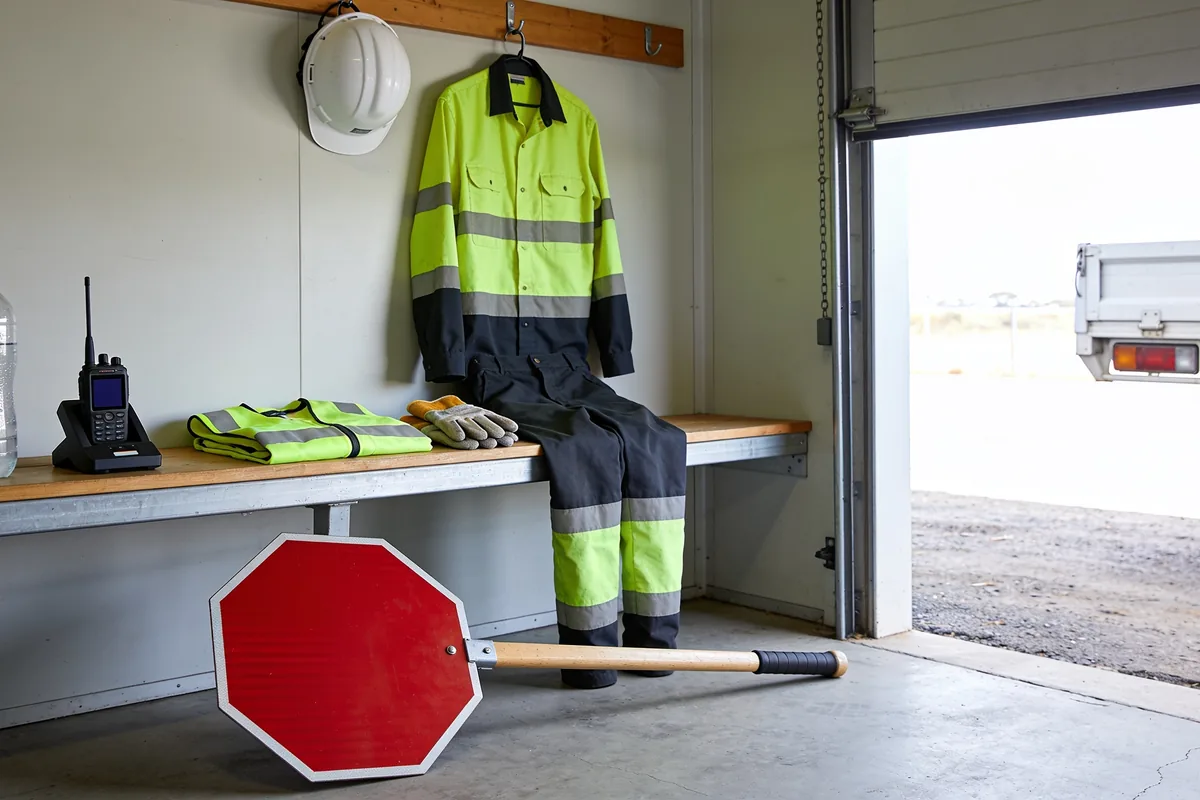
Then the middle of the shift, which is the part people picture when they hear the job title. Holding a stop and slow bat to hold and release traffic. Radio or hand signals to the crew and to the plant operators. Watching the site rather than the view. Letting pedestrians through, sometimes walking them past the works so they get where they are going safely.
Then packing down. Every device gets collected and the road is left as it was found. That last part is where the industry’s discipline shows, and where its lapses do too.
There is also a part that is not visible from outside the fence. On the road, the traffic controller is the public face of the whole worksite. That means questions, directions, and every so often, somebody who does not want to be told anything. The sign carries legal authority while it is up, which is why a controller is not being rude when they insist on something. They are doing the one job the site depends on.
The ticket: what you actually need, and where it works
The honest version of the ticket starts with a shape rather than a rule.
In Australia, a traffic controller generally holds a course completion from a registered training organisation, and, in most jurisdictions, an accreditation or card from a state or territory authority. The detail varies by jurisdiction, so here are two worked examples rather than a national answer.
New South Wales requires a Traffic Control Work Training card, issued through SafeWork NSW. Training and assessment have to be undertaken with an authorised registered training organisation, and recognition of prior learning is allowed on the training component, but the assessment still has to be done in full. Since mid-2020 the requirement has sat inside the work health and safety legislation, which means it reaches beyond construction: the regulator’s own examples include a supermarket worker directing traffic at a loading dock.
Queensland runs an accreditation scheme through its transport department, and it comes with a useful nuance. Not everyone who controls traffic needs to be accredited. The department’s own list of people who do not includes police officers, escort vehicle drivers, school crossing supervisors, State Emergency Service officers, and anyone directing traffic within a car park. But everyone who controls traffic should have appropriate training and wear appropriate safety clothing, card or no card.
Two things people get wrong, and both cost money.
First, the ticket does not travel everywhere. Traffic control work is included in the Automatic Mutual Recognition scheme, which lets licensed workers from most states and territories work across borders, with one exception, and that exception is Queensland. New South Wales also does not accept Victorian training issued by a registered training organisation, and interstate licensees still have to notify before they work.
Second, a construction induction card is not a traffic control ticket. They are different things, and plenty of sites will want both.
And one note for a Northern Territory reader: the Territory is its own jurisdiction, this article does not state its requirements, and NT WorkSafe is where to check them. Whichever jurisdiction you are in, confirm the course you are booking is recognised where you intend to work before you pay anyone.
How people actually get in
Two routes, and people arrive through both.
The common one is the ticket first, then the job: complete the course, get the card, and approach the companies that hold the traffic management contracts. In a place like the Northern Territory, those are often the same civil and road contractors doing the line marking and the signage work, which is the kind of business a Darwin company that runs traffic control and line marking crews across the Northern Territory is built across.
The other route is the job first, with the ticket alongside. Plenty of people come in as general labour on a civil crew and take the course once they are working, with the employer’s support. If you already have a foot in a civil company, that door is open.
What employers look for is short and unsentimental: the ticket, a construction induction card where the sites require one, a driver’s licence and your own way to get to a site that moves, your own personal protective equipment, and the two things that cannot be trained. Reliability, and the willingness to stand outside in bad weather without complaining about it.
And for the reader who has just landed the job, the first months have their own rules, and the site’s Probation Periods in Australia: How Long They Are, What Your Employer Can Do, and What to Ask covers them properly.
And the honest paragraph on who this suits. It suits someone who can be alone with their thoughts for hours, who does not need to be busy to be content, and who is comfortable being told where to stand. It suits less well someone who needs variety, or conversation, or a task list that changes by the hour. There is no shame in either answer. It is better to find out now than on day three.
What it pays, and why the figures you see online are wrong
This section carries no numbers, deliberately.
Here is why. A figure that is right this year is wrong the next. It varies by jurisdiction, by award, by enterprise agreement and by the type of work. And the advertised day rates you meet online are usually doing something sneaky: bundling the casual loading, the hours and the penalties into one impressive-looking number.
What is structurally true, and worth knowing: traffic control is paid under an award or an enterprise agreement. Casual work attracts a casual loading. Night work, weekend work and public holidays attract penalty rates, and some roles carry travel or site allowances. Work is project-based and weather-dependent, so a busy stretch can mean weeks of full days, and a quiet one can mean days off. That is the real reason two people doing the same job can have very different years.
The advice instead of a figure: ask a prospective employer what award or agreement applies, what the casual loading is, how the work is distributed across the year, and how far from home the sites tend to be. Those four answers tell you more than any advertised rate, and a decent employer will answer them without flinching.
What nobody tells you
The job ads leave this part out, and it is why this article exists.
Standing still is the hard part. Nobody warns you that the difficulty is not the danger or the lifting, it is hours of mostly standing in one place with your attention on. The boredom and the back pain arrive before anything else does. That is not a reason to avoid the work. It is a reason to know what you are choosing.
The weather is the job. In the Northern Territory that means heat that makes shade a planning decision, and a wet season that can suspend work entirely. Anywhere else it means sun, rain and cold that do not pause for the shift. A traffic controller works in whatever the day turns out to be.
The public is occasionally awful. Abuse from drivers is common enough to be a shared experience in every conversation about this job, and the sensible version is this: it is not personal, and crews look after each other. If you cannot let a stranger’s temper run off you, this part will wear you down.
The responsibility is real. The sign is held a certain way, and traffic is released at a certain moment, because a person is standing metres from moving vehicles. Everything about the job follows from that one fact, including the parts that feel like rules for their own sake.
And the balance of it, which deserves saying too: the work is outdoors, it is honest, it is often the door into a larger career in civil construction, and the crews who do it well are the people who make a site possible. That is not a consolation prize. It is the actual job.
Where it goes next
The progression is not a ladder, and none of it is automatic. It is a set of directions people move in.
Team leader is the first one. That means running the crew, setting up the site, and taking responsibility for the layout going in as the plan shows. It is also where understanding the plan and the drawing starts to matter, because you answer for them.
Preparing or designing the traffic management for a job is the next step for some: the office and site-planning side of the work, and the natural move for someone who has been on the road long enough to know what works. That is where the site’s The Hidden Work Behind Safe Road Projects and Public Events picks up the story, because the planning happens long before the first cone is placed.
Truck-mounted attenuator driving is a different set of tickets and a different job, and a real step for people who would rather be in a vehicle than on the shoulder. Line marking and civil crew work is the same projects and the same clients with a different craft attached. And supervision, or civil construction more broadly, is the wide door: traffic control is a genuine entry point into the industry for someone with no trade behind them.
The industry rewards the people who turn up and learn the site. That is less a slogan than a description of everyone who has moved up in it.
If you are thinking about it
The short version, in the order that works.
Find your regulator first, the state or territory whose roads you will work on, and confirm which course and card are recognised there before you pay anyone. Ask whether the ticket travels, if you might work across a border, because it does not travel everywhere. Book the course, and get the construction induction card as well if the sites you are aiming at require it.
Then talk to the companies that hold the contracts, rather than to a job board. Ask them three questions: what kind of work it is, whether that means highway or suburban; what the pattern looks like, including nights, weekends and time away from home; and what the safety arrangements are on a site like theirs. The answers will tell you more about the job than any listing will.
The ticket is a small, ordinary thing to get. The people who do well out of it are the ones who understood what the days are actually like before they started.
Sources consulted: SafeWork NSW traffic control work training information; Queensland Department of Transport and Main Roads traffic controller accreditation scheme; NT WorkSafe.
Careers & Work
Probation Periods in Australia: How Long They Are, What Your Employer Can Do, and What to Ask

The honest short version
A probation period is a trial period written into your employment contract, usually three to six months. During it, either side can end the arrangement more easily than they could later on. That is the practical effect, and it is worth understanding clearly before you sign anything.
Here is the part most people get wrong. A probation period is not a separate legal free-for-all. Your employer still has to follow the notice rules in your award or agreement, still has to pay you what you are owed, and still cannot dismiss you for an unlawful reason. Probation makes ending the job easier in some ways. It does not switch off your basic workplace protections.
The confusion is understandable. A clause that says “six months probation” sounds like a six-month period where the normal rules do not apply, and plenty of employers act as though that is what it means. The legal reality is more careful. Probation shapes how easily employment can be ended during those early months, but it does not remove the obligations that come with having an employee at all.
This article is general information about how probation works in Australia, not legal advice. Employment rules change and every contract differs, so treat this as a starting point and confirm the details that apply to you with the Fair Work Ombudsman if you are unsure.
What a probation period actually is
Put plainly, a probation period is a set amount of time at the start of a job where both sides test each other out. You find out whether the role suits you, and the employer finds out whether you suit them. If it is not working, either side can end things more easily during that window than they could once you have been there longer.
Under the Fair Work system, probation is not a separate legal category. It does not have its own set of rules that replace everything else. Its real meaning comes from how the notice and dismissal rules in your award, enterprise agreement or contract apply during those early months. That is an important distinction, because it means a probation clause cannot simply override the protections you otherwise have.
It helps to think of probation as a practical arrangement rather than a special status. The employer wants to limit their risk while they decide whether you are right for the role, and a probation clause gives them a cleaner path to end things quickly if you are not. You get the same benefit in reverse. Neither side is signing away the basic rules of employment, they are just agreeing that the first few months will be easier to walk away from.
When you see “six months probation” in a contract, read it as shorthand for this: for the first six months, the employer has an easier path to end the employment, and you have the same ease in the other direction if you want to leave.
How long it usually runs
The typical probation period in Australia is three to six months. That range covers most roles in most industries. A standard entry-level or mid-level job will often have a three-month or six-month probation written into the contract. Senior roles sometimes run longer, because it takes more time to judge whether a person at that level is delivering.
Why three to six months? It is roughly the time it takes to learn a role and show whether you can do it. In a fast-moving job you might prove yourself in weeks. In a senior or complex role, the real test might only come after a full project cycle, which is why longer probations are more common further up the ladder.
Extensions are possible, but they are not automatic. Your contract has to allow for an extension, and both sides have to agree to it. An employer cannot simply announce on the last day that your probation is now another three months unless the contract gives them that power and you have agreed. If an extension is raised, ask what specifically is not yet proven, and get the new end date in writing.
The starting point is always the contract. If it says how long the probation runs and what happens at the end, that is what governs. If the contract is silent on probation, or vague about how long it lasts, ask the employer directly what they intend before you accept. Getting that in writing is worth the small awkwardness.
What an employer can and cannot do during it
During a probation period, an employer can end your employment with the correct notice. That is the whole point of a trial. If the role is not working out, they do not have to wait until the probation ends to act, and they do not have to invent a reason. A shorter service period usually means a shorter notice period, but the notice that applies to you comes from your award, agreement or contract.
The notice rules are worth understanding because they are one of the few places where probation genuinely changes things. Notice periods in Australia generally scale with how long you have been employed, so someone in their first month is owed less notice than someone who has been there five years. A probation period does not create a special notice rule, it simply sits at the short end of the scale because your service is short.
What an employer cannot do is more important. They cannot dismiss you for an unlawful reason during probation, any more than they could after it. That includes discrimination, adverse action because of a workplace right you have exercised, or dismissal for a prohibited reason. Probation does not give an employer a licence to ignore those protections.
They also cannot use probation to avoid paying you what you are owed. Minimum wages, leave entitlements and superannuation all still apply from your first day. A probation period does not suspend the basics, and it does not mean you are somehow not really employed while it runs. You are an employee, with the ordinary entitlements of one, from the moment you start.
Your rights and entitlements still apply
Your core workplace rights carry straight through a probation period. You are entitled to be paid at the correct rate for your classification, under the award or agreement that covers your role. Leave accrues from the start, including annual leave and personal leave where they apply to you. Your employer has to pay superannuation on top of your wages from day one, at the rate set by law.
It is worth being specific about what “from day one” means, because a surprising number of people believe probation is a kind of waiting room before real employment begins. It is not. The moment you start work, you are an employee, and the clock on your entitlements starts running. Annual leave begins accruing from your first shift, not from the day your probation ends.
You are also entitled to a safe workplace. That protection is not something you earn after probation, it applies from the moment you walk in. Your employer has a duty to provide a healthy and productive workplace, and that duty does not pause while you are on probation. A clean and well-kept work environment is part of that baseline, and it matters more than it often gets credit for. If you have concerns about safety at work, you can raise them without losing the protection of workplace health and safety laws.
The same goes for the process around ending employment. If an employer does end your job during probation, they still have to follow the correct process, including giving you the notice you are owed or paying it out. Ending employment during probation is not a shortcut past paying what is due.
The unfair dismissal angle
This is where probation gets its reputation as a free pass, and the reality is more measured. To make an unfair dismissal claim in Australia, you generally need to have completed six months of continuous service with the employer. At a small business, that threshold is twelve months.
What that means in practice is that a dismissal inside a short probation period often falls outside the unfair dismissal system, because you simply have not been there long enough to meet the service requirement. That is why an employer can end a three-month probation without the same fear of an unfair dismissal claim that they might have once you have passed the six-month mark.
This is the real source of the “probation means they can fire you for anything” belief. The employer does not need a fair dismissal reason during that window, because the unfair dismissal system is not open to you yet. So yes, a person can lose their job during probation for a reason that would not hold up later. That part of the reputation is earned.
But here is the part that still stands. The unlawful dismissal protections are separate from the unfair dismissal system. An employer still cannot dismiss you during probation because of discrimination, or because you exercised a workplace right, even if you could not make a standard unfair dismissal claim. The thresholds and rules in this area are specific and they change, so check the current position with the Fair Work Commission if you are facing a dismissal.
What to ask before you accept
When a contract with a probation clause lands in front of you, ask a few direct questions before you sign. Most of these are reasonable to put to the employer or the recruiter, and a good employer will answer them without hesitation.
- How long is the probation period, and what is the exact end date?
- Can it be extended, and on what basis would an extension happen?
- What notice applies on each side during probation?
- What does success look like at the end of it?
- Is there a pay review or performance review scheduled for the end of probation?
- Is the role as described, including the hours, the location and the day-to-day duties?
Ask these in the same calm, practical tone you would use for any other part of the job. You are not being difficult, you are making sure both sides start with the same expectations. A contract is a two-way document, and the employer has had their lawyer or HR team look at it. Spending a few minutes understanding it before you sign is simply evening that up.
Two or three of these double as strong interview questions. Asking what success looks like, for example, tells you how the employer measures the role and gives you a target to aim at from week one. And understanding the real day-to-day of a role before you commit is a principle that applies well beyond probation. If you have ever accepted a job based on the title alone, a worked example like this guide to what a physio therapy assistant actually does shows how much the daily reality can differ from the name on the contract.
A trial in both directions
Here is the reframe that makes probation easier to handle. It works both ways. While the employer is deciding whether you are the right fit, you are deciding whether the job, the manager and the workload are right for you. A probation period is your chance to test the role as much as it is theirs to test you, so use it to gather that information rather than just trying to prove yourself.
Too many people spend their probation in a state of quiet anxiety, trying to be perfect and missing the signals about whether the job is actually a good fit. That is a wasted opportunity. The first few weeks are when you learn the most about a workplace, the pace, the culture, the way the manager actually runs things. Pay attention to what you are learning, because you are making a decision too.
If the job is not what you were sold, or the culture is a poor fit, you can leave with the correct notice and move on without burning a bridge. That is a genuine benefit, and it is easy to forget when you are focused on impressing people.
If probation ends early, or the employer ends it, ask for the reason in writing. Check that you were paid the right notice and any leave you are owed. And know where to get free help: the Fair Work Ombudsman can answer questions about pay, notice and entitlements, and a union can help if you are a member. An early end to a probation period is disappointing, but it is not the end of your career, and knowing your rights makes the next move clearer.
Sources:
- Fair Work Ombudsman, Probation and notice periods
- Fair Work Commission, Unfair dismissal
- business.gov.au, Hiring employees

A Spanish Spread at Home: What to Buy, What to Cook, and the Order to Do It In

Becoming a Traffic Controller: The Ticket, the Work, and What Nobody Tells You

Hydrotherapy, Explained: What Happens in the Pool and Who It Is Actually For

The Science Behind Melbourne’s Unpredictable Climate: What’s Really Going On?

Plastic-Free Coffee Makers: Myth or Must-Have?

Zero Waste Toothpaste: What’s Worth the Switch and What to Look For
-
 Melbourne1 year ago
The Science Behind Melbourne’s Unpredictable Climate: What’s Really Going On?
-
Eco Friendly4 years ago
Plastic-Free Coffee Makers: Myth or Must-Have?
-
Eco Friendly4 years ago
Zero Waste Toothpaste: What’s Worth the Switch and What to Look For
-

 Automotive1 year ago
Wet Weather Tyres in Australia: What to Look For and When to Replace Them
-
 Eco Friendly4 years ago
Plastic Free Packaging: How to Keep Your Business Plastic Free
-
 Eco Friendly4 years ago
How Aussie Businesses Can Reduce Plastic Pollution
-

 Home & Garden1 year ago
Boost Productivity and Mood with a Deep Cleaned Space
-

 Financial1 year ago
How to Secure the Best Car Finance Deal: Tips for Negotiating and Saving Money