
Healthcare
How Long Is Gastro Contagious? The Rule for Sending Kids Back to School


The small voice calls out around 2am, and you are awake before your brain catches up. You make it to the bathroom just in time, then sit on the cold tiles with a hand on a warm back while the washing machine starts its second load of the night. Most parents I know have been exactly here. Gastro does not care about your sleep.
There is a different worry that shows up once the worst passes, and it usually arrives on Sunday night. How long is this contagious? Can they go back to school on Monday? This article answers both with the real rule, and it gives you a calm plan for the days in between. It is general information, not medical advice, and the official sources for your state are listed at the end.
Before we get to the rule, one reassurance. Whatever you are picturing in that moment, this illness is familiar to every GP, every pharmacy and every childcare centre in the country, and there is a well-worn path through it. You are not the first parent to sit on a bathroom floor tonight, and you will not be the last. That is worth remembering when it feels overwhelming.
What gastro actually is
Gastro is short for gastroenteritis, which sounds serious and is really just an infection of the stomach and bowel. In most childhood cases it is viral, usually norovirus or rotavirus, and it has nothing to do with something you fed them or failed to wash. It is not the flu, even though people say “stomach flu.” It will not be helped by antibiotics, because antibiotics treat bacteria, and this is not that.
It is also extremely common. A bout or two before a child finishes primary school is completely normal, and most parents survive several of these nights. The first time feels frightening because the vomiting is sudden and the mess is everywhere, but the illness itself follows a known pattern. Naming it calmly matters, because children take their cue from the adults in the room. If you can be the steady one, it helps them more than any medicine.
You will also hear gastro called food poisoning, and the two overlap, but they are not the same thing. Food poisoning comes from eating food that carries bacteria or their toxins, and it tends to hit hard after a single meal. Viral gastro spreads from person to person, through hands, surfaces and close contact, which is why it runs through a family or a childcare room rather than striking one person who ate the wrong thing. Most childhood gastro is the viral kind, and that is quietly reassuring: it means nothing you bought, cooked or packed in a lunchbox is to blame.
How long it lasts
The symptoms are hard to miss. Vomiting, diarrhoea, tummy cramps, and sometimes a mild fever. They tend to arrive fast and feel awful, and then, for most children, they ease just as quickly.
The honest time frame is 24 to 72 hours. Most children are past the worst within that range, and it is the answer to the question parents type into Google at 3am: how long does gastro last. Some children are back to themselves within a day, and a few take a little longer. What you are waiting for is the gap between episodes to grow, the vomit to stop and the energy to creep back.
When symptoms push past that window, or when a child cannot keep even small amounts of fluid down, that is the signal to call the GP rather than keep waiting. It does not mean you have done anything wrong. It means the usual timeline has stretched, and a doctor is the right next step.
How long it is contagious
This is the part that surprises most parents, because it does not match how the child feels.
A child is most contagious while they are actively vomiting or having diarrhoea. That part is obvious. The trickier part is that the virus keeps being shed in stool for days after the symptoms stop. A child can look completely better, bounce off the couch and ask for toast, and still be passing the virus to everyone they touch.
That is why the return rule is built on symptom-free time rather than on “feeling better.” Feeling better and no longer being contagious are not the same moment. The child may feel ready for the world on Wednesday while the virus is still leaving their body on Friday. The clock that matters is the one that starts after the last episode, not the one that starts when they smile again.
It is also worth knowing that a child can shed the virus before any symptoms appear. The time between catching the virus and the first symptom is usually one to two days, which is part of why gastro is so efficient at moving through a house. By the time the first child vomits, the siblings have often already been exposed, and the family is effectively sharing the same bug whether you quarantine or not. That is not a failure of your cleaning. It is simply how this virus travels.
The school and childcare return rule
Here is the practical answer you came for. In Australia the guideline is to keep a child home until at least 24 hours after the last episode of vomiting or diarrhoea, and several states, along with many childcare centres, use 48 hours.
The exact number depends on where you live. SA Health uses at least 24 hours. NSW Health’s published exclusion table sets 48 hours for children in school and care, and some childcare settings apply 48 hours during outbreaks even in states where the general rule is shorter. That is why this article will not give you one magic national figure, because there is not one. Each state and territory publishes its own table, and your centre may have its own written policy on top of it.
So the advice is simple. Follow your centre’s written policy where one exists, because that is the rule that actually applies on Monday morning. Check your state’s health department table if you are unsure, and when in doubt, one extra day home is never the wrong call for gastro. Nobody was ever harmed by a child staying home an extra day, and plenty of classrooms have been spared a round of it by exactly that choice.
One practical note on the Monday morning moment. If the state number and the centre’s number disagree, the centre’s written policy wins for care, and the school’s policy wins for school. Ask both up front, in writing if you can, so you are not negotiating at the gate with a child in the back seat. A quick message to the centre on Sunday night saves a lot of awkwardness and gives everyone a clear answer.
Caring for a child with gastro at home
Home care for gastro is mostly about one thing: fluids. The illness clears on its own, and your job is to keep them hydrated while it does.
The method that works is little and often. Small, frequent sips of water, or an oral rehydration fluid from the pharmacy made up for kids, go down and stay down far better than one big drink that comes straight back up. A teaspoon or a few mouthfuls every few minutes is enough. Ice blocks count too, and for many children they are the easiest thing to accept. Plain food, like toast, crackers or a banana, only when they are ready for it, and rest whenever their body asks for it.
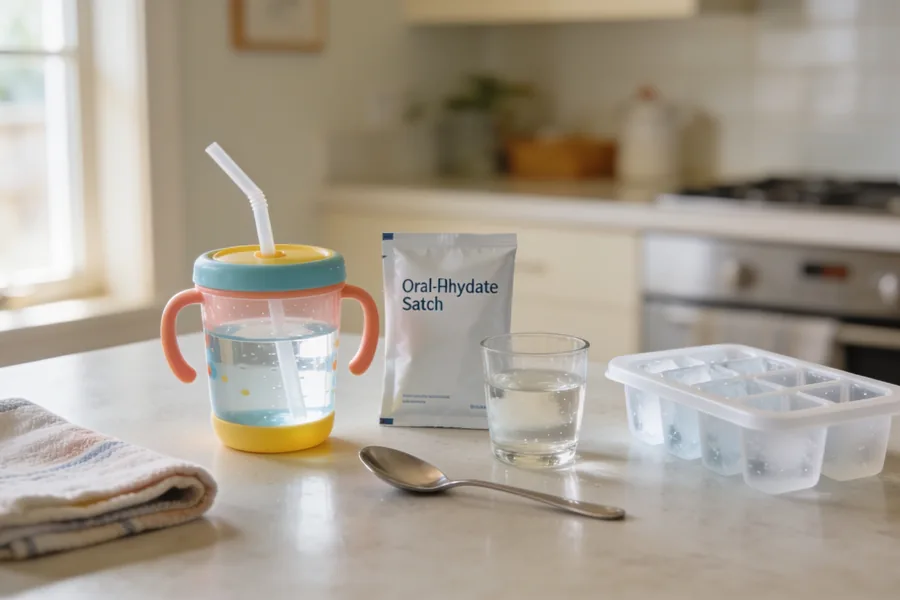
Keep the drinks within reach and keep your own voice calm. Children read your worry, and a relaxed parent who says “small sips, you are doing fine” gets more fluid into a sick child than a stressed one who is counting every millilitre. You are not failing if they refuse food for a day. The fluids are the medicine here, and food can wait until the stomach settles.
What not to give matters just as much. Skip full-strength juice and sugary drinks, because they can make diarrhoea worse, and do not reach for anti-vomiting medicine unless a doctor or pharmacist has said to use it. Plain water is fine for older children. For a baby, keep offering breastmilk or formula alongside the extra fluids, because for them it is both food and drink, and their small bodies lose fluid faster than an older child’s.
Red flags: when to call the doctor
Most gastro needs nothing more than time and fluids, but there is a list of signs that mean a call to the doctor, or to emergency care, is the right move. You are not overreacting to call. Every one of these is worth a professional opinion.
Dehydration can come on faster than parents expect, especially in babies and toddlers, because their bodies are small and they lose fluid quickly when both ends are busy. That is why this list exists. Read it as permission to call, not as something to worry through alone.
- Dry mouth and lips, or no tears when they cry.
- Fewer wet nappies than usual, or long gaps without weeing.
- Sunken eyes, or a soft spot on a baby’s head that dips.
- Unusual drowsiness, or floppiness that is not just tiredness.
- Blood in the vomit or the stool.
- Severe tummy pain that is not easing.
- A fever in a baby under three months.
If you see any of these, call your GP or health advice line. Dehydration is the real risk with gastro, and it is treatable, but it is easier to treat early than to turn around. Trust the list over the hope that it will pass. A worried parent who calls is doing the right thing, full stop.
Stopping it from spreading through the house
Gastro moves through a household fast, but you can slow it down with a few plain habits.
Soap and warm water beat hand sanitiser for this virus. Norovirus is stubborn, and sanitiser does not reliably kill it, so make handwashing the rule after the bathroom, after nappies, and before food. Clean the bathroom and the high-touch spots, the taps, the toilet flush, the door handles, with a bleach-based cleaner. Give the sick child their own towel for a few days, and wash your own hands after you help them. Keep their cup and plate separate, and wash them well.
If there is a baby in the house, a stomach bug needs even more care. The same habits that carry a newborn through winter illness season, which I have written about before in my guide to natural ways to prevent colds and flu in your newborn this winter, apply double here. Wash your hands before you pick the baby up, no matter how many times a day you do it, and keep the sick child’s things away from the baby’s things where you reasonably can.
Not every “stay home” is an illness
Gastro has a clear physical rule, and that makes it a straightforward call. But it is worth gently saying that not every child who says they feel sick on a school morning has a stomach bug.
If a child is regularly fighting school when they are well, complaining of tummy aches that vanish on weekends, or crying on Sunday nights about Monday, that is a different conversation, and a calmer one than a sick day. It deserves patience and a proper look at what is happening at school, not a lecture and not a forced day off. My calm guide to school refusal walks through how to tell the difference and where to start, because keeping the two separate helps you respond to the right problem.
A real stomach bug and a worried child both need you. They just need different things from you.
Let the clock, not the guilt, decide
Gastro is miserable, common and almost always short. It is not a reflection on your parenting, your cleaning or your cooking. It is a virus that moves through families, and almost every family gets its turn.
The rule is simple once you know it. Keep them home until they have been symptom-free for a full day, two in many states and centres, and use that time for fluids and rest. The doctor is the right call the moment you are worried, not the moment you are certain. And when you are second-guessing whether one more day at home is overkill, let the clock answer instead of the guilt. One extra day costs very little. A classroom of gastro costs a lot more.
Sources:
- Healthdirect Australia – gastroenteritis (what it is and when to seek help)
- NSW Health – School exclusion periods fact sheet (infectious disease exclusion times)
- SA Health – Exclusion from childcare, preschool, school and work









- Most households own a first aid kit and almost none of them has looked inside it since the day it arrived.
- A kit is not a shopping list. It is a decision about a house, and the decision is different for a family with a toddler, a house with a workshop, and a couple in their sixties.
- Things quietly go off in there: strips lose their stick, sterile seals fail, gloves perish, and liquids carry dates.
- Two mistakes make a kit useless, and neither of them is about what is in it.
- And the contents are the easy half, which is the part this article ends on.
There is a first aid kit in most Australian homes. It is usually in a cupboard near the bathroom, it usually arrived as a gift or a bulk-buy, and it has usually not been opened since. If that sounds familiar, this article is a gentle errand rather than a lecture. We are going to work out what a kit is for, what should be in yours rather than what a shop says, what has quietly expired, and where it should live so somebody can find it in the minutes that matter.
What a kit is actually for
The plain definition: first aid is what you do in the first minutes of an injury or an illness, until more help arrives. That is the whole window a kit is built for. The minutes before an ambulance, a doctor, or the neighbour who used to be a nurse.
So everything in the box should be there for one reason: somebody in this house might need it in those minutes. Not because a list said so, and not because it seemed sensible for a household that is, on average, not this one.
Two things follow. A kit does not treat anything by itself; it is equipment waiting for a person who knows what to do with it. And buying a bigger kit is not the same as being more prepared. The larger box with forty extra items is not a safer house. It is a larger box.
So the rest of this article is a set of questions rather than a list of products.
The four questions that decide what is in yours
The method here is borrowed, and it is borrowed openly: workplace first aid codes in Australia decide a kit’s contents by looking at what could happen, how likely and how serious each thing is, what is needed for it, and then reviewing the lot. That is a method rather than a rule, and in a house it transfers almost unchanged. It is a much more useful way to fill a box than a standard packing list.
Question one: who lives here, and who visits? A household with a toddler needs things a household of two adults does not, and a house where a frail grandparent visits needs a different set again. If a new baby is part of your picture, the site’s Natural ways to prevent colds and flu in your newborn this winter is about prevention rather than reaction, and it is the right companion piece for that stage.
Question two: what actually happens here? A kitchen, a workshop, a pool, a motorbike, a dog, a trampoline and a paddock produce very different kinds of trouble, and a kit should reflect the building and the habits rather than the suburb.
Question three, and this is the one nobody asks: what can anybody in the house actually do? Equipment for a skill nobody has is equipment that will not be used in a frightened moment. Answer that honestly and your kit gets more useful, not smaller.
Question four: where does it live, and who checks it? That one gets its own section further down, because a kit nobody can find is not a kit. The useful kit is the one whose contents were decided by the household’s own week.
What goes in, and what quietly goes off
Group the contents in your head rather than reading them as a shopping list. The groups are what you will check your box against.
Things that clean and cover a wound: the dressings, the strips, the bandages, the tape, the saline, the gloves.
Things for the events a kit is meant to equip you for, named as kinds of harm rather than as instructions: cuts, scratches, grazes and splinters; sprains and strains; minor burns; major bleeding; broken bones; eye injuries; and shock. Those are the categories a workplace code equips for, and a household can borrow them without borrowing a single instruction from anywhere. This article will not describe what to do about any of them, and that is on purpose.
Then the paragraph worth reading twice: things get smaller or disappear with age. Adhesive strips lose their stick. Saline, antiseptic and eye products carry expiry dates. Packaged sterile items stop being sterile if the seal has gone, which is why a split packet is a bin item rather than a spare. Gloves perish in a hot cupboard, quietly, and are the last thing you want failing at the wrong moment. A kit is not a time capsule. It is a small stock of perishable goods.
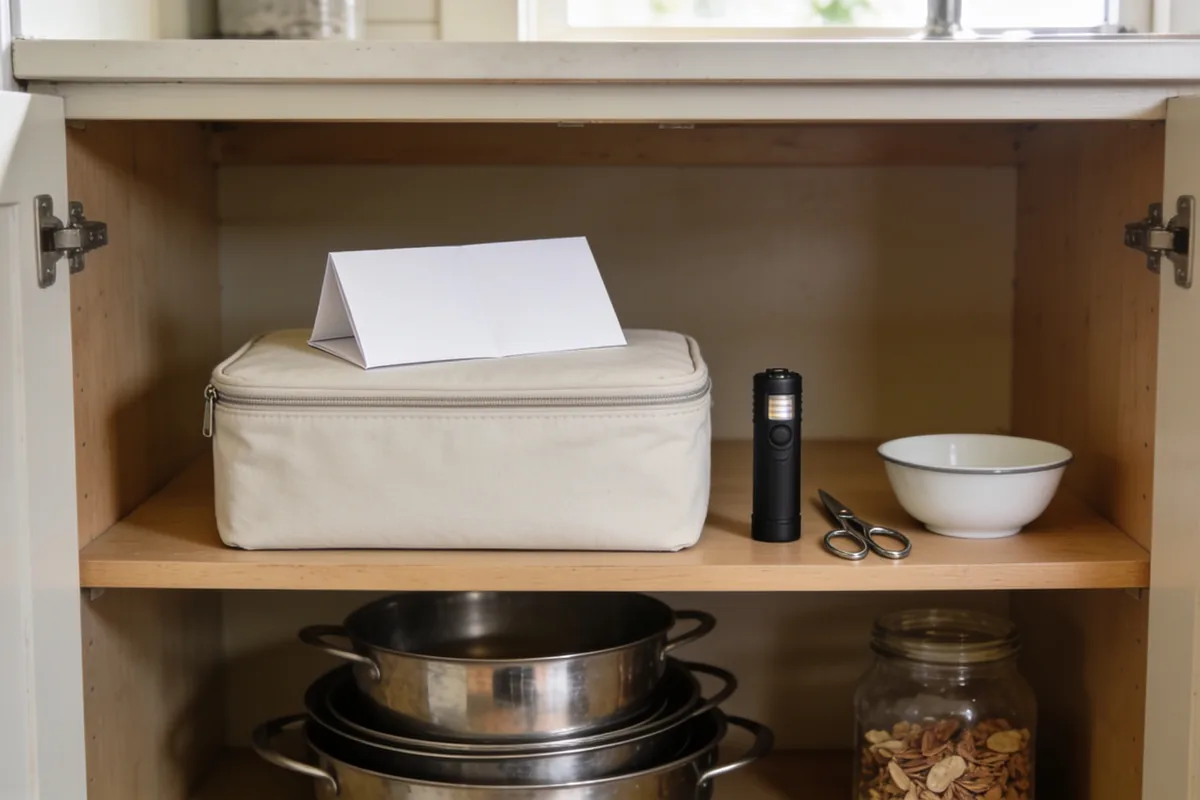
And the things people forget entirely: the list of what the kit contains, something to write with, emergency contact details that are current, a torch, and a pair of scissors that will cut what needs cutting.
A kit going off is a different thing from a certificate running out of currency. If it is the second one you are wondering about, that is a separate subject with its own rules.
The two mistakes that make a kit useless
Neither of these is about what you put in. Both are about everything around it.
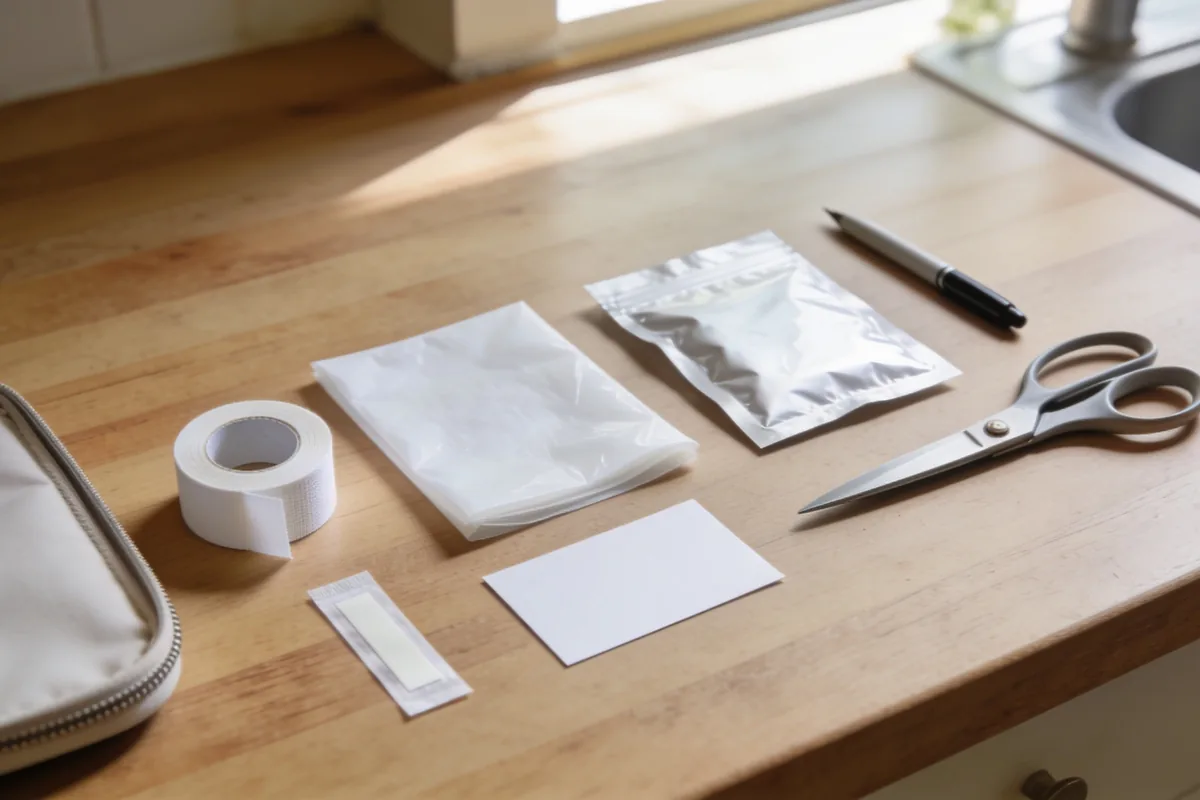
The first mistake is the kit nobody has checked. Bought, put in a cupboard, opened two years later to find the strips have curled, the saline has a date on it, and something is missing because it was used and never replaced. The fix is a routine rather than a resolution. Name one person who owns the kit in your household, check it after anything comes out of it, and give it one proper look a year, on a date you will remember, with the check date written on the inside of the lid so future you knows where things stand.
The second mistake is the kit nobody can find or reach. On the top shelf behind the saucepans, in a locked cupboard, in the boot under the pram, in a bathroom that only one person in the house uses. The borrowed workplace standard is a good one for a home too: reachable, known to everyone, and not locked. If two adults in the house cannot say where it is without looking, it is in the wrong place.
And the third mistake is the quiet one, so it gets its own moment later rather than a paragraph here: a kit containing equipment nobody in the house has been taught to use. Nothing about that is a reason to take anything out. It is information, and it tells you what to do next.
Where the kit should live
Placement, not storage. This is about function rather than tidiness.
One at home, in a place everybody in the house can name. That is the whole test, and it is stricter than it sounds. A kit is for the moment when somebody is frightened and moving fast, and muscle memory is the only map they will have.
One in the car. Workplace codes treat a kit as standard equipment for a vehicle that is somebody’s workplace, and the same logic works for the car that carries the family. One honest note: a car kit lives in heat, so it ages faster than the one in the hallway and deserves its own check more often.
One in the shed, the workshop or wherever the tools are, because that is where the injuries your household’s week produces tend to happen.
One in the caravan, the boat or the camper, because those are places where somebody can be a long way from help.
And one that is not about your house at all. The grandparent’s place. The car of the person who drives everybody else around. The sports bag that leaves the house every week, which in a household with children is a world of its own; the site’s The ultimate guide to cleaning kids’ toys: safe, simple, and effective methods looks after the rest of that gear, and the kit is the part that matters most.
One more version, for the household that needs a conversation rather than another kit: if two people live alone and see a neighbour twice a week, the useful arrangement is knowing where each other’s kit is, which is a five-minute conversation that pays for itself.
The only thing that matters more than the kit
The contents are the easy half, and this is the part worth ending on.
Among the many people who have written down what is in their own kit, one note keeps appearing: make sure everyone in the house knows how to use what is in it. That is the difference between a household that copes with a bad five minutes and one that watches them happen.
A kit is equipment for a situation that is unfamiliar by definition. Nobody uses it on a normal Tuesday, so nobody has practice by default. The households that manage are usually the ones where somebody was shown what to do once, properly, and has kept that with them since. That is a person deciding to be ready, and it costs an afternoon.
This article is not going to describe what to do with the things in the box. That is not what a cupboard article is for, and there are people whose whole job is teaching it well. The line from a Tarneit first aid trainer that delivers CPR and first aid courses, including on site for workplaces is worth keeping in the meantime: the box is worth having because somebody might need it, and it is worth knowing how to use because somebody will.
Where the kit should live
The short version, short enough to act on today.
Decide the contents by who lives here and what happens here. Check the dates and the seals, and replace what has gone off and what has been used. Write the check date inside the lid. Put it somewhere every adult in the house can point to without thinking. Keep one in the car and one where the tools are, and check the car one more often because of the heat. And make sure whoever is in the house knows what is inside.
The kit is not the part that saves anybody. It is the part that is already there when somebody who knows what to do needs it.
Sources consulted: Safe Work Australia’s model code of practice for first aid in the workplace; healthdirect information on first aid.


- A support coordinator is the one person in a plan whose job is to make the rest of the plan work, and most people are handed one without being told what that means.
- The scheme describes the role in plain words: help to understand and use the plan, choose providers, connect with community and mainstream services, and build the participant’s own confidence.
- A support coordinator is not a plan manager. The scheme draws that line in a single sentence, and it is the line readers most often get wrong.
- You choose your support coordinator, and you can change one at any time. You do not have to wait for your plan to end.
- The reader asking this question is not asking for a favour, and they are not stuck.
If you have been given a support coordinator, or you are about to sign one up, there is a decent chance nobody has explained what the role is meant to deliver. You get a name, an agreement and a feeling that you are supposed to be grateful, and the questions you have are left somewhere behind the paperwork. So here is the plain version: what the scheme says the role is for, the three levels of it, how it differs from plan management, how to tell whether the arrangement is working, and what to do if it is not. The last part takes one sentence, and it is allowed at any time.
What the scheme says the role is
Start with the scheme’s own short version, because it is shorter than most people expect: a support coordinator helps you use your plan effectively.
That means four headline things. Understanding and using the supports in your plan. Choosing the right providers. Connecting with community and mainstream supports and services, not only the funded ones. And building your own confidence and skills to manage your supports, which is the part that tells you what the role is really for.
The longer version is worth setting out, because it is the closest thing a participant gets to a job description, and almost nobody has seen it in one piece. A coordinator is there to help you understand your budgets and what your funding can be used for, and to make the choice about how that funding is managed. They help with what can be claimed and when, and with knowing when a service agreement is needed. They find providers, and they keep your supports lined up with what your plan says. They help you reach community and mainstream services as well as funded ones, and they know when a registered provider is required and when an unregistered one can be used, which is a genuinely useful thing to have explained. They set up service agreements and help you understand what providers can charge. They check whether the supports you have are working, and they help you plan for when things go wrong. And they help you change providers when something is not working, which is the item on the list that matters most to the reader who came here unhappy.
One sentence from the scheme pulls all of that together: the coordinator gives you the right information so you can make your own decisions about your plan and your supports. Hold on to that, because it is the standard everything later in this article is measured against. A coordinator who decides on your behalf, or who will only talk about you to somebody else, is not doing the role as the scheme describes it.
Three levels, and which one you have
Support coordination comes in three levels, and the honest reading is that they describe different situations rather than better or worse versions of the same help.
The first level is about connection. It is the lightest version of the support, and it is there to help you understand your plan, get plugged in to community and mainstream supports, and build some confidence in using what you have.
The second level is what most people mean when they say support coordination. It is about building the confidence and skills to direct your own life: keeping relationships going, living more independently, being part of your community, and getting the hang of running your own supports.
The third level is specialist support coordination, and it exists for a more complex situation. Its work is keeping services consistent through something difficult, which is why it exists as its own level rather than as extra hours of the second one.
Two things worth knowing if you are checking which one you have. The level is written in your plan, so begin by reading it there, and if it is not clear, that is a question with a plain answer. And the level is a statement about complexity, not about how deserving you are. Participants can ask about it, and asking is a planning conversation rather than an accusation aimed at anybody. The level can also change as circumstances change, which is something to raise rather than quietly live with.
A coordinator is not a plan manager
The two roles sit so close together that people use the names interchangeably, so here is the distinction in the scheme’s own terms: a plan manager helps keep track of your funding, and a support coordinator helps with your supports.
The practical difference is one line each. A plan manager is about the money moving correctly: invoices, claims, budgets, the paperwork. A coordinator is about the services being right, and about what happens when they are not. They can work alongside each other, and plenty of plans have both, but they are not the same job and they are not interchangeable.
One more name to watch for. If you have been told you have a recovery coach, or support connection rather than support coordination, that is a different arrangement again, and worth asking about by name so everybody is talking about the same thing.
How long it lasts, and why that is the design
Support coordination funding is usually included in plans for a set amount of time, and the scheme gives the reason plainly: as you become more comfortable and confident using your plan, you are less likely to need a coordinator.
Read that twice if you need to, because it is the most reassuring fact in the whole subject. The role is designed to work itself out of a job. A shrinking amount of coordination funding over time is not a judgement about you, and it is not the scheme losing interest. It is the support doing what it is for.
Two consequences follow. The funding is meant to be used flexibly to meet the goals in your plan, so there is no prize for hoarding it and no failure in using it. And the goal of the whole arrangement is your own capability, which means a coordinator who never builds any is falling short on the part of the role that matters most. If you take one thing away from this section: the plan should leave you needing less help to run it, not more.
Is the one you have doing the job?
This is the section the search results do not have, and it is written from the participant’s side rather than a provider’s.
What it looks like when it is working. You know what is in your plan and why. Providers are being found and lined up rather than left to you. Somebody is checking whether your supports are actually working rather than assuming they are. There is a plan for when things break, and you know what it is. And over time, you are the one doing more of this yourself, because that was the point.
What it looks like when it is not. Questions you have already answered get asked again. Your coordinator talks about you to somebody else rather than to you, which is the pattern the role is most specifically designed to avoid. A service agreement arrives before there has been a real conversation about what you want. You ask what has actually been done this month and there is no answer. A support stops, and nobody explains why.
Now the fair note, because this article is not a licence to fire anybody. A good coordinator can still have a bad month, and a bad month is not a pattern. The relationship is a working one rather than a friendship, and the test is whether your plan is being implemented, not whether you enjoy the phone calls. One practical place to look: your service agreement says what was promised, and you are entitled to read it and ask questions about it. The site keeps its guide to the ultimate checklist: what to look for in an NDIS provider for choosing a provider from the outside. This section is deliberately about judging one from the inside, and the two make a pair.
How to change one
Open with the scheme’s own sentence, because it is the permission the reader came for: you choose your support coordinator, you can change your support coordinator at any time, and you do not have to wait for your current plan to end.

Then the order that works. Read your service agreement first, because that is where the answer about ending it lives. Decide what you want from the next coordinator before you start looking, so the search has a target rather than a hope. Ask people who use services, which is what the scheme itself recommends, rather than starting with advertising. Ask every candidate the same set of questions, including what they will do in the first month and how they will report back. Set up a request for service when you have chosen. And make the new service agreement before the old one ends, so there is no gap in your supports while the paperwork moves.
Two honest notes for the road. A handover between coordinators is a normal thing, and the outgoing one can be asked to do it properly, so the next person is not starting from a blank page. And a participant can complain about the arrangements without changing coordinators at all, which matters if what you want is the arrangement fixed rather than the person replaced. How you do that, and how long anything takes, are answers that live in your agreement and with the scheme, so ask there rather than rely on a blog. If you are working out what you want from the next one, and which support suits you more broadly, the site’s The essential guide to choosing the right support for your NDIS journey covers that wider question and leaves this article to the coordinator relationship.
The things worth asking before signing
The scheme sets out a short process for finding a coordinator, and a service agreement sits at the end of it. These are the questions to bring to that step.
What exactly will you do in my first month? How will you tell me what you have done? Who do I contact, and how quickly will I hear back? What happens if you are away? How do you work with my other providers? How will you help me need you less? And what does the agreement say about ending it?
That last one is the question people find hardest to ask, and it is the one worth asking most. A candidate who handles these questions comfortably is showing you something. A candidate who finds them difficult is answering one of them. The site’s own Top 5 questions to ask when choosing an NDIS domestic care provider is a good model of the habit in a different support, and the habit transfers. And one note in the other direction, because it is fair to say: a participant who arrives with a clear idea of what they want gets a better coordinator. Preparation is not a burden the scheme puts on you. It is the first step of the process, and it is yours.
What to ask before you sign the agreement
The short version, in the order that helps.
What is in my plan, and at which level. What will you do in the first month. Who do I ring, and how quickly will I hear back. How will I know what has been done. What does the agreement say about ending it, if it comes to that. And how will all of this help me do more of it myself.
Those questions are the whole relationship in miniature, and any coordinator worth having will recognise them. The questions are the ones a registered NDIS provider that delivers specialised support coordination and community participation expects to be asked, and they are the standard the scheme’s own words set. The scheme built the choice into the role on purpose. A participant who knows that is already asking better questions than the page of providers they started with.
Sources consulted: NDIS information on what a support coordinator is and on how to find one.
- A mouthguard is a small, inexpensive thing that sits between a tooth and a badly aimed elbow.
- There are three types, and the difference between them is mostly fit.
- The best one is not the most expensive one. It is the one that fits, does not restrict breathing, stays in, and lets the wearer talk.
- It is worn at training as well as on game day, and for more activities than most people think.
- And it is useless if it is not looked after, which takes about a minute.
The season is starting, the gear list has a mouthguard somewhere near the bottom, and nobody has told you which one to buy or whether it matters. It matters, but not in the way the shelf display suggests. This is a small decision with a short set of facts behind it, and once you know them, the choice becomes easy. Here is what a mouthguard is for, the three types, who needs one, and how to look after it so it keeps doing its job.
What it is actually for
Start with the plain version from the state health department’s own information. A mouthguard fits snugly over the teeth to help prevent injuries to the teeth and mouth.
What it does in a knock, in the same source’s terms: it cushions a strong blow to the face, it acts as a shock absorber that protects the teeth and the lower jaw from breaking, and it prevents the wearer accidentally biting their lips, tongue or cheeks. That is the whole mechanism. No mystery, and no magic.
The source’s own examples of what happens without one are short. A misdirected elbow in a basketball game. A fall off a skateboard. And the outcomes it names for those moments: chipped or broken teeth, nerve damage to a tooth, or tooth loss. Nothing there is dramatic for its own sake, and none of it is rare.
One honest note on the scale of it. Most knocks do nothing at all, which is exactly why people skip the mouthguard, and the ones that do something tend to be the expensive sort of problem. If a fear of the dentist’s chair is part of why this decision keeps sliding down the list, the site’s 5 Common Myths About Root Canal Treatment Debunked! is a friendlier read than most search results, and worth five minutes before the season starts.
The three types, and the test that actually matters
Three kinds, and the honest ranking is about fit rather than price.
Stock or ready-made guards, sold at sports stores and chemists. Cheap, pre-formed, and the health department’s own note is that they often cannot be made to fit the mouth properly. That is not a scandal, it is a description of a shelf product.
Boil-and-bite guards, softened in hot water and shaped by the wearer at home. These are a real improvement on stock when they are done patiently, and a soft, ill-fitting lump when they are not. The instructions are on the packet, and the patience is on you.
Custom guards, made by a dental practitioner from an impression of the wearer’s teeth. The source says this provides the best comfort and fit, and it is the version built around the specific mouth it will sit in, which is the appointment a Perth dental practice with clinics in Wanneroo and Mount Lawley that makes mouthguards books most often before a season starts.
Now the turn, and it is the reason this section exists: the cheap one is not automatically the worse choice, and the expensive one is not automatically the right one. The source’s own test is what decides it, and a reader can check every part of it in about ten seconds at the counter. The mouthguard should be fitted to the mouth, not restrict breathing, be stable, be comfortable, allow the wearer to talk, and not cause choking. A parent can check the last few by asking the child to say a sentence and take a breath. If it fails any of them, it is the wrong guard, whatever it cost. Cost is the last thing to look at, not the first.
Who needs one, and for what
Broader than most people expect, in the source’s own framing: anyone who plays a sport that carries a major risk of a knock to the face. And here is the part that gets missed: it should be worn while playing and while training, not only on game day. Training is where the most hours happen, which makes it the exposure nobody counts.
Then the activities on the source’s list that are not team sports at all. Rollerblading. Skateboarding. Mountain bike riding. Trampolining. Horse riding. If any of those fill a weekend in your household, the mouthguard conversation applies there too.
Two specifics for particular readers. Braces are not a complication here, they are a covered case: a mouthguard can be made to fit over braces, where it cushions between the braces and the cheek or the lips, which is a relief for the readers most likely to be told they cannot play. And for the adult who plays socially rather than competitively, the source’s advice does not draw a line between the two. A Saturday game is still a game, and the level of the match does not change what an elbow does.
Looking after it, in four steps
The section nobody writes, and it takes about a minute.
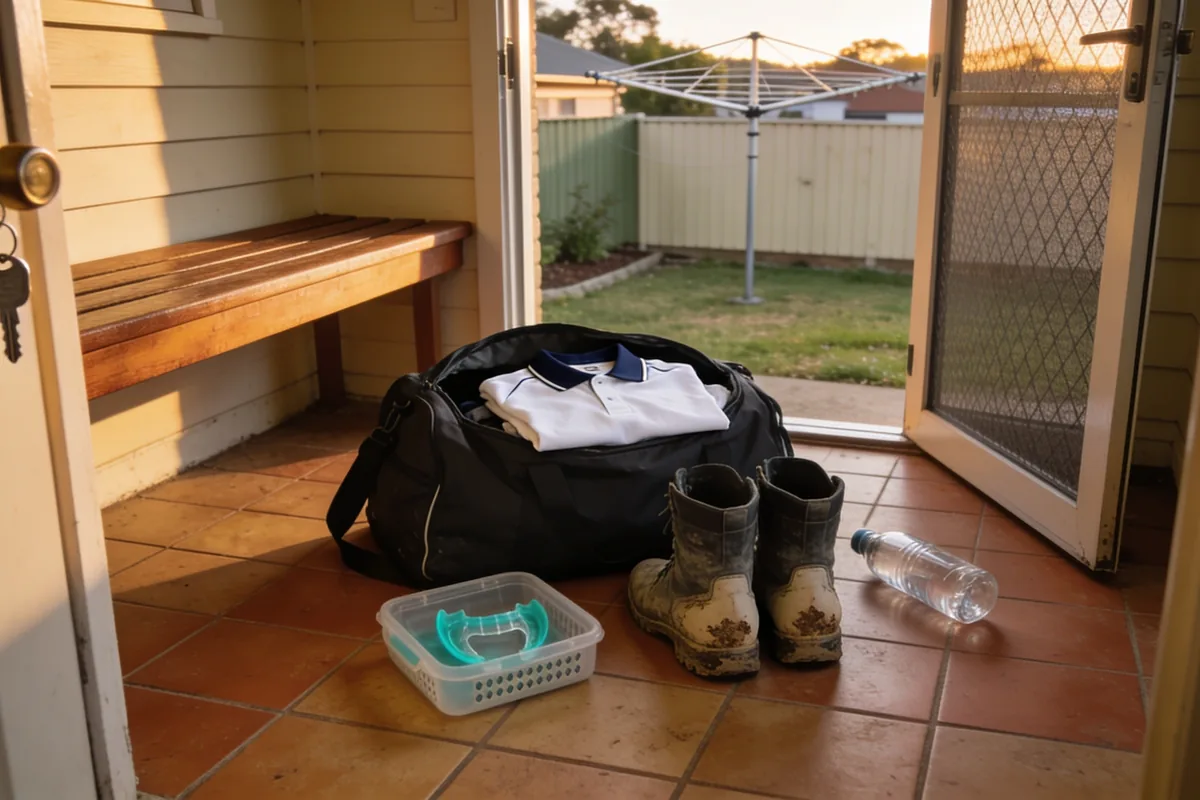
Before it goes in: rinse it with mouthwash or a mild antiseptic, then with water. After it comes out: wash it with mild soap and cold water, then dry it, and store it in a rigid box away from heat.
Then four consequences, which follow from the source rather than being printed on it. Heat is what ruins a mouthguard, so it does not live on a car dashboard, in a hot car, or in a dishwasher, and it is not re-boiled once it has been fitted. Do not share one, because it goes in a mouth. That one needs no explanation, and it gets none. Check it before each season for chewing, cracks, or a fit that has gone soft and loose. And if anything seems wrong with it, or with the mouth it sits in, ring the dental practice, which is the source’s own closing line.
One last thought to finish the section. A guard that lives loose at the bottom of a sports bag, uncleaned, is a guard that will not be worn, and a guard that is not worn protects nothing. The rigid box is not a fussy detail. It is the difference between gear and clutter.
When a child needs a new one
A growing mouth is the main reason, and the source states it plainly: as the mouth grows, a new mouthguard is needed. That gives a child’s guard a working life measured in seasons rather than years, which is worth knowing before you choose what to buy.
The other reasons, one line each. It has been chewed through or bitten flat. It has gone soft or loose after heat or a hot wash. It was bought before the braces went on, or before they came off. It has been lost, which is common and not a reason for a lecture. And the child has moved to a different sport, or a different level of contact, and the old guard no longer matches the job.
And the honest line for parents weighing it up: a guard that no longer fits is not a cheaper version of a guard that does. It is a piece of plastic in a bag, and the fit was the entire point. A new guard, fitted properly, is the smaller problem in every version of that story.
A mouthguard is not a night guard
A short section, because the search results on this topic mix two different devices together.
They do different jobs. A sports mouthguard is worn during activity to cushion an impact. A night guard is worn while sleeping, for a different reason entirely. They are made differently, they fit differently, and they are for different problems entirely. This article is about the sports one.
One thing worth saying clearly, though. If a reader is waking with a sore jaw, worn teeth or a headache, that is a conversation with a dentist about what is actually happening, not a reason to buy a sports guard from the chemist. The two should not be swapped, in either direction. That is as far as this piece goes on the subject, and it is deliberately far enough.
Before the season starts
Short and ordered, so a parent or a player can act on it this week.
Get the guard before the first training session, not before the first game, because training is where the source says it should be worn as well. Check the list at the counter: fitted, breathing, stable, comfortable, can talk. Do not buy the one the child will not wear, whichever type that turns out to be. Label it, and keep it in a rigid box, out of the heat. Look at it at the start of every season, and replace it when the mouth has grown or the guard has had enough.
And the closing thought, which is the whole case for the thing: a mouthguard is one of the few pieces of protective gear a player can lose and simply replace. The entire point of it is the five seconds it is asked to do its job.
Sources consulted: HealthyWA information on mouthguards.

Gutter Guards: What They Stop, and What They Never Will

The First Aid Kit You Already Own (and What Has Quietly Gone Off in It)

Car Air Conditioning in a Hot Town: What “Not Cold” Is Actually Telling You

The Science Behind Melbourne’s Unpredictable Climate: What’s Really Going On?

Plastic-Free Coffee Makers: Myth or Must-Have?

Zero Waste Toothpaste: What’s Worth the Switch and What to Look For
-
 Melbourne1 year ago
The Science Behind Melbourne’s Unpredictable Climate: What’s Really Going On?
-
Eco Friendly4 years ago
Plastic-Free Coffee Makers: Myth or Must-Have?
-
Eco Friendly4 years ago
Zero Waste Toothpaste: What’s Worth the Switch and What to Look For
-

 Automotive1 year ago
Wet Weather Tyres in Australia: What to Look For and When to Replace Them
-
 Eco Friendly4 years ago
Plastic Free Packaging: How to Keep Your Business Plastic Free
-
 Eco Friendly4 years ago
How Aussie Businesses Can Reduce Plastic Pollution
-
 Home & Garden1 year ago
Boost Productivity and Mood with a Deep Cleaned Space
-

 Food1 year ago
The 9 Best Foods and Drinks to Enjoy Before Bed for Restful Sleep